Omega De Ville 166.0161 - A Practical Collector's Guide
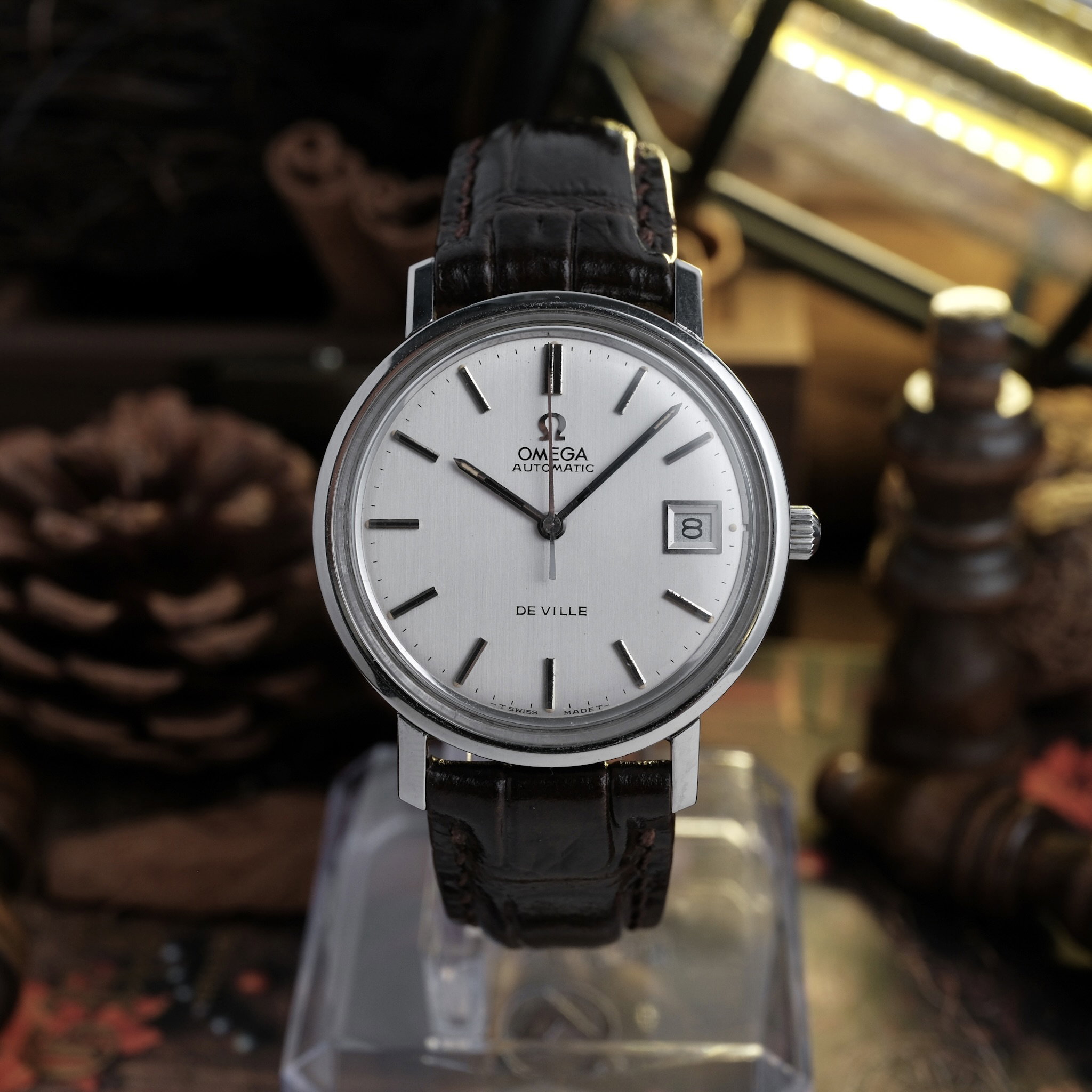
The Omega De Ville 166.0161 is a 35 mm automatic dress watch best bought with a clean original dial and minimal plating loss.
We auction more than 100 vintage watches a week.
Get first access: new Omega 166.0161 drops and alerts before auctions end.
Browse 57 live Omega auctionsThe De Ville 166.0161 belongs to Omega's 1972-1973 dress-watch production, pairing a 35 mm case with the automatic Caliber 1012. Its narrow baton furniture and brushed or sunburst dial treatments make it formal without becoming ornate, while the compact diameter keeps the watch visibly period-correct.
Steel and gold-plated cases create the main buying decision. Steel tolerates regular wear better, while the plated version gives the champagne and silver dials a warmer appearance but exposes you to permanent wear-through at the case edges. Across the examples we have handled, dial condition separates good purchases more decisively than case material does.
Reference
166.0161
Model
De Ville
Production years
1972-1973
Case diameter
35 mm excluding the crown
| Movement | Omega Caliber 1012 automatic |
| Jewel count | 23 jewels |
| Case materials | Stainless steel or gold-plated with stainless steel back |
| Gold plating | 20 microns on documented gold-plated examples |
| Dial variants | Silver or champagne, with sunburst or vertical brushing |
| Case construction | Front-loading monocoque associated with Tool 106 |
What it was built for
The 166.0161 was built as a slim-looking automatic dress watch rather than a sports watch. Its 35 mm case slips under a cuff, and the applied stick indices keep the silver or champagne dial legible without adding visual weight. Caliber 1012 provides automatic winding, making this De Ville more convenient for repeated wear than a manually wound dress watch.
The front-loading monocoque construction associated with Tool 106 gives the case an uninterrupted back and changes how the movement is accessed. That architecture should be left to a watchmaker familiar with front-loading Omega cases, since ordinary caseback tools are not the correct route into the watch. The service history of any individual example remains unknown unless invoices accompany it.
The model landscape
Reference 166.0161 occurs in stainless steel and in gold-plated form with a stainless steel back. The plated cases include a 20-micron version, while known dial treatments include silver sunburst, vertically brushed silver, vertically brushed champagne and champagne sunburst. Applied baton indices may carry dark central inlays, matched by slim baton hands.
Steel is the easier ownership choice because scratches can remain cosmetic rather than exposing a different base colour. Gold-plated examples deserve a premium only when the plating remains intact and the dial is materially better than the available steel alternative. Between a bright but worn-through plated case and an honest steel case with an equally clean dial, take the steel watch.
What goes wrong
Plating loss is the first fault to disclose on a gold-plated 166.0161, especially where the case takes repeated contact. No routine polish can replace missing gold, and further polishing makes the transition to the underlying metal more obvious. Steel cases avoid that failure mode, but polishing can still soften the edges and alter the compact case profile.
The dial carries the largest share of value. A redial costs more than ordinary case wear because the original brushed or sunburst surface, applied markers and printed text cannot be recreated by servicing. Spotting on a champagne surface can be honest ageing, but broad staining, lifted furniture or mismatched hands are damage or evidence of parts substitution, not patina.
Caliber 1012 must match the reference, and a different movement can indicate a franken or married watch even when the exterior looks coherent. Replaced crowns and crystals are consumable-service realities, but they should be described rather than hidden behind an all-original claim. Without service documentation, the movement's maintenance history is unknown and should be priced as an unknown.
Dating this watch
| Serial range / caliber | Year | Note |
|---|---|---|
| 1000000 | 1902 | approximate, ±1-3 years |
| 2000000 | 1908 | approximate, ±1-3 years |
| 3000000 | 1912 | approximate, ±1-3 years |
| 4000000 | 1916 | approximate, ±1-3 years |
| 5000000 | 1923 | approximate, ±1-3 years |
| 6000000 | 1925 | approximate, ±1-3 years |
| 7000000 | 1929 | approximate, ±1-3 years |
| 8000000 | 1935 | approximate, ±1-3 years |
| 9000000 | 1939 | approximate, ±1-3 years |
| 10000000 | 1944 | approximate, ±1-3 years |
| 11000000 | 1947 | approximate, ±1-3 years |
| 12000000 | 1950 | approximate, ±1-3 years |
| 13000000 | 1952 | approximate, ±1-3 years |
| 14000000 | 1954 | approximate, ±1-3 years |
| 15000000 | 1956 | approximate, ±1-3 years |
| 16000000 | 1958 | approximate, ±1-3 years |
| 17000000 | 1960 | approximate, ±1-3 years |
| 18000000 | 1961 | approximate, ±1-3 years |
| 19000000 | 1962 | approximate, ±1-3 years |
| 20000000 | 1963 | approximate, ±1-3 years |
| 21000000 | 1964 | approximate, ±1-3 years |
| 22000000 | 1965 | approximate, ±1-3 years |
| 24000000 | 1966 | approximate, ±1-3 years |
| 25000000 | 1967 | approximate, ±1-3 years |
| 26000000 | 1968 | approximate, ±1-3 years |
| 28000000 | 1969 | approximate, ±1-3 years |
| 31000000 | 1970 | approximate, ±1-3 years |
| 32000000 | 1971 | approximate, ±1-3 years |
| 33000000 | 1972 | approximate, ±1-3 years |
| 35000000 | 1973 | approximate, ±1-3 years |
| 37000000 | 1974 | approximate, ±1-3 years |
| 39000000 | 1975 | approximate, ±1-3 years |
| 40000000 | 1976 | approximate, ±1-3 years |
| 41000000 | 1977 | approximate, ±1-3 years |
| 42000000 | 1978 | approximate, ±1-3 years |
| 43000000 | 1979 | approximate, ±1-3 years |
| 44000000 | 1980 | approximate, ±1-3 years |
| 45000000 | 1982 | approximate, ±1-3 years |
| 46000000 | 1984 | approximate, ±1-3 years |
| 47000000 | 1985 | approximate, ±1-3 years |
| 48000000 | 1986 | approximate, ±1-3 years |
| 49000000 | 1988 | approximate, ±1-3 years |
| 50000000 | 1990 | approximate, ±1-3 years |
| 53000000 | 1993 | approximate, ±1-3 years |
| 54000000 | 1995 | approximate, ±1-3 years |
| 56000000 | 1996 | approximate, ±1-3 years |
| 58000000 | 1998 | approximate, ±1-3 years |
| 60000000 | 2000 | approximate, ±1-3 years |
Dating data comes from our decoder tables; treat years as approximate.
What to check before you buy
- Dial and furniture: The known dials are silver or champagne with sunburst or vertical brushing, applied baton indices and slim baton hands. Fresh printing over a flattened finish indicates a redial, not an original dial cleaned by service.
- Movement caliber: The movement should be Omega Caliber 1012, with 23 jewels stated for this configuration. Another caliber is not a harmless variation and can indicate a franken or a case and movement married from separate watches.
- Case format: The case should measure 35 mm excluding the crown and conform to the front-loading construction associated with Tool 106. Tool marks or deformation around the opening points indicate improper access rather than ordinary wear.
- Case material and plating: Known cases are stainless steel or gold-plated with a stainless steel back, including 20-micron plating. Colour loss at exposed edges is plating wear, while aggressive polishing can soften the case profile.
- Reference coherence: The reference must read exactly 166.0161 and agree with the De Ville dial, 35 mm case and Caliber 1012. Correct individual parts do not prove a correct watch if their ageing and configuration conflict.
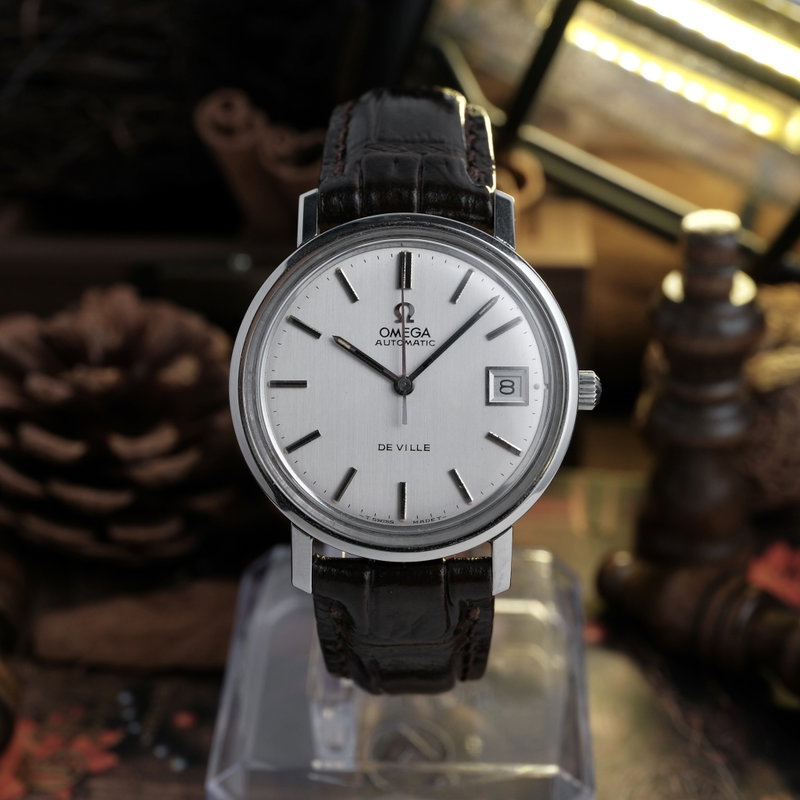
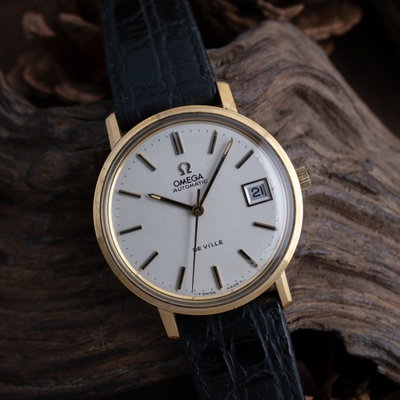
Other 166.0161 examples we auctioned
7 Omega 166.0161 auctioned
More Omega references
Related pages
Frequently asked questions
Ready to hunt for your own?
More than 100 vintage watches go under the hammer every week.