Omega Seamaster 166.003: What to Know Before Buying
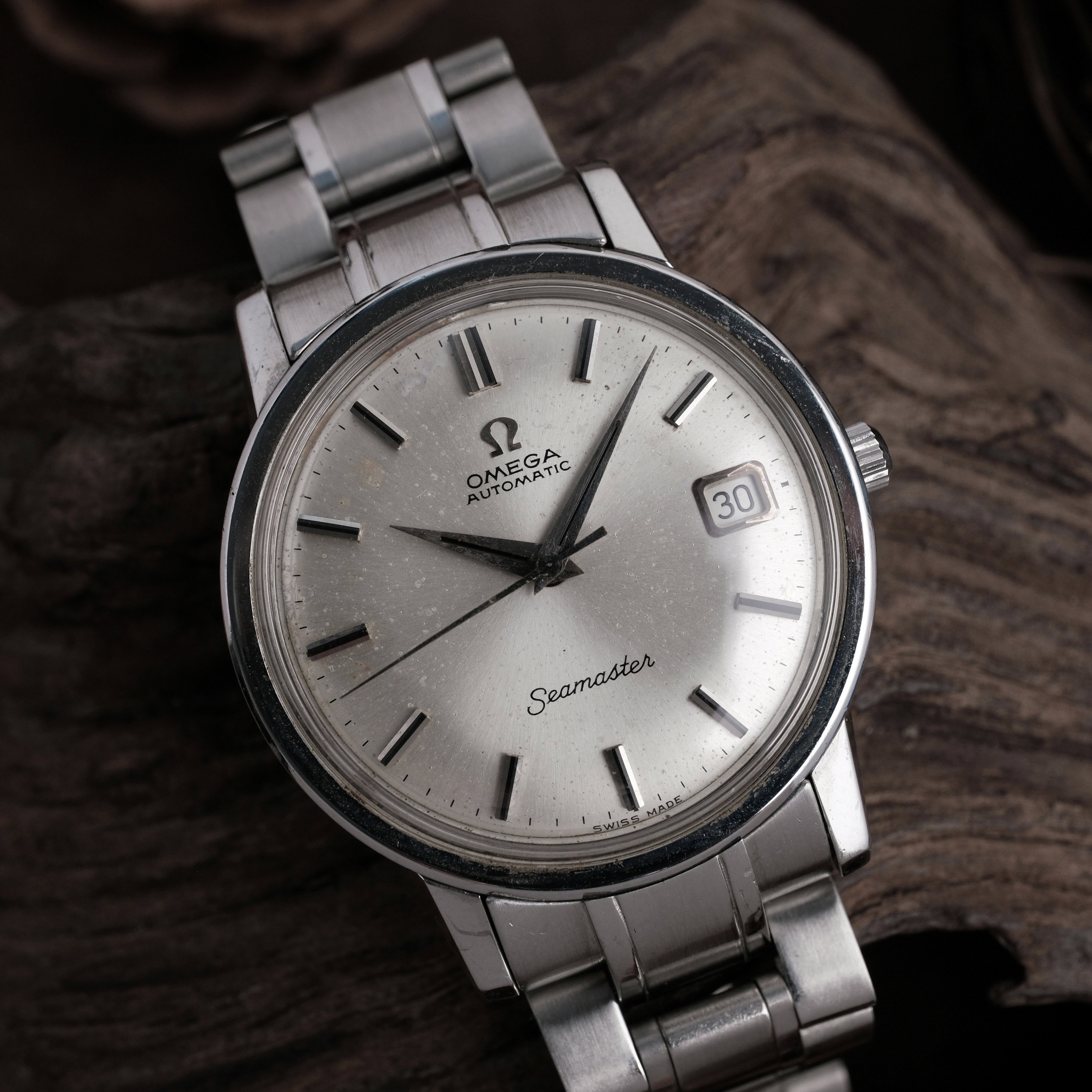
The Omega Seamaster 166.003 is a 34 mm steel automatic best bought with an honest silver sunburst dial, defined case lines and the correct caliber 562 or 565.
We auction more than 100 vintage watches a week.
Get first access: new Omega 166.003 drops and alerts before auctions end.
Browse 60 live Omega auctionsThe Seamaster 166.003 is a 34 mm stainless-steel automatic from 1964-1970, with a date at 3 o'clock and either caliber 562 or 565. Its proportions place it firmly in the compact 1960s dress-watch tradition, while the steel case makes it less vulnerable than a plated alternative would be.
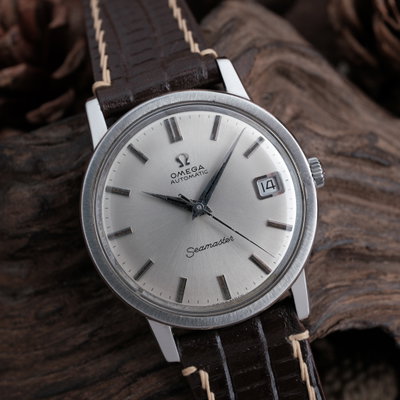
The version to want has a clean silver sunburst dial, applied indices and legible printing, backed by case lines that have not been rounded away. Heavy spotting changes the watch more than ordinary case wear does, while dark lume and oxidised hands need to be priced as damage rather than softened into patina.
Known production years
1964-1970
Case diameter
34 mm excluding the crown
Case material
Stainless steel
Movement type
Automatic
| Known calibers | 562 and 565 |
| Jewel count | 24 jewels |
| Dial configuration | Silver sunburst with applied indices |
| Date position | 3 o'clock |
| Known bracelet configuration | Signed beads-of-rice bracelet |
The model landscape
Early watches handled from 1964 and 1965 use caliber 562, while examples from 1969 and 1970 use caliber 565. Both are automatic movements with 24 jewels, and that change is useful supporting evidence when the movement and serial are assessed together. It is not proof on its own, because movements can be married to cases.
Silver sunburst dials occur with applied faceted or steel indices, including black inserts, and a framed date window at 3 o'clock. Some watches retain a signed beads-of-rice bracelet, but the bracelet should be treated as a configuration bonus rather than allowed to excuse a damaged dial. Between a spotted example on bracelet and a clean-dial watch without one, take the clean dial.
On the wrist
At 34 mm excluding the crown, the 166.003 wears as a compact vintage Omega rather than a reduced modern watch. The broad silver dial and slim applied markers preserve legibility, while the date window gives it more daily utility than a time-only dress watch. Its scale works particularly well with a cuff, although buyers accustomed to larger cases should judge the diameter honestly before buying.
Dauphine hands and the sunburst finish make the face change sharply with light. Black inserts in the hands and indices strengthen contrast when intact, but oxidation, pitting and degraded luminous fill can make an otherwise bright dial read tired. A beads-of-rice bracelet adds visual width and can make the same case feel less formal.
What goes wrong
Heavy widespread dial spotting is the costliest recurring fault, and a refinished dial costs more than every ordinary case mark combined. Dark, degraded lume is damage, not patina; oxidation and pitting on the dauphine hands are separate faults. A service dial may be genuine Omega, but it is still a replacement and should be described as such.
Polishing softens the case lines, while repeated bracelet wear can produce stretch and poor end-link fit. The hippocampus medallion should remain deeply engraved enough to read, although engraving depth alone cannot authenticate the watch. Caliber, serial, dial layout and case must agree as a group, because a genuine movement in the wrong case is a married watch and mixed period parts create a franken.
Service history is unknown unless supported by documentation. Timegrapher performance from a past sale does not establish present condition, and neither caliber number nor serial range proves that the movement has been serviced. Buy the dial first, then case definition, then mechanical state.
Dating this watch
| Serial range / caliber | Year | Note |
|---|---|---|
| 1,000,000 | 1902 | approximate, ±1-3 years |
| 2,000,000 | 1908 | approximate, ±1-3 years |
| 3,000,000 | 1912 | approximate, ±1-3 years |
| 4,000,000 | 1916 | approximate, ±1-3 years |
| 5,000,000 | 1923 | approximate, ±1-3 years |
| 6,000,000 | 1925 | approximate, ±1-3 years |
| 7,000,000 | 1929 | approximate, ±1-3 years |
| 8,000,000 | 1935 | approximate, ±1-3 years |
| 9,000,000 | 1939 | approximate, ±1-3 years |
| 10,000,000 | 1944 | approximate, ±1-3 years |
| 11,000,000 | 1947 | approximate, ±1-3 years |
| 12,000,000 | 1950 | approximate, ±1-3 years |
| 13,000,000 | 1952 | approximate, ±1-3 years |
| 14,000,000 | 1954 | approximate, ±1-3 years |
| 15,000,000 | 1956 | approximate, ±1-3 years |
| 16,000,000 | 1958 | approximate, ±1-3 years |
| 17,000,000 | 1960 | approximate, ±1-3 years |
| 18,000,000 | 1961 | approximate, ±1-3 years |
| 19,000,000 | 1962 | approximate, ±1-3 years |
| 20,000,000 | 1963 | approximate, ±1-3 years |
| 21,000,000 | 1964 | approximate, ±1-3 years |
| 22,000,000 | 1965 | approximate, ±1-3 years |
| 24,000,000 | 1966 | approximate, ±1-3 years |
| 25,000,000 | 1967 | approximate, ±1-3 years |
| 26,000,000 | 1968 | approximate, ±1-3 years |
| 28,000,000 | 1969 | approximate, ±1-3 years |
| 31,000,000 | 1970 | approximate, ±1-3 years |
| 32,000,000 | 1971 | approximate, ±1-3 years |
| 33,000,000 | 1972 | approximate, ±1-3 years |
| 35,000,000 | 1973 | approximate, ±1-3 years |
| 37,000,000 | 1974 | approximate, ±1-3 years |
| 39,000,000 | 1975 | approximate, ±1-3 years |
| 40,000,000 | 1976 | approximate, ±1-3 years |
| 41,000,000 | 1977 | approximate, ±1-3 years |
| 42,000,000 | 1978 | approximate, ±1-3 years |
| 43,000,000 | 1979 | approximate, ±1-3 years |
| 44,000,000 | 1980 | approximate, ±1-3 years |
| 45,000,000 | 1982 | approximate, ±1-3 years |
| 46,000,000 | 1984 | approximate, ±1-3 years |
| 47,000,000 | 1985 | approximate, ±1-3 years |
| 48,000,000 | 1986 | approximate, ±1-3 years |
| 49,000,000 | 1988 | approximate, ±1-3 years |
| 50,000,000 | 1990 | approximate, ±1-3 years |
| 53,000,000 | 1993 | approximate, ±1-3 years |
| 54,000,000 | 1995 | approximate, ±1-3 years |
| 56,000,000 | 1996 | approximate, ±1-3 years |
| 58,000,000 | 1998 | approximate, ±1-3 years |
| 60,000,000 | 2000 | approximate, ±1-3 years |
Dating data comes from our decoder tables; treat years as approximate.
What to check before you buy
- Dial print and furniture: The silver sunburst dial should have applied indices and a date window at 3 o'clock. Heavy spotting is known, but blurred or newly uniform printing can indicate a redial rather than honest ageing.
- Hands and luminous material: Dauphine hands with black inserts are known on the reference. Oxidation, pitting and dark degraded lume must be disclosed, while a mismatch between hand and dial lume can indicate replacement or relume.
- Case and caseback: The stainless-steel case measures 34 mm excluding the crown, and known casebacks carry a hippocampus medallion. Soft case lines or a weak medallion can result from polishing and do not prove a fake by themselves.
- Movement and chronology: Correct handled movements are automatic calibers 562 and 565 with 24 jewels. Compare the movement serial with the approximate table and reject combinations that conflict with the known 1964-1970 production span.
- Franken and married-watch signs: A genuine Omega movement does not authenticate the complete watch. Dial layout, caliber, serial chronology, case dimensions and caseback must agree, or the watch may be franken or the movement married to another case.
Other 166.003 examples we auctioned
7 Omega 166.003 auctioned
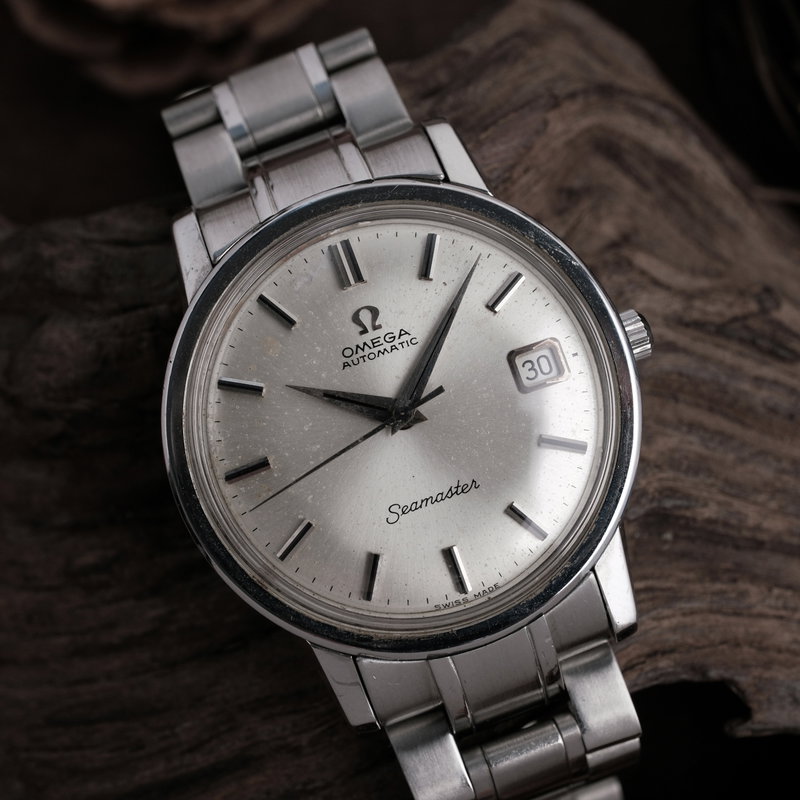
Omega · Seamaster · 166.003 · 1965
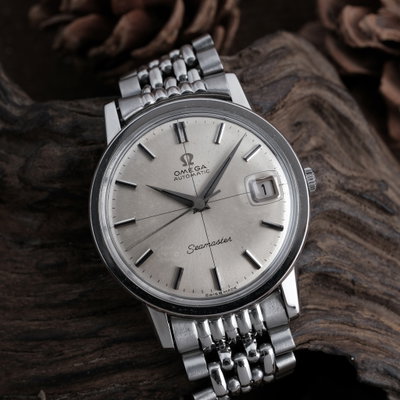
Omega · Seamaster · 166.003 · 1964
Omega · Seamaster · 166.003 · 1970
Omega · Seamaster · 166003 · 1969
More Omega references
Related pages
Frequently asked questions
Ready to hunt for your own?
More than 100 vintage watches go under the hammer every week.