Omega Genève 135.070: what matters before you buy
Omega Genève reference 135.070 is a 35 mm manual-wind watch whose best buy is the honest-dial steel version, not the cleaner-looking redial.
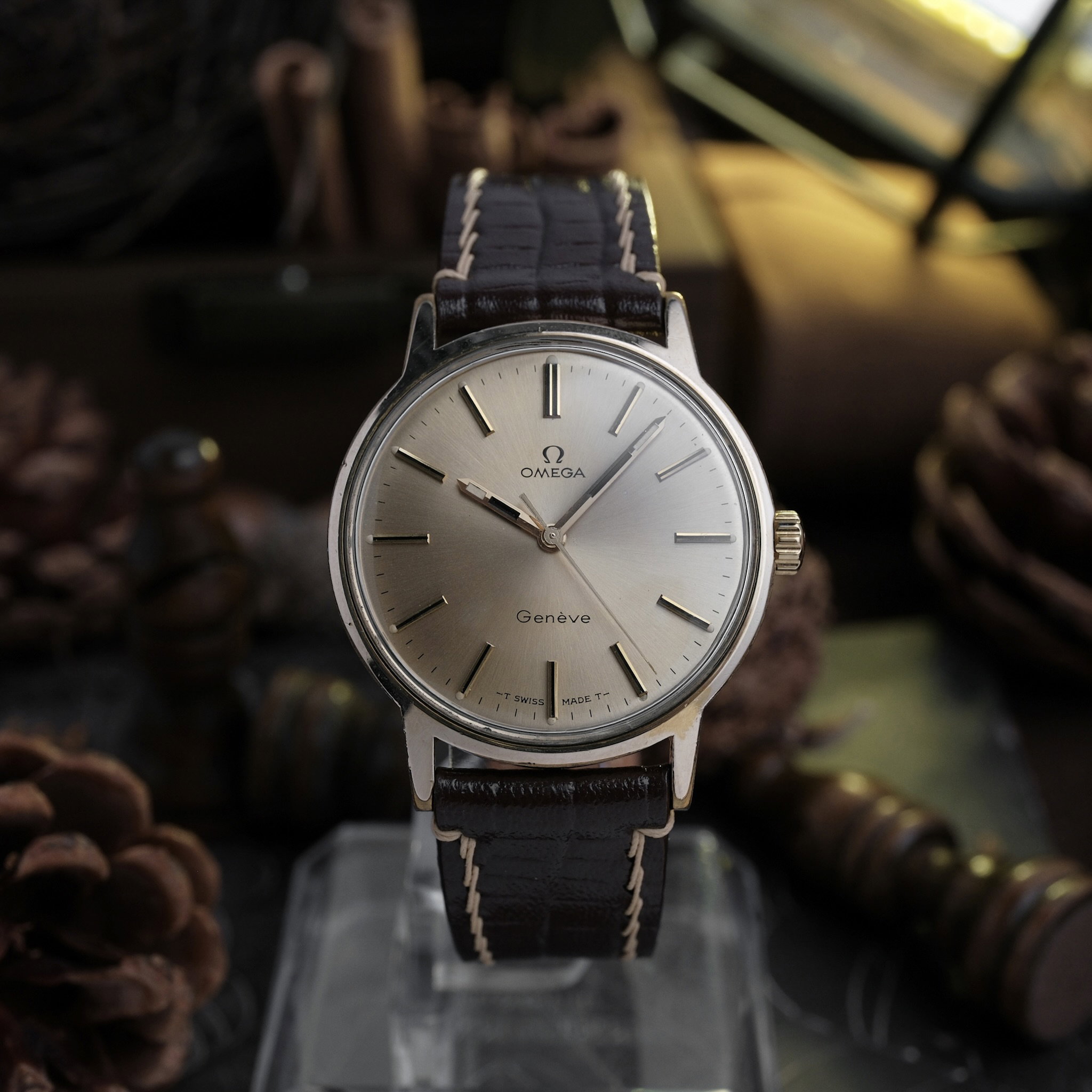
The Genève 135.070 makes most sense as a compact manual-wind Omega rather than a miniature modern watch. Its 35 mm case sits discreetly under a cuff, while caliber 601 keeps the ownership proposition mechanically simple. Examples handled date from 1969 to 1970.
The choice is not merely silver versus champagne. Stainless steel cases and 20-micron gold-plated cases with steel backs both occur, and their ageing differs sharply. Steel is the safer purchase: worn plating cannot be returned by routine servicing, while a sound steel case can tolerate daily use without exposing another metal beneath.
Reference
135.070
Model
Genève
Known production years
1969-1970
Case size
35 mm excluding the crown
| Movement | Omega caliber 601, manual wind |
| Jewel count | 17 jewels |
| Case materials | Stainless steel, or 20-micron gold-plated with stainless steel caseback |
| Known dial configurations | Silver sunburst with black baton indices, or champagne-silver with gold-tone indices and black inserts |
The model landscape
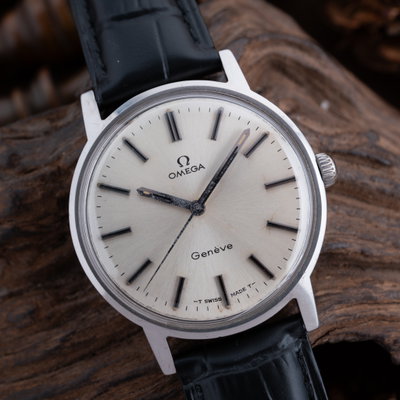
Reference 135.070 exists with more visual range than its plain Genève name suggests. Silver sunburst dials occur with applied black baton indices, while champagne-silver dials can carry applied gold-tone indices with black inserts. Baton hands follow those contrasting schemes, and some examples retain lume strips and outer lume plots.
Between an honest steel watch with scattered spotting and a glossy plated example with uncertain dial work, take the steel watch. The 20-micron plated version can be attractive when coverage remains even, but wear at the lug edges permanently changes the case. A redial costs more in lost credibility than honest spotting, provided the damage has not disrupted the printing.
Where the value sits
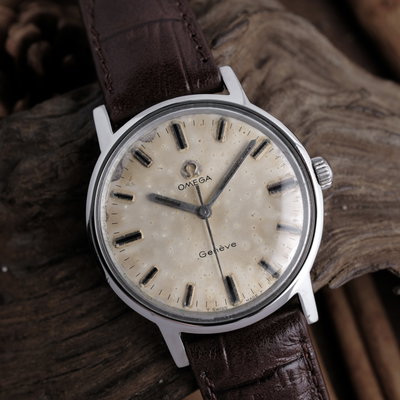
The dial creates the widest spread. A silver sunburst surface with crisp text and limited spotting sits above widespread bubbling, finish loss or a redial, even when the damaged dial has dramatic character. One handled example had bubbling across the surface and darker loss along the left perimeter, which is damage rather than patina.
Case material sets the next division. Steel avoids plating loss, while the gold-tone version earns its premium only when the 20-micron layer remains intact at the lugs and case edges. Caliber 601 is common to the examples, so value does not come from a movement upgrade. It comes from a coherent dial, hands and case that belong together.
What goes wrong
Dial damage is the expensive fault: bubbling, spotting and finish loss cannot be treated as even patina. Black baton hands can oxidise, and old lume can darken independently from the dial plots. A clean service dial is genuine Omega but remains a replacement; a redial is refinished work and should be valued lower.
Plated cases wear through first at exposed edges, while repeated polishing softens lug geometry on steel and plated cases alike. Crowns are consumable and may be replaced, so a signed crown supports period correctness but does not establish originality. Caliber 601 still needs service evidence and timing assessment. Without documentation, the service history is unknown.
Dating this watch
| Serial range / caliber | Year | Note |
|---|---|---|
| 1000000 | 1902 | approximate, ±1-3 years |
| 2000000 | 1908 | approximate, ±1-3 years |
| 3000000 | 1912 | approximate, ±1-3 years |
| 4000000 | 1916 | approximate, ±1-3 years |
| 5000000 | 1923 | approximate, ±1-3 years |
| 6000000 | 1925 | approximate, ±1-3 years |
| 7000000 | 1929 | approximate, ±1-3 years |
| 8000000 | 1935 | approximate, ±1-3 years |
| 9000000 | 1939 | approximate, ±1-3 years |
| 10000000 | 1944 | approximate, ±1-3 years |
| 11000000 | 1947 | approximate, ±1-3 years |
| 12000000 | 1950 | approximate, ±1-3 years |
| 13000000 | 1952 | approximate, ±1-3 years |
| 14000000 | 1954 | approximate, ±1-3 years |
| 15000000 | 1956 | approximate, ±1-3 years |
| 16000000 | 1958 | approximate, ±1-3 years |
| 17000000 | 1960 | approximate, ±1-3 years |
| 18000000 | 1961 | approximate, ±1-3 years |
| 19000000 | 1962 | approximate, ±1-3 years |
| 20000000 | 1963 | approximate, ±1-3 years |
| 21000000 | 1964 | approximate, ±1-3 years |
| 22000000 | 1965 | approximate, ±1-3 years |
| 24000000 | 1966 | approximate, ±1-3 years |
| 25000000 | 1967 | approximate, ±1-3 years |
| 26000000 | 1968 | approximate, ±1-3 years |
| 28000000 | 1969 | approximate, ±1-3 years |
| 31000000 | 1970 | approximate, ±1-3 years |
| 32000000 | 1971 | approximate, ±1-3 years |
| 33000000 | 1972 | approximate, ±1-3 years |
| 35000000 | 1973 | approximate, ±1-3 years |
| 37000000 | 1974 | approximate, ±1-3 years |
| 39000000 | 1975 | approximate, ±1-3 years |
| 40000000 | 1976 | approximate, ±1-3 years |
| 41000000 | 1977 | approximate, ±1-3 years |
| 42000000 | 1978 | approximate, ±1-3 years |
| 43000000 | 1979 | approximate, ±1-3 years |
| 44000000 | 1980 | approximate, ±1-3 years |
| 45000000 | 1982 | approximate, ±1-3 years |
| 46000000 | 1984 | approximate, ±1-3 years |
| 47000000 | 1985 | approximate, ±1-3 years |
| 48000000 | 1986 | approximate, ±1-3 years |
| 49000000 | 1988 | approximate, ±1-3 years |
| 50000000 | 1990 | approximate, ±1-3 years |
| 53000000 | 1993 | approximate, ±1-3 years |
| 54000000 | 1995 | approximate, ±1-3 years |
| 56000000 | 1996 | approximate, ±1-3 years |
| 58000000 | 1998 | approximate, ±1-3 years |
| 60000000 | 2000 | approximate, ±1-3 years |
Dating data comes from our decoder tables; treat years as approximate.
What to check before you buy
- Dial and hand pairing: Silver sunburst dials are known with applied black baton indices and black baton hands. Champagne-silver dials can use gold-tone indices with black inserts and matching gold-tone baton hands.
- Case construction: Reference 135.070 occurs in stainless steel and in a 20-micron gold-plated case with a stainless steel back. Plating wear at the lug edges is damage, not evidence of a different factory case material.
- Movement identity: The movement should be the manual-wind caliber 601 with 17 jewels. A correct caliber does not by itself exclude a married watch, so its fit with the case, dial and hands still matters.
- Crown and replacement parts: A signed crown is documented on a steel example, but crowns and crystals are consumables. Treat a correct signed crown as period-correct unless documentation establishes that it has remained with the watch.
Other 135.070 examples we auctioned
More Omega references
Related pages
Frequently asked questions
Ready to hunt for your own?
More than 100 vintage watches go under the hammer every week.