Omega Genève 132.0052 - A Collector's Buying Guide
The Omega Genève 132.0052 is a compact 1974 dress watch best bought with a clean dial, coherent movement and the least case wear.
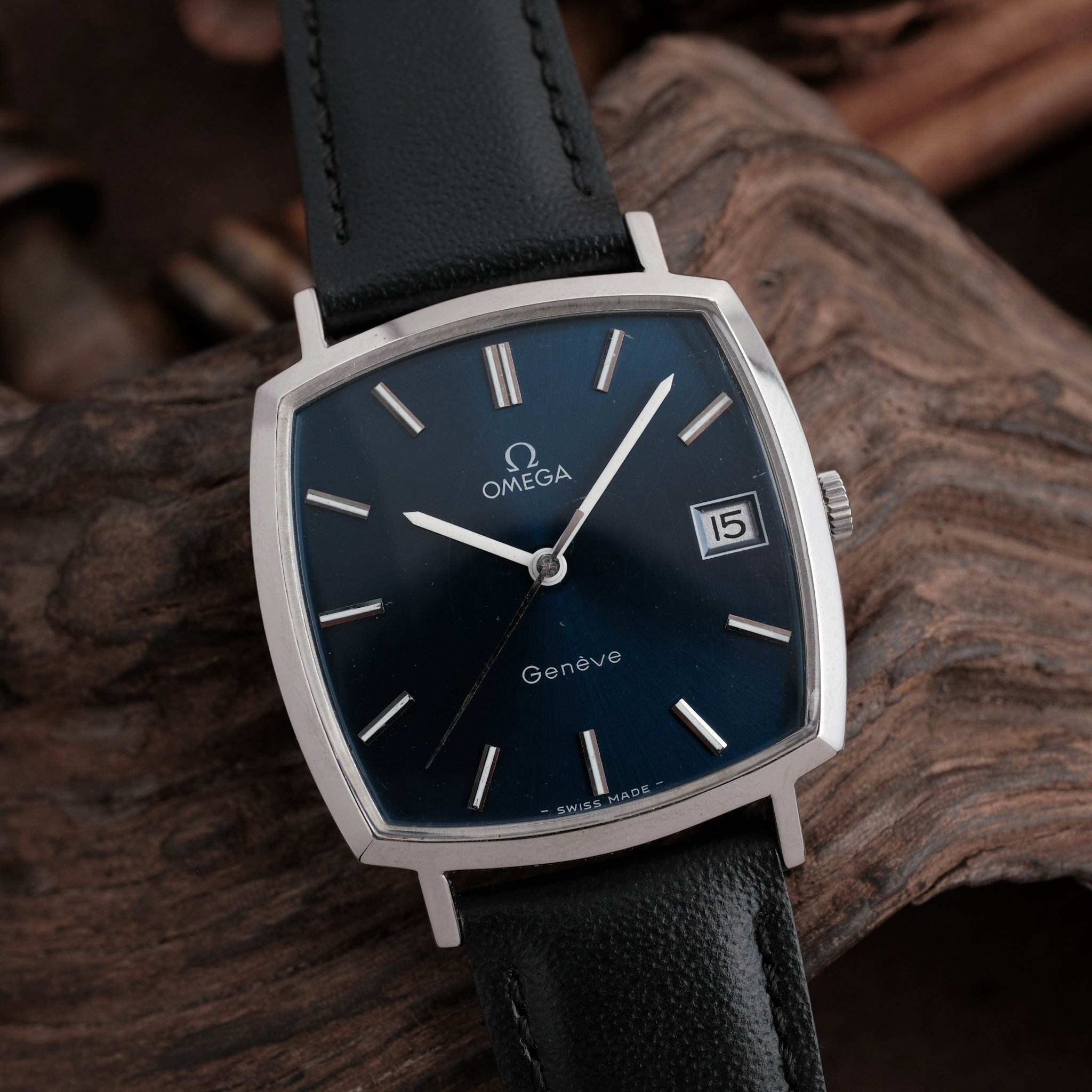
The Genève 132.0052 belongs unmistakably to 1974: a square cushion case, applied indices and sunburst or vertically brushed dials give it the strong geometry of that year. Steel and 20-micron gold-plated cases are known, with steel backs on the plated examples.
The dial should decide the purchase. A clean sunburst or brushed surface is worth protecting, while a redial costs more than ordinary case scratches. Between a worn plated example and a coherent steel watch at similar money, take the steel watch unless the plated one has the clearly better dial.
Model
Omega Genève
Reference
132.0052
Production year
1974-1974
Case size
31-32 mm excluding crown
| Case materials | Stainless steel or 20-micron gold plate with stainless steel back |
| Movement options | Manual-wind caliber 1030 or automatic caliber 1010 |
| Known dial finishes | Blue, silver or champagne sunburst; vertically brushed gold-tone |
| Case shape | Square cushion |
The model landscape
Reference 132.0052 is not one fixed visual specification. Known dials include blue, silver and champagne sunburst finishes, plus a vertically brushed gold-tone version. Applied indices may carry white or black inserts, and matching stick hands preserve the intended contrast.
Movement choice also varies. Manual-wind examples use caliber 1030, while an automatic example uses caliber 1010. The manual watch gives you a daily winding routine; the automatic removes that step. Neither should command a premium merely for its winding system - dial quality, case material and component coherence matter more.
On the wrist
Known cases measure 31 or 32 mm excluding the crown, but the square cushion outline gives the watch more visual area than a round case of similar width. It remains compact and works best as a 1970s dress watch rather than as a modern oversized sports watch.
The blue sunburst dial gives the strongest contrast, while silver and champagne read more quietly under a cuff. Black inserts improve definition on the gold-tone dial. If legibility matters most, take the blue steel version over the lower-contrast gold-tone combinations.
What goes wrong
Gold plating can wear through at the case edges, and no routine service replaces lost 20-micron plating invisibly. Steel cases avoid that problem, though scratches, minor dings and softened transitions between the brushed top and polished sides still reduce definition. Crystals also collect marks and crowns may be service replacements.
Dial damage matters more. Reject peeling, broad staining or a refinish that erases the original sunburst or vertical brushing. Hands can oxidise, luminous tips can age, and mismatched inserts may indicate replacement parts. A franken watch can contain genuine Omega components that never left the factory together.
Running is not the same as serviced. The examples handled showed substantial positive daily rates, so timing requires measurement rather than reassurance. The service history is unknown without documentation, and no claim should go beyond the movement and case evidence. Buy the cleanest coherent dial in steel; choose plated gold only when edge wear is limited and plainly disclosed.
Dating this watch
| Serial range / caliber | Year | Note |
|---|---|---|
| 1000000 | 1902 | approximate, ±1-3 years |
| 2000000 | 1908 | approximate, ±1-3 years |
| 3000000 | 1912 | approximate, ±1-3 years |
| 4000000 | 1916 | approximate, ±1-3 years |
| 5000000 | 1923 | approximate, ±1-3 years |
| 6000000 | 1925 | approximate, ±1-3 years |
| 7000000 | 1929 | approximate, ±1-3 years |
| 8000000 | 1935 | approximate, ±1-3 years |
| 9000000 | 1939 | approximate, ±1-3 years |
| 10000000 | 1944 | approximate, ±1-3 years |
| 11000000 | 1947 | approximate, ±1-3 years |
| 12000000 | 1950 | approximate, ±1-3 years |
| 13000000 | 1952 | approximate, ±1-3 years |
| 14000000 | 1954 | approximate, ±1-3 years |
| 15000000 | 1956 | approximate, ±1-3 years |
| 16000000 | 1958 | approximate, ±1-3 years |
| 17000000 | 1960 | approximate, ±1-3 years |
| 18000000 | 1961 | approximate, ±1-3 years |
| 19000000 | 1962 | approximate, ±1-3 years |
| 20000000 | 1963 | approximate, ±1-3 years |
| 21000000 | 1964 | approximate, ±1-3 years |
| 22000000 | 1965 | approximate, ±1-3 years |
| 24000000 | 1966 | approximate, ±1-3 years |
| 25000000 | 1967 | approximate, ±1-3 years |
| 26000000 | 1968 | approximate, ±1-3 years |
| 28000000 | 1969 | approximate, ±1-3 years |
| 31000000 | 1970 | approximate, ±1-3 years |
| 32000000 | 1971 | approximate, ±1-3 years |
| 33000000 | 1972 | approximate, ±1-3 years |
| 35000000 | 1973 | approximate, ±1-3 years |
| 37000000 | 1974 | approximate, ±1-3 years |
| 39000000 | 1975 | approximate, ±1-3 years |
| 40000000 | 1976 | approximate, ±1-3 years |
| 41000000 | 1977 | approximate, ±1-3 years |
| 42000000 | 1978 | approximate, ±1-3 years |
| 43000000 | 1979 | approximate, ±1-3 years |
| 44000000 | 1980 | approximate, ±1-3 years |
| 45000000 | 1982 | approximate, ±1-3 years |
| 46000000 | 1984 | approximate, ±1-3 years |
| 47000000 | 1985 | approximate, ±1-3 years |
| 48000000 | 1986 | approximate, ±1-3 years |
| 49000000 | 1988 | approximate, ±1-3 years |
| 50000000 | 1990 | approximate, ±1-3 years |
| 53000000 | 1993 | approximate, ±1-3 years |
| 54000000 | 1995 | approximate, ±1-3 years |
| 56000000 | 1996 | approximate, ±1-3 years |
| 58000000 | 1998 | approximate, ±1-3 years |
| 60000000 | 2000 | approximate, ±1-3 years |
Dating data comes from our decoder tables; treat years as approximate.
What to check before you buy
- Dial print and finish: Known dials use sunburst blue, silver or champagne, or a vertically brushed gold-tone finish. Flat paint, lost brushing or crude Genève text points to a redial rather than honest ageing.
- Hands and applied indices: Known configurations pair applied indices with white or black inserts and stick hands. The gold-tone dial uses matching black inserts; unexplained colour or style mismatches can signal replacement parts.
- Case and caseback: The square cushion case has a brushed top and polished sides. Steel and 20-micron gold-plated cases are known, with stainless steel backs on plated examples; blurred transitions indicate polishing.
- Movement caliber: Reference 132.0052 is known with manual-wind caliber 1030 and automatic caliber 1010. A different caliber, or a winding system inconsistent with the movement, requires explanation and may indicate a married watch.
- Crown: The available evidence does not establish one crown specification for every 132.0052. Treat the crown as a consumable and do not call it original without documentation or configuration-specific proof.
- Movement condition: A correct caliber alone does not prove authenticity or recent service. Corrosion, damaged screw heads or inconsistent components matter, while an undocumented service claim should be treated as unknown.
Other 132.0052 examples we auctioned
More Omega references
Related pages
Frequently asked questions
Ready to hunt for your own?
More than 100 vintage watches go under the hammer every week.