Omega De Ville 111.0118 - a collector's buying guide
Omega De Ville reference 111.0118 is a 31 mm, manual-winding 1970s dress watch best bought with a clean dial and intact case plating.
We auction more than 100 vintage watches a week.
Get first access: new Omega 111.0118 drops and alerts before auctions end.
Browse 62 live Omega auctionsThe Omega De Ville 111.0118 is a compact dress watch built around a square-cushion case, a restrained dial and a manual-winding caliber 625. At 31 mm excluding the crown, it makes sense as a formal 1970s object rather than a smaller substitute for a modern round watch.
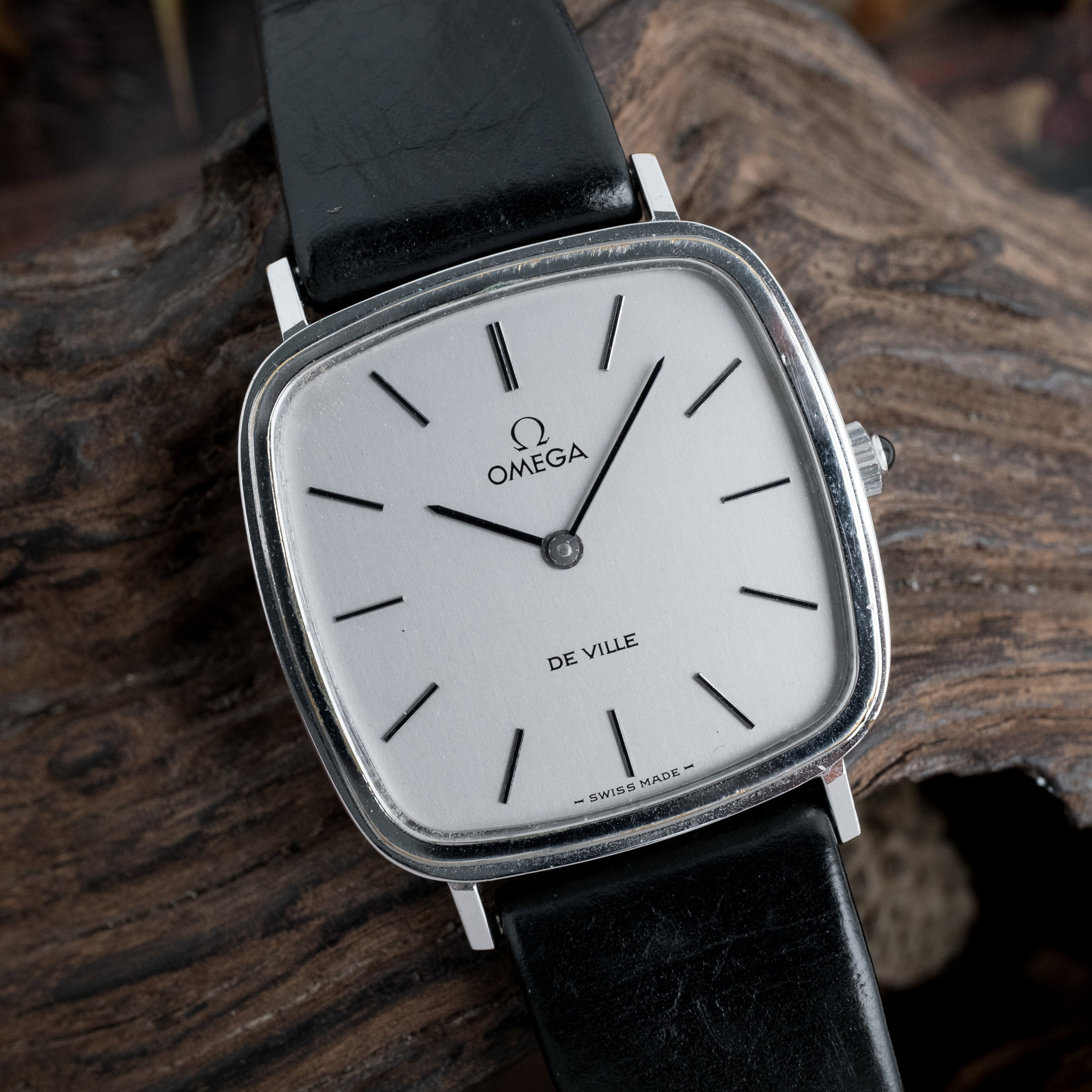
The meaningful choice is between the known case-and-dial combinations: 20-micron gold plating with a light champagne dial, or white gold plating around a vertically brushed silver dial. Both use a stainless steel caseback, and the reference is known from 1974 through 1979. Buy the cleaner dial and better-preserved plating rather than treating color as the first priority.
Reference
111.0118
Model
De Ville
Known production years
1974-1979
Case size
31 mm excluding the crown
| Movement | Manual winding |
| Caliber | 625 |
| Known jewel count | 17 jewels |
| Case forms | Square-cushion |
| Known case materials | 20-micron gold-plated or white gold-plated, with stainless steel caseback |
| Known dial variants | Light champagne with black baton indices, or vertically brushed silver with black printed indices |
What it was built for
Reference 111.0118 was built as a slim-looking manual-winding dress watch, with its square-cushion outline doing more visual work than its 31 mm measurement suggests. The black baton or printed indices keep the display sparse, while the stainless steel caseback separates the wearing surface from the plated case exterior.
Caliber 625 suits that purpose because daily winding removes the need for automatic winding hardware. The watch belongs under a cuff and in quieter settings, not in a role where water exposure or impact resistance matters. Its service history is unknown unless documentation accompanies the individual watch, and no assumption about water resistance is justified.
Where the value sits
The dial carries the largest condition premium. A clean light champagne dial or vertically brushed silver dial is preferable to a refinished dial, even when the latter sits inside a brighter case. A redial costs more in collectability than modest case wear, while a genuine service dial is a different category and must not be described as original to the watch.
Plating establishes the next part of the spread. Wear-through at lug edges cannot be reversed by routine servicing, and polishing can soften the square-cushion outline without restoring lost metal. At equal cost, take the example with intact plating and a coherent dial-hand combination over one sold mainly on a service claim.
Where to start
The vertically brushed silver dial with black printed indices gives the clearest reading of the reference's geometric design, while the light champagne dial makes the 20-micron gold-plated version look warmer and more formal. Neither finish is automatically superior. The better purchase is the one with undisturbed printing, matching black hands and plating that has not worn through at the corners or lugs.
Caliber 625 should be present, and the caseback should be stainless steel. Among examples we have handled, a black cabochon crown and an Omega-signed buckle have accompanied the silver, white gold-plated configuration, but that does not establish either component as universal across the full 1974-1979 range. Without supporting documentation, the individual watch itself sets the limit of the claim.
Dating this watch
| Serial range / caliber | Year | Note |
|---|---|---|
| 1,000,000 | 1902 | approximate, ±1-3 years |
| 2,000,000 | 1908 | approximate, ±1-3 years |
| 3,000,000 | 1912 | approximate, ±1-3 years |
| 4,000,000 | 1916 | approximate, ±1-3 years |
| 5,000,000 | 1923 | approximate, ±1-3 years |
| 6,000,000 | 1925 | approximate, ±1-3 years |
| 7,000,000 | 1929 | approximate, ±1-3 years |
| 8,000,000 | 1935 | approximate, ±1-3 years |
| 9,000,000 | 1939 | approximate, ±1-3 years |
| 10,000,000 | 1944 | approximate, ±1-3 years |
| 11,000,000 | 1947 | approximate, ±1-3 years |
| 12,000,000 | 1950 | approximate, ±1-3 years |
| 13,000,000 | 1952 | approximate, ±1-3 years |
| 14,000,000 | 1954 | approximate, ±1-3 years |
| 15,000,000 | 1956 | approximate, ±1-3 years |
| 16,000,000 | 1958 | approximate, ±1-3 years |
| 17,000,000 | 1960 | approximate, ±1-3 years |
| 18,000,000 | 1961 | approximate, ±1-3 years |
| 19,000,000 | 1962 | approximate, ±1-3 years |
| 20,000,000 | 1963 | approximate, ±1-3 years |
| 21,000,000 | 1964 | approximate, ±1-3 years |
| 22,000,000 | 1965 | approximate, ±1-3 years |
| 24,000,000 | 1966 | approximate, ±1-3 years |
| 25,000,000 | 1967 | approximate, ±1-3 years |
| 26,000,000 | 1968 | approximate, ±1-3 years |
| 28,000,000 | 1969 | approximate, ±1-3 years |
| 31,000,000 | 1970 | approximate, ±1-3 years |
| 32,000,000 | 1971 | approximate, ±1-3 years |
| 33,000,000 | 1972 | approximate, ±1-3 years |
| 35,000,000 | 1973 | approximate, ±1-3 years |
| 37,000,000 | 1974 | approximate, ±1-3 years |
| 39,000,000 | 1975 | approximate, ±1-3 years |
| 40,000,000 | 1976 | approximate, ±1-3 years |
| 41,000,000 | 1977 | approximate, ±1-3 years |
| 42,000,000 | 1978 | approximate, ±1-3 years |
| 43,000,000 | 1979 | approximate, ±1-3 years |
| 44,000,000 | 1980 | approximate, ±1-3 years |
| 45,000,000 | 1982 | approximate, ±1-3 years |
| 46,000,000 | 1984 | approximate, ±1-3 years |
| 47,000,000 | 1985 | approximate, ±1-3 years |
| 48,000,000 | 1986 | approximate, ±1-3 years |
| 49,000,000 | 1988 | approximate, ±1-3 years |
| 50,000,000 | 1990 | approximate, ±1-3 years |
| 53,000,000 | 1993 | approximate, ±1-3 years |
| 54,000,000 | 1995 | approximate, ±1-3 years |
| 56,000,000 | 1996 | approximate, ±1-3 years |
| 58,000,000 | 1998 | approximate, ±1-3 years |
| 60,000,000 | 2000 | approximate, ±1-3 years |
Dating data comes from our decoder tables; treat years as approximate.
What to check before you buy
- Dial and hand configuration: A known gold-plated example pairs a light champagne dial with black baton indices, while a known white gold-plated example uses a vertically brushed silver dial, black printed indices and matching black stick hands.
- Case construction: Reference 111.0118 uses a 31 mm square-cushion case excluding the crown, with a stainless steel caseback. Rounded corners, softened transitions or exposed base metal indicate polishing or plating wear.
- Movement caliber: The movement should be the manual-winding Omega caliber 625. A different caliber can indicate a married or franken watch unless specific evidence establishes a legitimate factory configuration.
- Crown and buckle claims: A black cabochon crown and Omega-signed buckle are known on a 1975 silver-dial example, but the available evidence does not establish them as universal. Period-correct is not the same as original to a given watch.
- Redial and service-dial separation: The sparse dial should retain coherent black printing and the stated surface finish. A repainted surface is a redial, while a genuine factory replacement is a service dial and should be disclosed separately.
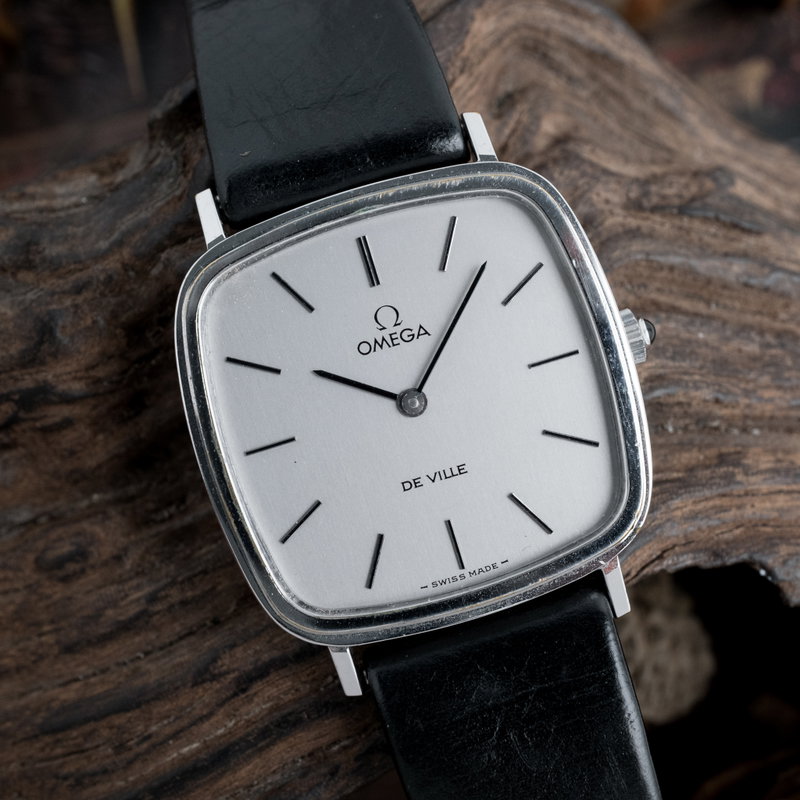
Other 111.0118 examples we auctioned
4 Omega 111.0118 auctioned
More Omega references
Related pages
Frequently asked questions
Ready to hunt for your own?
More than 100 vintage watches go under the hammer every week.