Omega De Ville 111.077 - A Buyer's Reference Guide
Choose the steel Omega De Ville 111.077 with the cleanest credible dial; gold plating and dial refinishing create the largest condition risks.
We auction more than 100 vintage watches a week.
Get first access: new Omega 111.077 drops and alerts before auctions end.
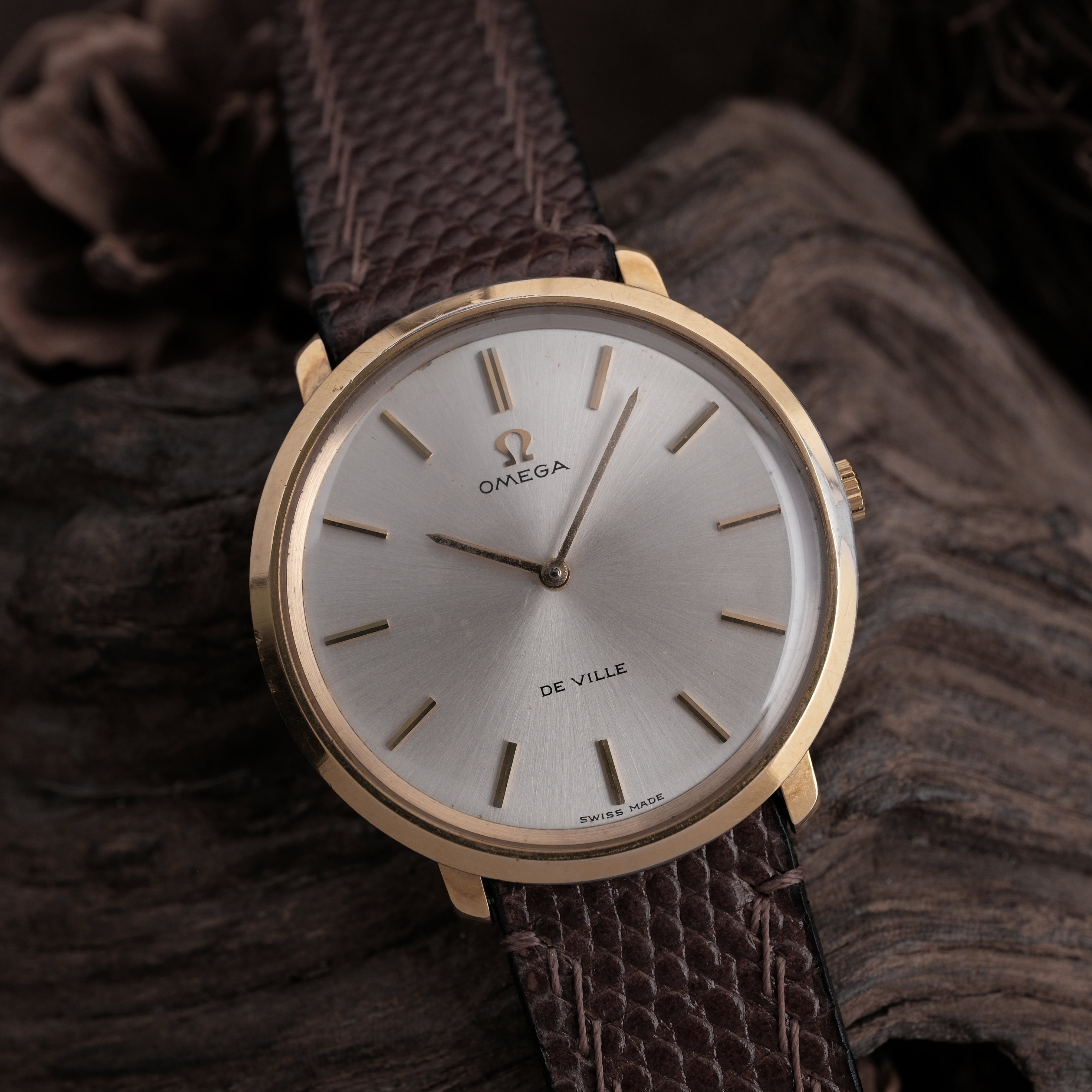
Browse 60 live Omega auctionsThe De Ville 111.077 strips a dress watch down to two hands, a slim case and manual-wind caliber 620. Examples handled from 1968 to 1972 establish a useful choice: silver sunburst dials in steel or gold-plated cases, plus a grey linen-textured steel version at the end of the known period.
The steel version is the safer purchase against a gold-plated example at similar money. Worn plating cannot be returned by routine servicing, while surface marks on steel are easier to accept without altering the case. Dial quality decides the watch, however: a refinished dial costs more in collector appeal than ordinary case scratches or an unknown service history.
Reference
111.077
Model
De Ville
Known production years
1968-1972
Movement
Manual-wind Omega caliber 620
| Known case sizes | 33 mm or 34 mm, excluding crown |
| Known case materials | Stainless steel; gold-plated with stainless steel caseback |
| Known dial finishes | Silver sunburst; grey linen-textured |
| Display | Two hands |
The model landscape
The earlier steel configuration pairs a silver sunburst dial with black printed indices and hands. A gold-plated version keeps the silver sunburst surface but uses applied gold-tone baton markers and an applied Omega logo, with a stainless steel caseback. These are materially different propositions because plating wear at the lugs exposes the base metal, whereas a marked steel case can remain coherent without cosmetic intervention.
By 1972, the steel 111.077 also existed with a grey linen-textured dial, black indices and black stick hands. That texture gives the dial more visual depth, but it also makes refinishing harder to disguise convincingly. Between a sharp steel example with an honest silver dial and a plated example with brighter presentation, take the steel watch; between two steel watches, let dial integrity decide.
On the wrist
Known cases measure 33 mm or 34 mm excluding the crown, and the thin integrated bezel leaves much of that width to the dial. The two-hand layout remains legible because no seconds hand or date display interrupts the printed indices. This is a cuff watch: the ultra-thin profile lies low, while manual winding makes the crown part of regular ownership rather than an occasional control.
The grey linen dial reads more assertively than the silver sunburst version because its texture remains visible across the broad, uncluttered surface. Silver is quieter and works more easily as a formal watch. The one-millimetre spread matters less than case sharpness and dial contrast, so a clean 33 mm example is preferable to a softened 34 mm case.
What goes wrong
Dial damage is the first financial fault. Light scattered spotting occurs on both silver sunburst and grey linen examples, and minor spotting under magnification is preferable to a redial that removes the original surface. Crisp black typography must agree with the dial finish; an implausibly uniform surface, lost linen texture or mismatched furniture can indicate refinishing or a franken assembly.
Gold plating wears through at exposed edges and lugs, and no ordinary service replaces the missing original finish. Steel cases collect surface scratches, while repeated polishing softens the thin bezel and rounds the lugs. Crystals, crowns and gaskets are consumables, so their presence cannot support a blanket all-original claim. The service history is unknown without documentation, and a timing result from one day does not establish movement condition.
Start with a steel 111.077 whose caliber 620, case and dial configuration agree, then accept modest spotting before refinishing. The grey linen version is the more distinctive choice against silver sunburst, but only when the texture remains intact; otherwise the honest silver-dial steel watch is the defensible buy.
Dating this watch
| Serial range / caliber | Year | Note |
|---|---|---|
| 1,000,000 | 1902 | approximate, ±1-3 years |
| 2,000,000 | 1908 | approximate, ±1-3 years |
| 3,000,000 | 1912 | approximate, ±1-3 years |
| 4,000,000 | 1916 | approximate, ±1-3 years |
| 5,000,000 | 1923 | approximate, ±1-3 years |
| 6,000,000 | 1925 | approximate, ±1-3 years |
| 7,000,000 | 1929 | approximate, ±1-3 years |
| 8,000,000 | 1935 | approximate, ±1-3 years |
| 9,000,000 | 1939 | approximate, ±1-3 years |
| 10,000,000 | 1944 | approximate, ±1-3 years |
| 11,000,000 | 1947 | approximate, ±1-3 years |
| 12,000,000 | 1950 | approximate, ±1-3 years |
| 13,000,000 | 1952 | approximate, ±1-3 years |
| 14,000,000 | 1954 | approximate, ±1-3 years |
| 15,000,000 | 1956 | approximate, ±1-3 years |
| 16,000,000 | 1958 | approximate, ±1-3 years |
| 17,000,000 | 1960 | approximate, ±1-3 years |
| 18,000,000 | 1961 | approximate, ±1-3 years |
| 19,000,000 | 1962 | approximate, ±1-3 years |
| 20,000,000 | 1963 | approximate, ±1-3 years |
| 21,000,000 | 1964 | approximate, ±1-3 years |
| 22,000,000 | 1965 | approximate, ±1-3 years |
| 24,000,000 | 1966 | approximate, ±1-3 years |
| 25,000,000 | 1967 | approximate, ±1-3 years |
| 26,000,000 | 1968 | approximate, ±1-3 years |
| 28,000,000 | 1969 | approximate, ±1-3 years |
| 31,000,000 | 1970 | approximate, ±1-3 years |
| 32,000,000 | 1971 | approximate, ±1-3 years |
| 33,000,000 | 1972 | approximate, ±1-3 years |
| 35,000,000 | 1973 | approximate, ±1-3 years |
| 37,000,000 | 1974 | approximate, ±1-3 years |
| 39,000,000 | 1975 | approximate, ±1-3 years |
| 40,000,000 | 1976 | approximate, ±1-3 years |
| 41,000,000 | 1977 | approximate, ±1-3 years |
| 42,000,000 | 1978 | approximate, ±1-3 years |
| 43,000,000 | 1979 | approximate, ±1-3 years |
| 44,000,000 | 1980 | approximate, ±1-3 years |
| 45,000,000 | 1982 | approximate, ±1-3 years |
| 46,000,000 | 1984 | approximate, ±1-3 years |
| 47,000,000 | 1985 | approximate, ±1-3 years |
| 48,000,000 | 1986 | approximate, ±1-3 years |
| 49,000,000 | 1988 | approximate, ±1-3 years |
| 50,000,000 | 1990 | approximate, ±1-3 years |
| 53,000,000 | 1993 | approximate, ±1-3 years |
| 54,000,000 | 1995 | approximate, ±1-3 years |
| 56,000,000 | 1996 | approximate, ±1-3 years |
| 58,000,000 | 1998 | approximate, ±1-3 years |
| 60,000,000 | 2000 | approximate, ±1-3 years |
Dating data comes from our decoder tables; treat years as approximate.
What to check before you buy
- Dial configuration: Known dials are silver sunburst or grey linen-textured. Black printing should remain coherent with the surface, while lost linen texture or unusually uniform paint is a redial warning rather than patina.
- Hands and hour furniture: The grey linen configuration uses black stick hands and black indices. Silver versions include black printed furniture or applied gold-tone batons, so mismatched parts can indicate a franken watch assembled from incompatible examples.
- Movement: Handled examples use the manual-wind Omega caliber 620. A claimed 111.077 with another caliber is not supported by this evidence and needs documentation before the case and movement can be accepted as belonging together.
- Case material and wear: Established cases are stainless steel or gold-plated with a stainless steel caseback. Exposed base metal at the lugs is plating loss, while a rounded thin bezel and softened lugs indicate polishing.
- Date consistency: Handled watches run from 1968 through 1972, and the Omega serial table is approximate by one to three years. A date outside that span is not automatically false, but the available evidence does not establish it.
Other 111.077 examples we auctioned
5 Omega 111.077 auctioned
More Omega references
Related pages
Frequently asked questions
Ready to hunt for your own?
More than 100 vintage watches go under the hammer every week.