Seiko 6206-8040: A Collector's Guide to the Day-at-Six Seikomatic
Buy the Seiko 6206-8040 for its day-at-six calendar layout, but put dial quality and case integrity ahead of surface shine.
We auction more than 100 vintage watches a week.
Get first access: new Seiko 6206-8040 drops and alerts before auctions end.
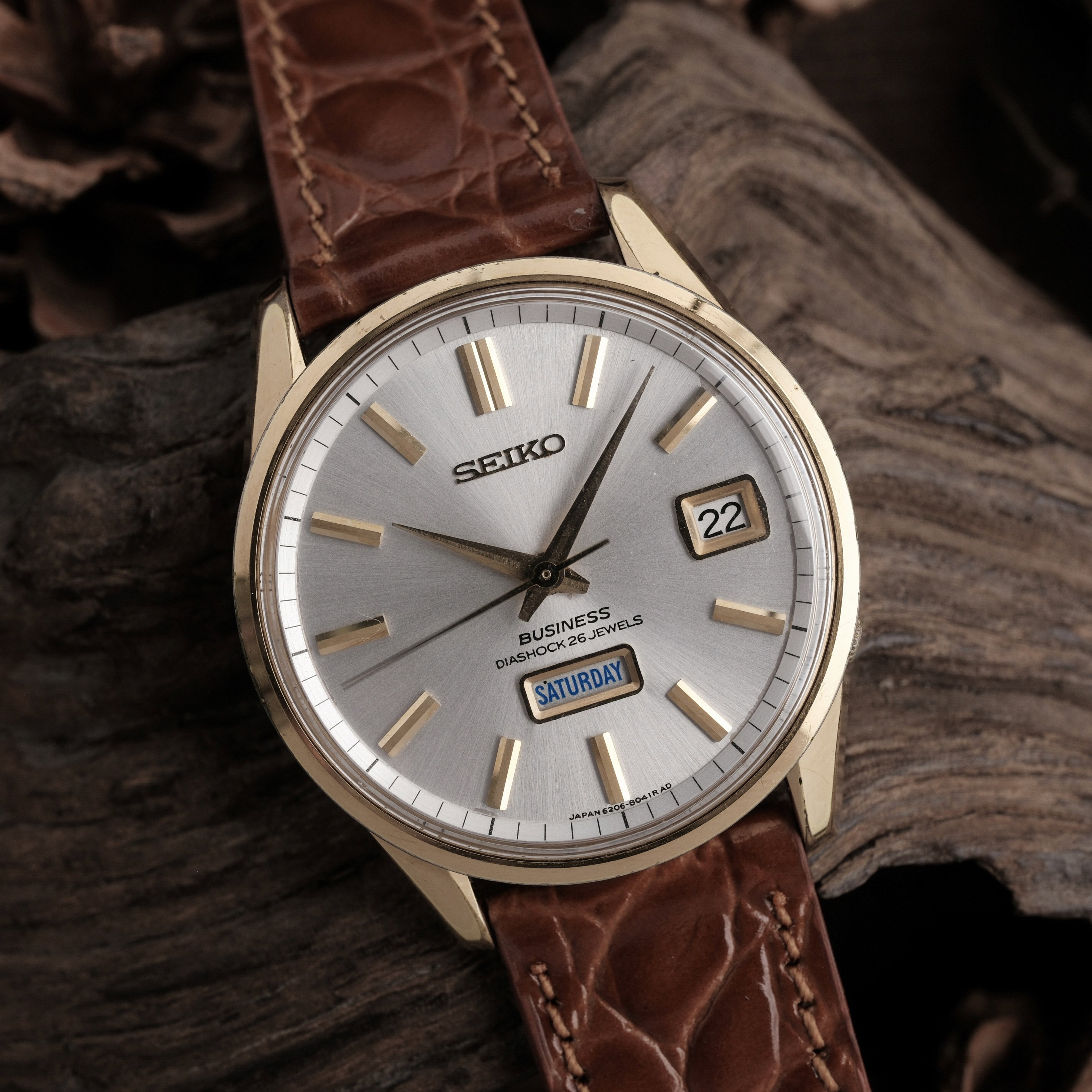
Browse 27 live Seiko auctionsThe Seiko 6206-8040 is defined by a calendar arrangement that changes the whole face: the day sits at 6 o'clock and the date at 3. Examples from 1965 to 1967 carry the same reference across Seikomatic and Business naming, so the dial signature matters when comparing two watches.
A 36 mm case, recessed crown at 4 o'clock and automatic caliber 6206B place the watch firmly in Seiko's mid-1960s daily-wear catalogue. Steel cases and gold-plated SGP cases with stainless steel backs both occur. The strongest purchase is the version whose silver sunburst finish, applied furniture and case material still agree with one another.
Known production years
1965-1967
Reference
6206-8040
Model names
Seikomatic and Business
Movement
Automatic caliber 6206B
| Jewel count | 26 jewels |
| Case size | 36 mm excluding the crown |
| Case materials | Stainless steel, or gold-plated SGP with stainless steel caseback |
| Calendar layout | Day at 6 o'clock and date at 3 o'clock |
| Crown position | Recessed at 4 o'clock |
| Dial configuration | Silver sunburst with applied indices |
The model landscape
The steel Seikomatic is the safest place to start. Its case can show polishing and wear without exposing a base metal, while the gold-plated SGP version can lose plating around the lugs and case edges. Business-signed examples use the same 6206-8040 reference and calendar arrangement, but the name on the dial should be judged as part of that specific version rather than treated as interchangeable.
Value sits first in the dial, then in the case. A clean silver sunburst surface with coherent printing is worth a wider premium than a bright refinished dial, and plating loss cannot be corrected by routine servicing. Between a softly polished example with an untouched dial and a sharper case carrying a redial, take the untouched dial unless the printing or calendar apertures raise doubts.
On the wrist
At 36 mm excluding the crown, the 6206-8040 wears as a compact dress watch rather than a small modern sports watch. The recessed crown at 4 o'clock keeps the case outline uninterrupted, while the separated day and date displays make both calendar indications easy to locate. Applied indices and dauphine-style hands give the silver dial enough contrast for office wear, though oxidation on the hands can reduce clarity.
The automatic caliber 6206B has 26 jewels, so this is not a hand-wound watch disguised by a slim case. Its practical distinction is the calendar display rather than thickness or water resistance, neither of which the available evidence establishes. Service history is often unknown, and without documentation we do not treat a plausible timegrapher reading as proof of prior maintenance.
What goes wrong
A refinished dial is the costliest common mistake because it removes the original sunburst surface and can distort the Seiko or Seikomatic printing. Gold plating also wears through at lug tips and edges, while polishing softens the case profile and weakens the dolphin engraving found on steel casebacks. Hands can oxidise, crowns can be replaced, and a movement or dial from another watch can create a franken assembly.
Condition should be read as a hierarchy. Reject incorrect calendar geometry or a married case and movement before worrying about light hand oxidation. Of the 6206-8040 examples we have photographed, the day aperture at 6 o'clock, date at 3 o'clock and recessed crown are the most useful whole-watch identifiers; fine printing and movement markings should confirm that initial judgement.
Dating this watch
| Serial range / caliber | Year | Note |
|---|---|---|
| 6206 | 1963-1968 | caliber production window |
Dating data comes from our decoder tables; treat years as approximate.
What to check before you buy
- Calendar layout: The 6206-8040 should place the day aperture at 6 o'clock and the date at 3 o'clock. A conventional paired day-date display conflicts with the handled dial configuration.
- Movement identity: The movement should be the automatic caliber 6206B with 26 jewels. Another caliber is not supported for this reference and may indicate a replacement or married assembly.
- Dial and model signature: Both Seikomatic and Business names occur with 6206-8040, so the signature must be assessed with the case execution. Uneven printing over a lost sunburst finish points to a redial, not a service dial.
- Case construction: Known executions are stainless steel and gold-plated SGP with a stainless steel back. Exposed base metal at the lug tips confirms plating wear, while rounded edges indicate prior polishing.
- External architecture: The crown is recessed at 4 o'clock, and steel examples can carry a dolphin engraving on the caseback. A proud crown or incompatible back warrants checking for replacement parts rather than assuming originality.
Other 6206-8040 examples we auctioned
17 Seiko 6206-8040 auctioned
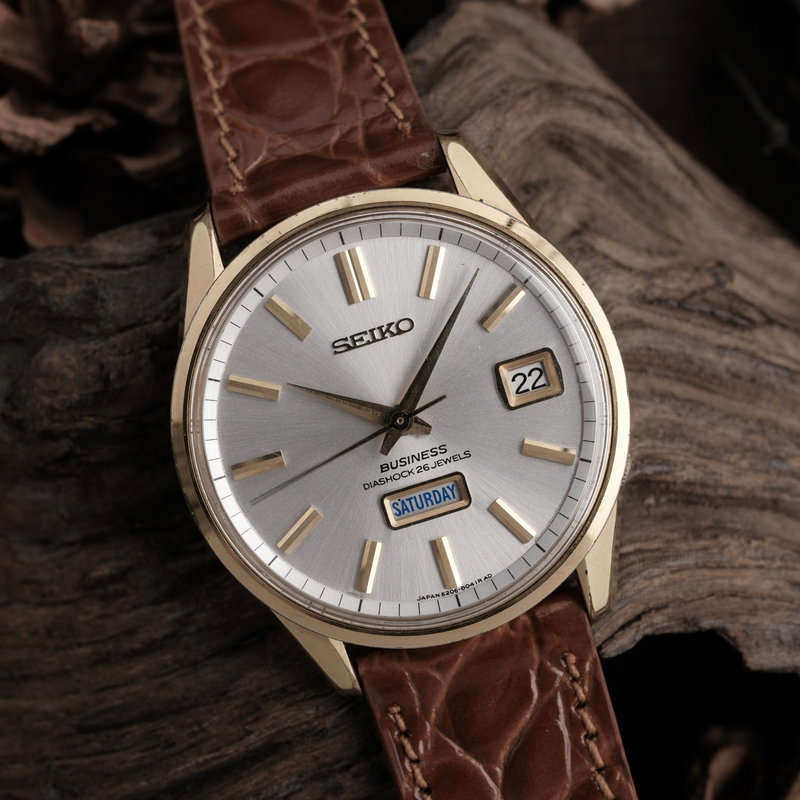
Seiko · Business · 6206-8040 · 1967
Seiko · Seikomatic · 6206-8040 · 1965
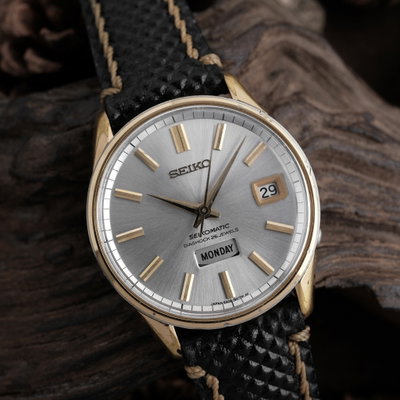
Seiko · Seikomatic · 6206-8040 · 1965
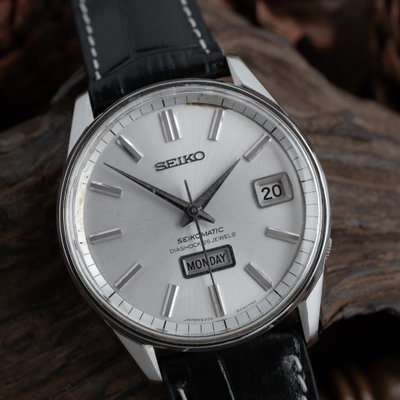
Seiko · Seikomatic · 6206-8040 · 1966
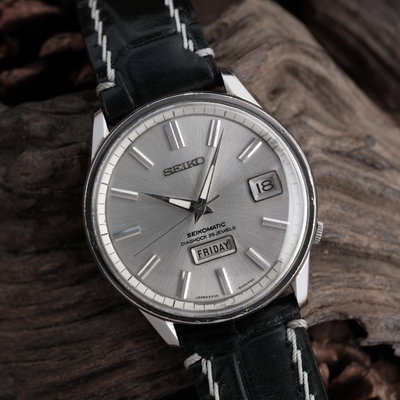
Seiko · Seikomatic · 6206-8040 · 1966
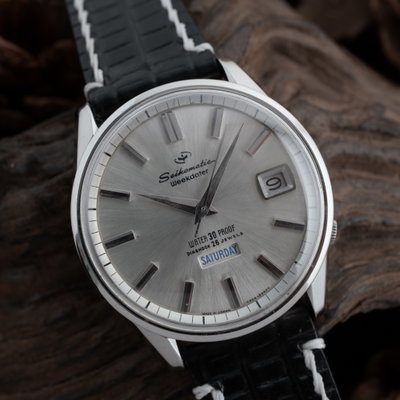
Seiko · Seikomatic Weekdater · 6206-8040 · 1965
More Seiko references
Related pages
Frequently asked questions
Ready to hunt for your own?
More than 100 vintage watches go under the hammer every week.