Vintage Seiko Actus: References, Calibers and Buying Advice
The vintage Seiko Actus to buy is a 37 mm steel example with an honest sunburst dial, a sharp cushion case and movement parts that belong together.
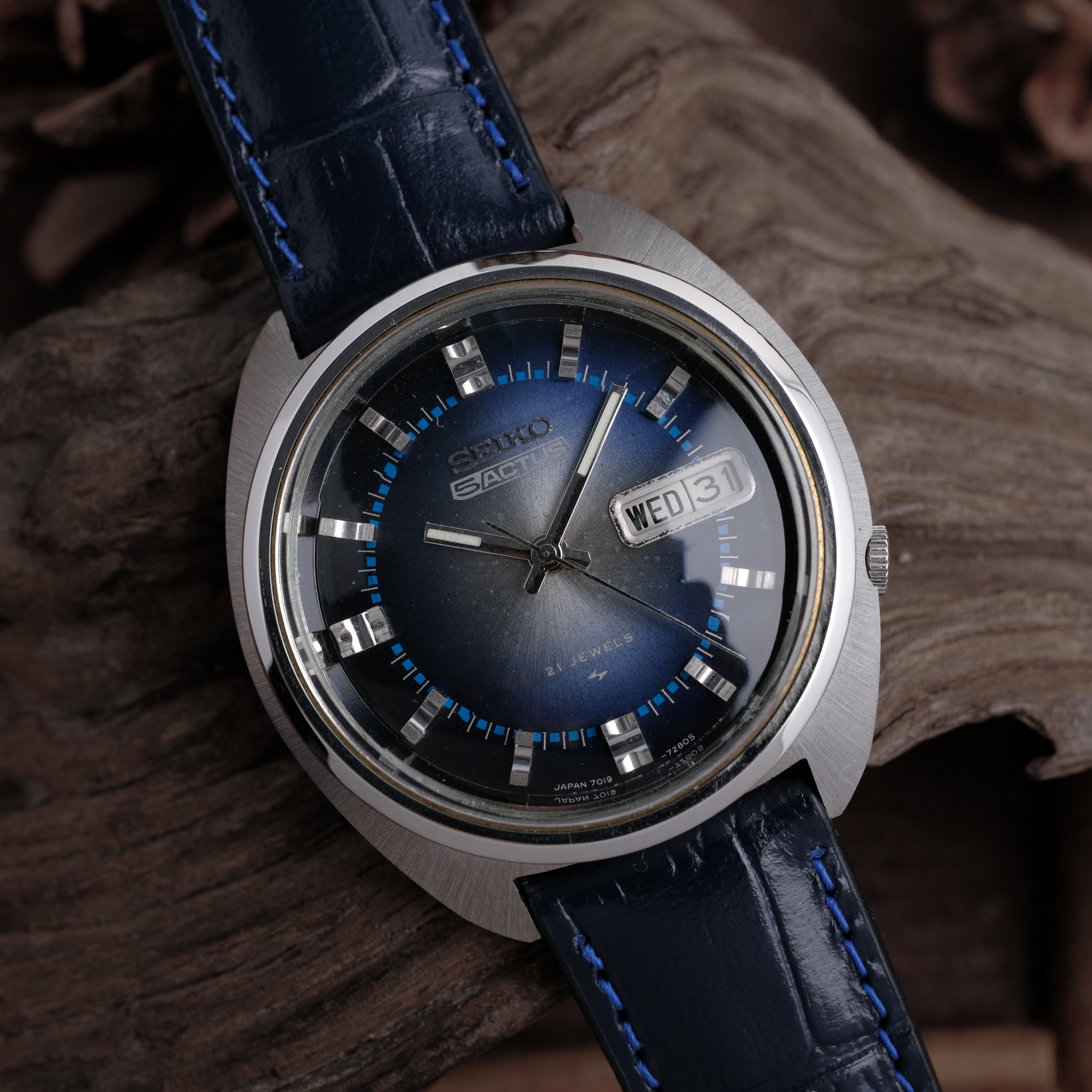
The Seiko Actus belongs to the bolder side of the early 1970s Japanese domestic market. Between 1970 and 1976, the model paired automatic movements with blue sunburst or vignette dials, applied faceted indices and day-date displays. The Actus SS examples from 1974 make the point clearly: their C-shaped cushion cases, recessed crowns and steel bracelets were designed as contemporary everyday watches, not restrained dress pieces.
The safest purchase is a steel Actus with an honest dial and defined case geometry. A 37 mm 7019-7210 from 1973 wears more assertively than its diameter suggests because the cushion case carries visual weight across the wrist, while the 1974 6106-7520 adds a factory faceted crystal. A refinished dial costs more in lost character than light case wear, and a softened case cannot recover its original lines.
Known production years
1970-1976
Observed case diameter
37 mm excluding the crown
Observed case material
Stainless steel
Observed movements
Automatic caliber 7019A, caliber 6106 and caliber 6106C
| Observed jewel counts | 21 jewels with caliber 7019A; 23 jewels with caliber 6106C |
| Observed display | Day-date |
| Observed dial finishes | Blue sunburst and blue vignette sunburst |
| Observed case form | C-shaped cushion case with recessed crown on 6106-7520 |
| Observed crystal | Factory faceted crystal on 6106-7520 |
What it was built for
The Actus was built for a youthful, style-conscious domestic market, and its construction reflects that brief. The 7019-7210 combines a 7019A automatic movement with a blue vignette sunburst dial and tall applied indices, while the 6106-8670 uses the 6106C and a day-date display at three. These were practical steel watches with deliberate visual impact, not slim formal watches adapted with colourful dials.
The 1974 Actus SS examples also show how much variation sits inside the name. The 6106-7520 uses a C-shaped cushion case, recessed crown and factory faceted crystal, whereas the 6106-8670 carries black-striped indices matched by baton hands. Those details matter because a replacement crystal, generic crown or mismatched hand set can flatten the design even when the watch remains mechanically usable.
On the wrist
At 37 mm excluding the crown, the handled 7019-7210, 6106-7520 and 6106-8670 have enough presence for modern wear without losing their 1970s proportions. The cushion case spreads the mass beyond the dial, so lug definition and bracelet fit affect the wrist impression more than the nominal diameter. Blue sunburst finishes change visibly with light, while the darker vignette edge on the 7019-7210 makes its centre look broader.
The recessed crown keeps the case silhouette clean but gives less purchase than an exposed crown. Day-date displays make these Actus examples useful as everyday watches, although water resistance is unknown and should not be assumed from the steel case. Bracelet stretch, loose end-link fitment and a faceted crystal with chipped edges are the practical faults most likely to change how a used Seiko Actus feels in daily wear.
Where to start
Start with the dial, then judge the case around it. A deep blue 6106-7520 with intact sunburst finish is a stronger purchase than a shinier example with repainted printing, and the 7019-7210 depends heavily on retaining its silver-blue centre and dark navy edge. Minor spotting and dust are visible on the handled 1973 example, but they are less damaging than a redial that removes the original radial finish.
Case wear needs equally direct treatment. Polishing softens the C-shaped outline and rounds the transitions first; bracelet stretch and replacement crowns follow behind, while plated-looking bright edges should not be mistaken for preserved geometry. A commemorative caseback engraving, such as the April 1975 NGK Spark Plug service engraving on a 6106-8670, is part of that watch's history but does not authenticate the dial or movement.
Between a sharp 7019A example and a softened 6106 watch with a cleaner-looking redial, take the 7019A. The caliber family alone does not settle value: dial originality, crisp case shape, correct faceted crystal where fitted and coherent hands matter more. Service history is unknown unless documentation accompanies the watch, and without it the movement's current running condition should not be inferred from an old timing claim.
Dating this watch
| Serial range / caliber | Year | Note |
|---|---|---|
| 6106 | 1968-1976 | caliber production window |
| 6306 | 1976-1981 | caliber production window |
Dating data comes from our decoder tables; treat years as approximate.
What to check before you buy
- Dial finish and furniture: On 7019-7210, the dial should retain a radial silver-blue centre fading to a dark navy edge, with tall applied faceted indices. Flat paint, lost sunburst texture or printing sitting over damage indicates a redial.
- 6106-7520 case and crystal: The 6106-7520 should retain its C-shaped cushion profile, recessed crown and factory faceted crystal. A smooth generic crystal or rounded, mushy case transitions removes reference-specific architecture.
- 6106-8670 hands and indices: The 6106-8670 handled has applied silver-tone indices with black central stripes matched by baton hands. A hand set without that visual relationship may be period-correct elsewhere but needs scrutiny here.
- Caseback engraving limits: The known 6106-8670 engraving records 25 years of service at NGK Spark Plug in April 1975. It supports the caseback's individual history only and cannot establish that the case, dial and movement are not married.
Recent Seiko results
Related pages
Frequently asked questions
Ready to hunt for your own?
More than 100 vintage watches go under the hammer every week.