Seiko Business 6206-8010: What to Know Before You Buy
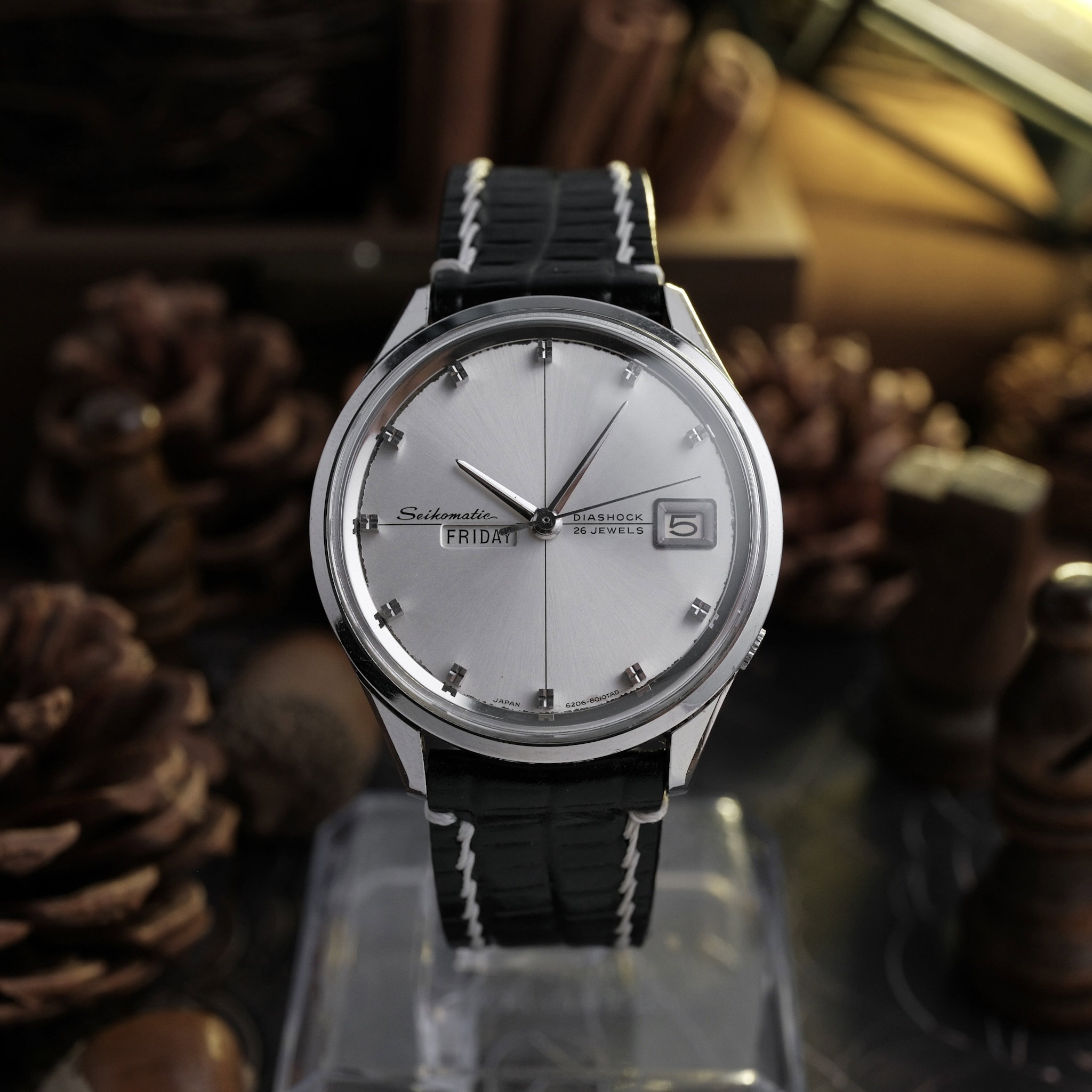
The Seiko Business 6206-8010 to buy has an honest silver sunburst dial, a crisp steel case and the correct 26-jewel 6206A or 6206B automatic movement.
We auction more than 100 vintage watches a week.
Get first access: new Seiko 6206-8010 drops and alerts before auctions end.
Browse 27 live Seiko auctionsThe Seiko Business 6206-8010 puts the day at 9 o'clock and the date at 3 o'clock, splitting the calendar across its silver sunburst dial. That layout gives this mid-1960s automatic its identity and makes calendar alignment central to judging an example.
Sold within the Seikomatic line, the reference is known from 1965 through 1967 with automatic caliber 6206A or 6206B. Both are 26-jewel movements, while handled steel cases measure between 35 and 36 mm without the crown. Dial preservation matters more than the small measured difference in case diameter.
Brand
Seiko
Model
Business, within the Seikomatic line
Reference
6206-8010
Known production years
1965-1967
| Movement | Automatic |
| Calibers | 6206A or 6206B |
| Jewel count | 26 jewels |
| Case material | Stainless steel |
| Handled case measurements | 35-36 mm, excluding the crown |
| Dial | Silver sunburst with applied faceted or textured indices |
| Calendar layout | Day at 9 o'clock and date at 3 o'clock |
| Crown | Recessed |
What it was built for
The Business 6206-8010 was an everyday automatic with unusually clear calendar separation. Its day display sits at 9 o'clock and its date at 3 o'clock, leaving the hands unobstructed around the dial centre. The recessed crown also reduces its visual presence and places the emphasis on automatic winding rather than frequent manual winding.
A stainless-steel case and silver sunburst dial put the watch firmly in the office-watch language of the period. Applied faceted or textured indices catch light more strongly than printed markers, while the divided calendar remains readable without enlarging either aperture. The 6206A and 6206B are both documented in this reference, so the suffix alone does not decide which watch deserves the premium.
What goes wrong
Dial damage is the costliest weakness. Known examples have edge wear near 9 o'clock, surface spotting and discoloration, all of which interrupt the silver sunburst finish. Even ageing can qualify as patina, but concentrated staining or lost finish is damage, and a redial removes the surface that carries most of this reference's value.
Polishing softens the lugs and erases the transition between the case top and sides. The recessed crown can be replaced by a more prominent crown, and wear can flatten the dolphin and crown medallion on the caseback. None of those faults should be disguised by a clean crystal, while a service dial must be described as a factory replacement rather than passed off as the dial that left the factory with the watch.
The service history is unknown unless invoices accompany the individual watch. A running 6206A or 6206B still needs assessment for calendar operation and automatic winding, because a snapshot rate does not establish service condition. A different movement makes the watch franken or married unless the relationship between case and movement can be established without speculation.
Where to start
Start with the dial, then the case, then the movement. The stronger buy has an honest silver sunburst surface, correctly separated calendar windows and applied indices that agree in finish with the hands. Between a cleaner polished case and a sharper case with a refinished dial, take neither shortcut - the redial costs more in collectability, while lost case geometry cannot be put back.
Handled examples measure from 35 to 36 mm without the crown, but the evidence does not establish separate factory size variants. Treat that spread as a measurement to confirm on the individual watch, not a hierarchy. At this scale the reference wears as a compact dress automatic, and the recessed crown keeps the right side visually clean under a cuff.
Value sits in the spread between intact and damaged dials, followed by case definition and a coherent 6206A or 6206B movement. The watch to want has limited edge wear, no broad discoloration, crisp remaining case lines and a caseback medallion whose wear agrees with the rest of the case. Buy that against a brighter redial or a heavily softened case at the same premium.
Dating this watch
| Serial range / caliber | Year | Note |
|---|---|---|
| 6206 | 1963-1968 | caliber production window |
Dating data comes from our decoder tables; treat years as approximate.
What to check before you buy
- Dial and calendar layout: The silver sunburst dial should carry applied faceted or textured indices, with the day aperture at 9 o'clock and the date at 3 o'clock. A flat refinished surface or altered calendar geometry is a redial warning.
- Hands and dial agreement: Silver-tone dauphine-style hands are documented with the applied indices. Mismatched hand finish, incompatible ageing or hands that conflict with the dial furniture can indicate replacement parts or a franken assembly.
- Case and crown: The stainless-steel case uses a recessed crown. A crown that projects prominently changes the intended case profile, while soft or mushy lugs indicate polishing that has removed metal and cannot be reversed.
- Caseback medallion: Known casebacks retain a dolphin and crown medallion. Its wear should agree with wear across the rest of the case, since a sharply preserved medallion paired with heavily softened lugs requires closer scrutiny.
- Movement identity: The correct movement families documented for 6206-8010 are the automatic 6206A and 6206B, each with 26 jewels. A different caliber is evidence of a franken or married watch unless the watch itself establishes otherwise.
Other 6206-8010 examples we auctioned
16 Seiko 6206-8010 auctioned
More Seiko references
Related pages
Frequently asked questions
Ready to hunt for your own?
More than 100 vintage watches go under the hammer every week.