Omega Seamaster 196 1501 / 396 1501 reference guide
Buy this reference for its intact wave dial, crisp steel case and correct quartz caliber, with the signed bracelet treated as a meaningful advantage.
Live now
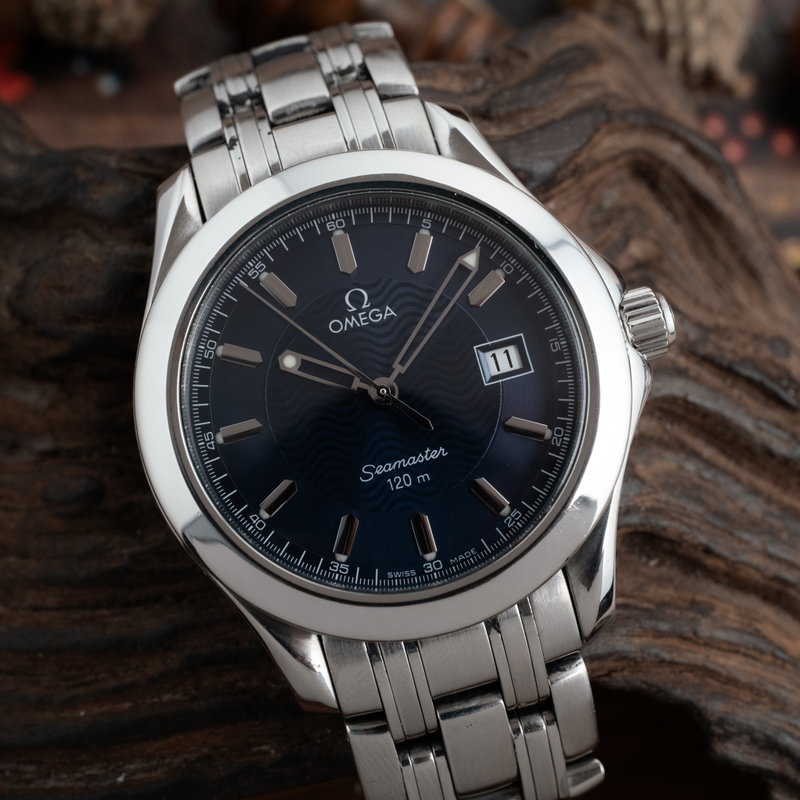
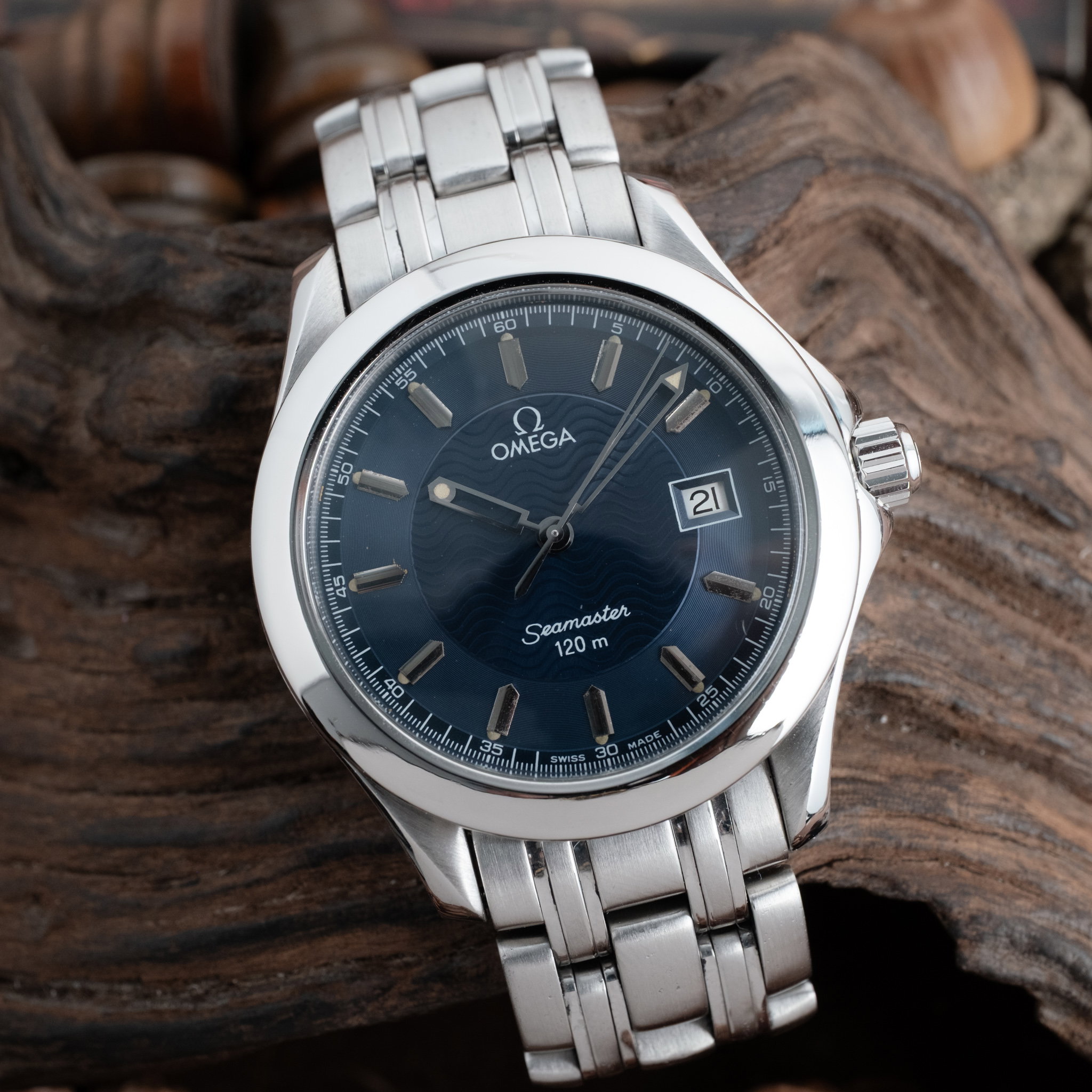
The Omega Seamaster 120M reference 196 1501 / 396 1501 belongs to the 1990s, when quartz accuracy, a steel sports case and a signed multi-link bracelet made the watch practical for daily use. The 38 mm case gives the blue or silver wave dial enough room for clear applied indices and luminous skeleton hands.
Two quartz movements occur in watches we have handled: caliber 1438 and caliber 1538. That distinction matters less than a clean movement, a coherent dial and hand set, and matching identification where it can be established. On a used Omega Seamaster 196 1501 / 396 1501, the wave dial carries more of the reference's character than a polished case ever can.
Reference
196 1501 / 396 1501
Model
Seamaster 120M
Production period represented
1990s, including examples dated 1995
Case diameter
38 mm excluding the crown
| Case material | Stainless steel |
| Movement type | Quartz |
| Known calibers | Omega 1438 and Omega 1538 |
| Caliber 1538 jewel count | 6 jewels |
| Known dial configurations | Blue or silver wave pattern |
| Hand style | Luminous skeleton hands |
| Bracelet | Signed multi-link stainless steel bracelet |
What it was built for
The Seamaster 120M combined quartz timekeeping with a 38 mm stainless steel case, luminous applied indices and luminous skeleton hands. Blue and silver wave dials provide strong contrast, while the signed multi-link steel bracelet keeps the watch in its intended sports-watch form. A loose replacement strap removes one of the reference's most specific components.
Calibers 1438 and 1538 both occur within this reference, so movement number alone does not settle the watch's quality. Caliber 1538 is recorded with 6 jewels, while no jewel count is established here for caliber 1438. The service history of most surviving examples is unknown, and without dated paperwork the movement's condition should carry more weight than a service claim.
Where the value sits
The largest spread sits between a clean wave dial and one with moisture spotting, damaged printing or mismatched luminous material. Blue and silver are both established configurations, so colour is a buying choice rather than an authenticity hierarchy. Take the cleaner dial, especially when the applied indices, skeleton hands and lume remain visually coherent.
A signed multi-link bracelet adds meaningful completeness because replacing it with a generic bracelet changes the reference's proportions and clasp detail. Case quality follows: crisp lug geometry and distinct brushed and polished surfaces rank ahead of a brighter case with softened edges. Matching serial numbers on the case lug and movement strengthen one caliber 1438 example we handled, but that observation cannot be extended to every watch without direct inspection.
Where to start
Start with the dial, then choose the strongest case and bracelet combination available. A refinished wave dial costs more in lost appeal than ordinary surface scratches on the steel case, while rounded lugs cannot be corrected without removing still more metal. Between a bright polished watch and one with light scuffs but crisp geometry, the crisp case is the better purchase.
For a vintage Omega Seamaster 196 1501 / 396 1501 intended for regular wear, either established quartz caliber is defensible. The safer example has a clean battery compartment, sharp dial printing, intact hand and index lume, and a bracelet without excessive stretch. Water resistance is not established by the Seamaster 120M name alone, and no current pressure-test result is supplied here.
Dating this watch
| Serial range / caliber | Year | Note |
|---|---|---|
| 1000000 | 1895 | approximate, ±1-3 years |
| 2000000 | 1902 | approximate, ±1-3 years |
| 3000000 | 1908 | approximate, ±1-3 years |
| 4000000 | 1912 | approximate, ±1-3 years |
| 5000000 | 1916 | approximate, ±1-3 years |
| 6000000 | 1923 | approximate, ±1-3 years |
| 7000000 | 1929 | approximate, ±1-3 years |
| 8000000 | 1935 | approximate, ±1-3 years |
| 9000000 | 1939 | approximate, ±1-3 years |
| 10000000 | 1944 | approximate, ±1-3 years |
| 11000000 | 1947 | approximate, ±1-3 years |
| 12000000 | 1950 | approximate, ±1-3 years |
| 13500000 | 1952 | approximate, ±1-3 years |
| 14000000 | 1954 | approximate, ±1-3 years |
| 15000000 | 1956 | approximate, ±1-3 years |
| 16000000 | 1958 | approximate, ±1-3 years |
| 17000000 | 1960 | approximate, ±1-3 years |
| 18000000 | 1961 | approximate, ±1-3 years |
| 19000000 | 1962 | approximate, ±1-3 years |
| 20000000 | 1963 | approximate, ±1-3 years |
| 21000000 | 1964 | approximate, ±1-3 years |
| 22000000 | 1965 | approximate, ±1-3 years |
| 23000000 | 1966 | approximate, ±1-3 years |
| 25000000 | 1967 | approximate, ±1-3 years |
| 26000000 | 1968 | approximate, ±1-3 years |
| 28000000 | 1969 | approximate, ±1-3 years |
| 29000000 | 1970 | approximate, ±1-3 years |
| 33000000 | 1971 | approximate, ±1-3 years |
| 34000000 | 1972 | approximate, ±1-3 years |
| 36000000 | 1973 | approximate, ±1-3 years |
| 38000000 | 1974 | approximate, ±1-3 years |
| 39000000 | 1975 | approximate, ±1-3 years |
| 40000000 | 1977 | approximate, ±1-3 years |
| 41000000 | 1978 | approximate, ±1-3 years |
| 42000000 | 1979 | approximate, ±1-3 years |
| 44000000 | 1980 | approximate, ±1-3 years |
| 45000000 | 1982 | approximate, ±1-3 years |
| 46000000 | 1984 | approximate, ±1-3 years |
| 48000000 | 1985 | approximate, ±1-3 years |
| 49000000 | 1986 | approximate, ±1-3 years |
| 51000000 | 1989 | approximate, ±1-3 years |
| 53000000 | 1991 | approximate, ±1-3 years |
| 54000000 | 1993 | approximate, ±1-3 years |
| 55000000 | 1995 | approximate, ±1-3 years |
Dating data comes from our decoder tables; treat years as approximate.
What to check before you buy
- Dial and hand configuration: Known examples use a blue or silver wave-pattern dial with applied luminous indices and skeleton hands. Flat replacement dials, inconsistent furniture or mismatched luminous material require explanation rather than being treated as harmless variation.
- Quartz caliber: The reference is established with Omega quartz calibers 1438 and 1538, with caliber 1538 recorded at 6 jewels. A different movement number is not supported by the watches handled here and should not be accepted without further evidence.
- Case geometry and finishing: The 38 mm stainless steel case should retain clear lug geometry and distinguishable brushed and polished surfaces. Rounded lugs or blurred transitions diagnose metal removal, while light scratches alone are normal wear rather than an authenticity fault.
- Bracelet and clasp: Known watches use a signed multi-link stainless steel bracelet, and one blue-dial example has a gold-tone Omega clasp logo. Confirm that the bracelet construction and clasp signature agree with the watch rather than assuming any signed bracelet is correct.
- Serial consistency: One caliber 1438 watch had matching serial numbers on the case lug and movement, while 55 million serials align approximately with 1995 in the supplied table. This is supporting evidence only, since matching placement is not established for every surviving example.
Other 196 1501 / 396 1501 examples we auctioned
2 Omega 196 1501 / 396 1501 auctioned
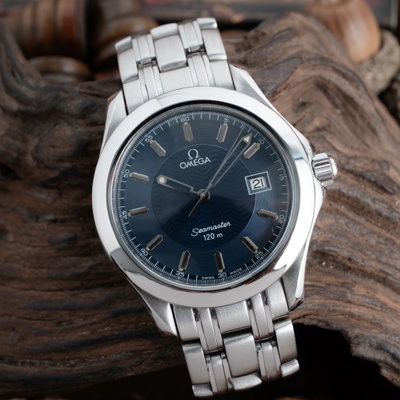
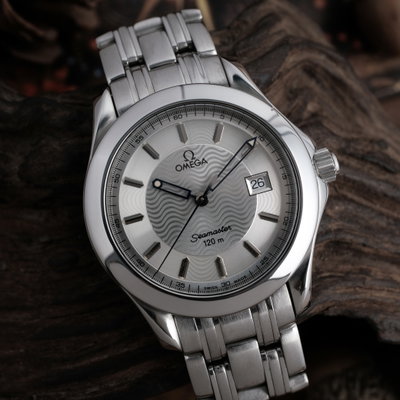
We auction more than 100 vintage watches a week.
Get first access: new Omega 196 1501 / 396 1501 drops and alerts before auctions end.
More Omega references
Related pages
Frequently asked questions
Ready to hunt for your own?
More than 100 vintage watches go under the hammer every week.