Omega Speedmaster 175.0043 / 375.0043 Reference Guide
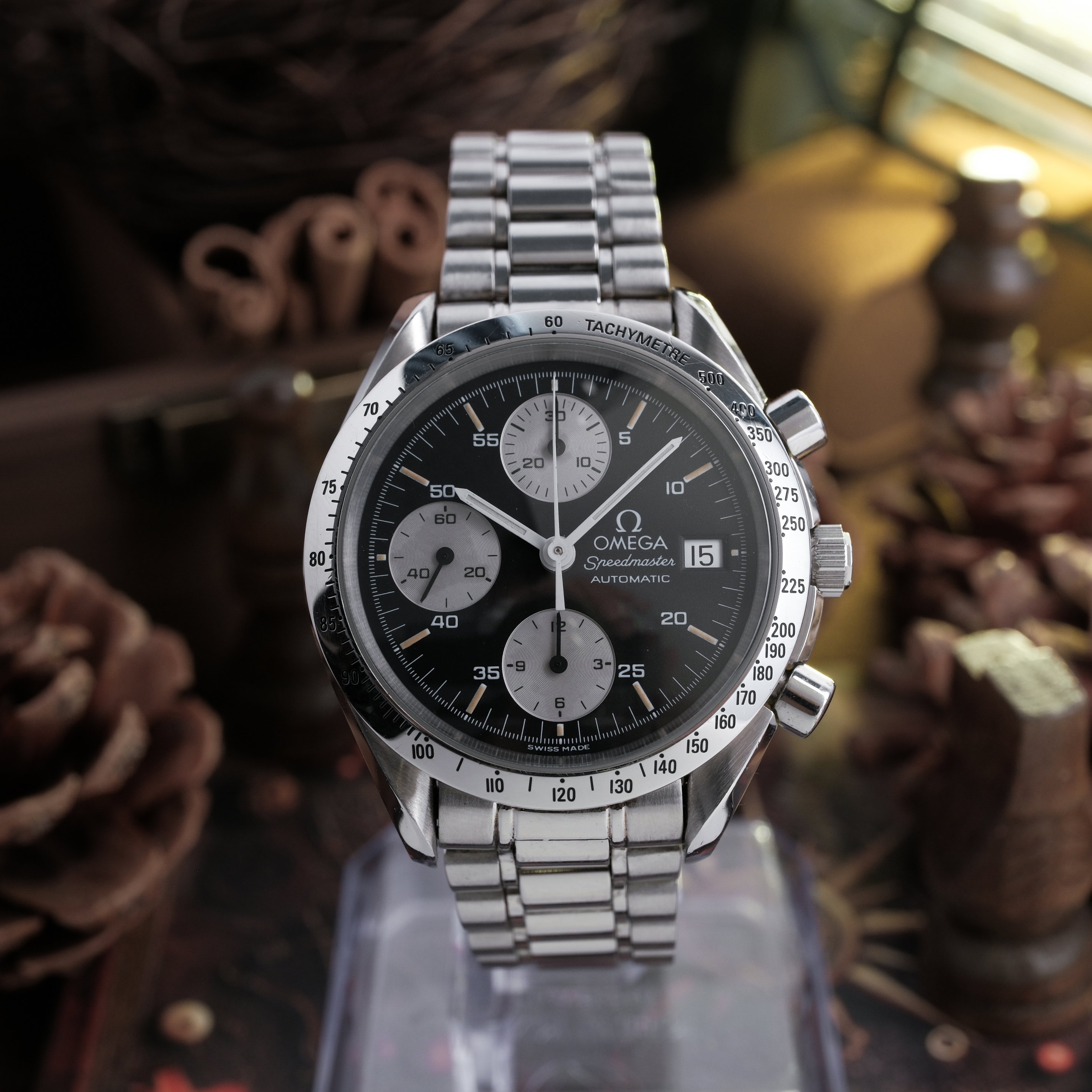
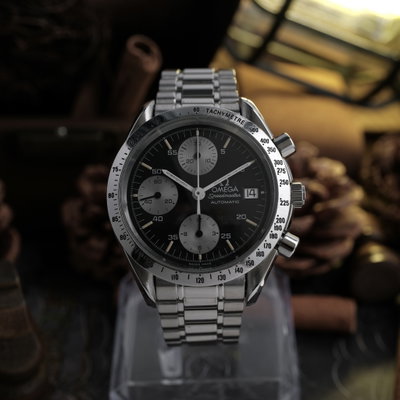
Buy this vintage Omega Speedmaster for its reverse-panda dial and automatic date layout, but prioritise an honest dial and sharp case over service claims.
We auction more than 100 vintage watches a week.
Get first access: new Omega 175.0043 / 375.0043 drops and alerts before auctions end.
Browse 63 live Omega auctionsThe Speedmaster 175.0043 / 375.0043 puts an automatic chronograph and date into a stainless-steel case measuring 38 to 39 mm without the crown. The black reverse-panda version, with silver concentric or guilloché sub-dials, is the clearest expression of the reference and the one to buy against the later deep-blue dial.
Examples handled from 1991 through 1998 carry either caliber 1155 or caliber 1152, so the movement number must agree with the rest of the watch rather than being assumed from the reference alone. A refinished dial costs more than softened case lines here: silver sub-dial texture, luminous plots and white baton hands dominate the face, and poor work has nowhere to hide.
Reference
175.0043 / 375.0043
Model
Omega Speedmaster
Known production years
1991-1998
Case material
Stainless steel
| Case diameter | 38-39 mm excluding the crown |
| Movement | Automatic chronograph |
| Recorded calibers | Omega caliber 1155 and Omega caliber 1152 |
| Dial configurations | Black reverse panda with silver textured sub-dials, or deep blue with concentric sub-dials |
| Date | Date complication, positioned at 3 o'clock on the black-dial examples |
What it was built for
This Speedmaster was built as an automatic date chronograph rather than a manual-wind exercise in period nostalgia. The date sits at 3 o'clock on the black-dial examples, while caliber 1155 removes daily winding from the routine. That combination makes the watch useful beyond timed events, although the service history of any individual example remains unknown without receipts.
At 38 to 39 mm excluding the crown, the case occupies less space than many later sports chronographs while retaining an asymmetrical profile and twisted lugs. The black dial remains legible because the silver registers separate elapsed time from the main display. Case thickness is not established by the watches handled, so cuff clearance should not be claimed from diameter alone.
Where the value sits
The premium belongs first to an honest dial, then to the case. On the reverse-panda version, intact black printing, textured silver sub-dials and evenly aged luminous plots matter more than a bright polish. The blue dial is a valid alternative seen in 1998 with an applied silver logo and concentric registers, but visible hand oxidation and scattered dial marks must be priced as damage rather than renamed patina.
Case wear is easier to judge and harder to reverse. Repeated polishing softens the twisted lugs and rounds the asymmetrical case profile, while ordinary wear leaves marks without erasing geometry. Replacement crowns, relumed hands and a movement transplanted from another watch can create a franken or married example even when every component is genuine Omega. Between a sharp case with an honest dial and a shinier redial, take the former.
Dating and serials
The handled production span runs from 1991 through 1998. Serial numbers in the 53 million range align approximately with 1991, 54 million with 1993 and 55 million with 1995, but Omega serial dating carries a margin of roughly one to three years. A serial estimate should support the watch's configuration, not overrule physical evidence.
Caliber 1155 is present in examples dated 1991 and 1993, while caliber 1152 is present in a 1998 example. That does not establish a precise changeover date, and the available evidence cannot support one. Jewel-count descriptions also conflict for caliber 1155, so the caliber engraving and movement architecture carry more weight than an unsupported listing specification.
Dating this watch
| Serial range / caliber | Year | Note |
|---|---|---|
| 1,000,000 | 1895 | approximate, ±1-3 years |
| 2,000,000 | 1902 | approximate, ±1-3 years |
| 3,000,000 | 1908 | approximate, ±1-3 years |
| 4,000,000 | 1912 | approximate, ±1-3 years |
| 5,000,000 | 1916 | approximate, ±1-3 years |
| 6,000,000 | 1923 | approximate, ±1-3 years |
| 7,000,000 | 1929 | approximate, ±1-3 years |
| 8,000,000 | 1935 | approximate, ±1-3 years |
| 9,000,000 | 1939 | approximate, ±1-3 years |
| 10,000,000 | 1944 | approximate, ±1-3 years |
| 11,000,000 | 1947 | approximate, ±1-3 years |
| 12,000,000 | 1950 | approximate, ±1-3 years |
| 13,500,000 | 1952 | approximate, ±1-3 years |
| 14,000,000 | 1954 | approximate, ±1-3 years |
| 15,000,000 | 1956 | approximate, ±1-3 years |
| 16,000,000 | 1958 | approximate, ±1-3 years |
| 17,000,000 | 1960 | approximate, ±1-3 years |
| 18,000,000 | 1961 | approximate, ±1-3 years |
| 19,000,000 | 1962 | approximate, ±1-3 years |
| 20,000,000 | 1963 | approximate, ±1-3 years |
| 21,000,000 | 1964 | approximate, ±1-3 years |
| 22,000,000 | 1965 | approximate, ±1-3 years |
| 23,000,000 | 1966 | approximate, ±1-3 years |
| 25,000,000 | 1967 | approximate, ±1-3 years |
| 26,000,000 | 1968 | approximate, ±1-3 years |
| 28,000,000 | 1969 | approximate, ±1-3 years |
| 29,000,000 | 1970 | approximate, ±1-3 years |
| 33,000,000 | 1971 | approximate, ±1-3 years |
| 34,000,000 | 1972 | approximate, ±1-3 years |
| 36,000,000 | 1973 | approximate, ±1-3 years |
| 38,000,000 | 1974 | approximate, ±1-3 years |
| 39,000,000 | 1975 | approximate, ±1-3 years |
| 40,000,000 | 1977 | approximate, ±1-3 years |
| 41,000,000 | 1978 | approximate, ±1-3 years |
| 42,000,000 | 1979 | approximate, ±1-3 years |
| 44,000,000 | 1980 | approximate, ±1-3 years |
| 45,000,000 | 1982 | approximate, ±1-3 years |
| 46,000,000 | 1984 | approximate, ±1-3 years |
| 48,000,000 | 1985 | approximate, ±1-3 years |
| 49,000,000 | 1986 | approximate, ±1-3 years |
| 51,000,000 | 1989 | approximate, ±1-3 years |
| 53,000,000 | 1991 | approximate, ±1-3 years |
| 54,000,000 | 1993 | approximate, ±1-3 years |
| 55,000,000 | 1995 | approximate, ±1-3 years |
Dating data comes from our decoder tables; treat years as approximate.
What to check before you buy
- Dial configuration: A black dial should carry contrasting silver textured sub-dials, while the handled 1998 alternative is deep blue with an applied silver logo and concentric registers. A mixed configuration needs evidence rather than assumption.
- Hands and luminous material: The black reverse-panda example uses white baton hour and minute hands with luminous inserts and creamy luminous indices. Mismatched ageing, fresh lume or hand oxidation must be disclosed and can indicate relume or replacement.
- Case geometry: The stainless-steel case has an asymmetrical outline and twisted lugs. Polishing first softens those lug transitions and rounds their edges, so crisp remaining geometry matters more than a uniformly bright surface.
- Movement and date: Handled watches contain automatic Omega caliber 1155 or 1152, and the reference includes a date complication. A different caliber, absent date mechanism or inconsistent movement-era combination raises the risk of a franken or married watch.
Other 175.0043 / 375.0043 examples we auctioned
4 Omega 175.0043 / 375.0043 auctioned
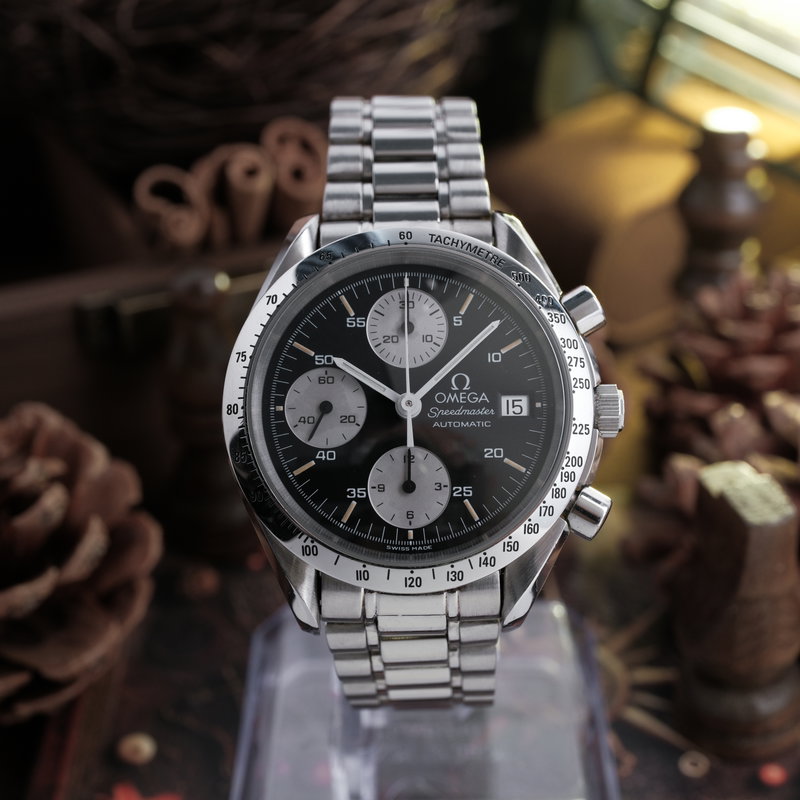
Omega · Speedmaster · 175.0043 / 375.0043 · 1993
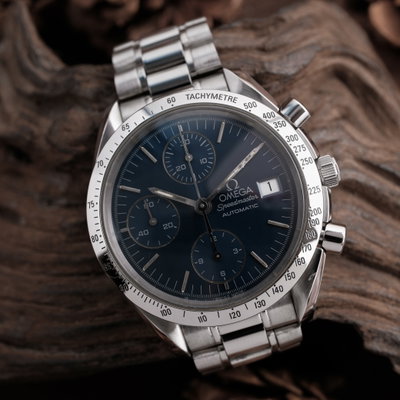
Omega · Speedmaster · 175.0043 / 375.0043 · 1998
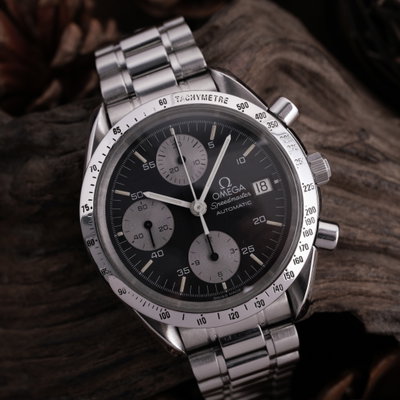
Omega · Speedmaster · 175.0043 / 375.0043 · 1991
Omega · Speedmaster · 175.0043 / 375.0043
More Omega references
Related pages
Frequently asked questions
Ready to hunt for your own?
More than 100 vintage watches go under the hammer every week.