Omega Constellation 168.044: A Buyer's Guide
The Omega Constellation 168.044 is a 1970s automatic chronometer whose value rests on its brushed silver dial, angular case and correct caliber 1001.
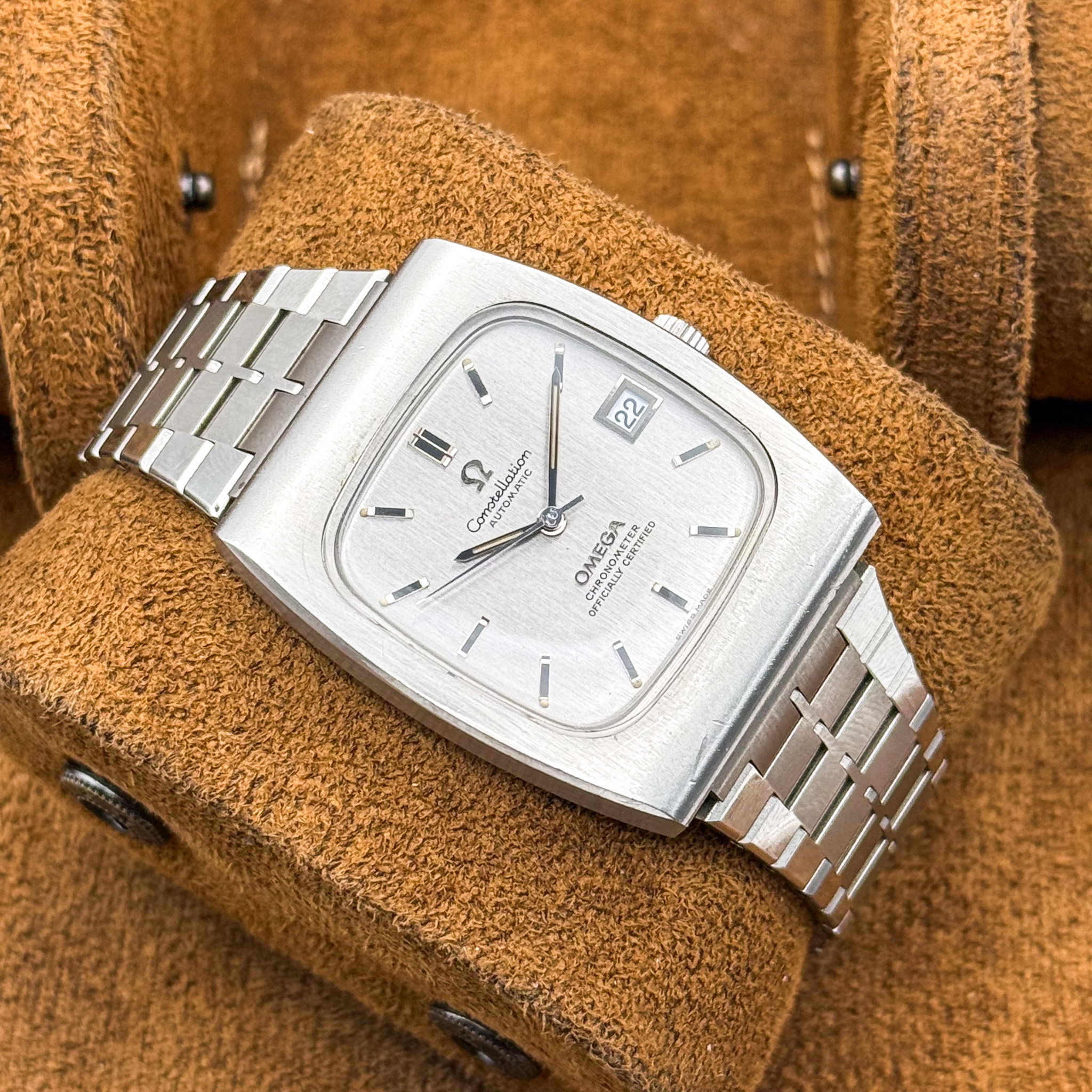
The Constellation 168.044 puts Omega's 1970s design shift into a compact, square-cushion case. Its automatic caliber 1001, framed date at three and silver vertically brushed dial make it a chronometer with a distinctly geometric face rather than a conventional round dress watch.
The version to want is the stainless-steel watch with a clean, correctly brushed dial and a well-fitted matching bracelet. Gold-plated examples offer the same caliber and 33 mm proportions, but wear through the plating cannot be reversed. On either version, dial spotting matters more than superficial case scratches because refinishing removes the vertical finish and changes the watch collectors are paying for.
Brand
Omega
Model
Constellation
Reference
168.044
Production period
1970s
| Case size | 33 mm excluding the crown |
| Case materials | Stainless steel or gold-plated with stainless-steel caseback |
| Movement | Automatic Omega caliber 1001 |
| Dial | Silver vertically brushed dial with applied black-inlaid indices |
| Date display | Framed window at three o'clock |
What it was built for
The 168.044 combines chronometer specification with the more angular case design Omega used during the 1970s. Caliber 1001 is automatic, while the framed date at three makes the watch practical for daily use. The square-cushion case and integrated-looking bracelet give it more visual weight than its dimensions suggest.
This is not a sports watch disguised as a dress watch. The silver vertically brushed dial, applied Omega logo, Constellation star and black-inlaid baton furniture keep the display formal, while the geometric case makes it unmistakably a 1970s Constellation. Water resistance cannot be assumed, and the service history of an individual watch is unknown unless receipts establish it.
The model landscape
The meaningful choice is between stainless steel and gold-plated cases with a stainless-steel caseback. Steel tolerates visible wear more honestly and leaves room for careful refinishing only when the original geometry remains. Gold plating introduces a permanent risk: once the coating wears through at the lugs or case edges, a routine service cannot return the factory surface.
Both versions use the same 33 mm case measurement excluding the crown, so the buying decision belongs elsewhere. Take the stronger dial and sharper case over the brighter watch. A matching bracelet adds the intended 1970s silhouette, but its fit and stretch must be judged separately from the head of the watch.
What goes wrong
Dial spotting is the first fault to price. It is visible on known silver vertically brushed dials, and refinishing is worse than honest marks because it can erase the directional grain, disturb the text and alter the relationship between the applied logo and Constellation star. A genuine service dial is different from a redial, but neither should be described as the original dial.
Cases lose information through polishing. On the square-cushion 168.044, softened transitions and rounded edges matter because the geometry supplies much of the watch's character. Gold-plated cases can wear through at exposed edges, and matching bracelets can develop stretch or poor end-link fit. Replacement crowns, swapped hands and a caliber other than 1001 also raise the risk of a franken or married watch.
The movement needs a competent mechanical assessment rather than a claim that it runs strongly. Caliber 1001 should be present, but caliber identity alone does not establish that the movement and case left the factory together. Without documentation, the service history and any past replacement of crowns, crystals, gaskets or movement parts remain unknown.
Dating this watch
| Serial range / caliber | Year | Note |
|---|---|---|
| 1,000,000 | 1895 | approximate, ±1-3 years |
| 2,000,000 | 1902 | approximate, ±1-3 years |
| 3,000,000 | 1908 | approximate, ±1-3 years |
| 4,000,000 | 1912 | approximate, ±1-3 years |
| 5,000,000 | 1916 | approximate, ±1-3 years |
| 6,000,000 | 1923 | approximate, ±1-3 years |
| 7,000,000 | 1929 | approximate, ±1-3 years |
| 8,000,000 | 1935 | approximate, ±1-3 years |
| 9,000,000 | 1939 | approximate, ±1-3 years |
| 10,000,000 | 1944 | approximate, ±1-3 years |
| 11,000,000 | 1947 | approximate, ±1-3 years |
| 12,000,000 | 1950 | approximate, ±1-3 years |
| 13,500,000 | 1952 | approximate, ±1-3 years |
| 14,000,000 | 1954 | approximate, ±1-3 years |
| 15,000,000 | 1956 | approximate, ±1-3 years |
| 16,000,000 | 1958 | approximate, ±1-3 years |
| 17,000,000 | 1960 | approximate, ±1-3 years |
| 18,000,000 | 1961 | approximate, ±1-3 years |
| 19,000,000 | 1962 | approximate, ±1-3 years |
| 20,000,000 | 1963 | approximate, ±1-3 years |
| 21,000,000 | 1964 | approximate, ±1-3 years |
| 22,000,000 | 1965 | approximate, ±1-3 years |
| 23,000,000 | 1966 | approximate, ±1-3 years |
| 25,000,000 | 1967 | approximate, ±1-3 years |
| 26,000,000 | 1968 | approximate, ±1-3 years |
| 28,000,000 | 1969 | approximate, ±1-3 years |
| 29,000,000 | 1970 | approximate, ±1-3 years |
| 33,000,000 | 1971 | approximate, ±1-3 years |
| 34,000,000 | 1972 | approximate, ±1-3 years |
| 36,000,000 | 1973 | approximate, ±1-3 years |
| 38,000,000 | 1974 | approximate, ±1-3 years |
| 39,000,000 | 1975 | approximate, ±1-3 years |
| 40,000,000 | 1977 | approximate, ±1-3 years |
| 41,000,000 | 1978 | approximate, ±1-3 years |
| 42,000,000 | 1979 | approximate, ±1-3 years |
| 44,000,000 | 1980 | approximate, ±1-3 years |
| 45,000,000 | 1982 | approximate, ±1-3 years |
| 46,000,000 | 1984 | approximate, ±1-3 years |
| 48,000,000 | 1985 | approximate, ±1-3 years |
| 49,000,000 | 1986 | approximate, ±1-3 years |
| 51,000,000 | 1989 | approximate, ±1-3 years |
| 53,000,000 | 1991 | approximate, ±1-3 years |
| 54,000,000 | 1993 | approximate, ±1-3 years |
| 55,000,000 | 1995 | approximate, ±1-3 years |
Dating data comes from our decoder tables; treat years as approximate.
What to check before you buy
- Dial and furniture: The silver dial should retain a vertical brushed finish, applied black-inlaid baton indices, an applied Omega logo, the Constellation star and a framed date at three. Flat paint or lost grain points toward refinishing.
- Hands: The hour and minute hands should carry black inlays that correspond with the black-inlaid baton indices. Mismatched furniture does not alone prove a fake, but it can identify a service replacement or franken assembly.
- Case construction: The 33 mm case should have a square-cushion form. Known configurations are stainless steel or gold-plated with a stainless-steel caseback, so any different material combination needs explanation rather than assumption.
- Movement: The movement should be the automatic Omega caliber 1001. The correct caliber is necessary but not sufficient, because a genuine movement can still be married to a case from another watch.
- Case and bracelet wear: Assess whether polishing has softened the square-cushion transitions and whether the matching bracelet has stretch or poor end-link fit. On gold-plated examples, exposed metal at the lugs or edges is permanent wear.
Other 168.044 examples we auctioned
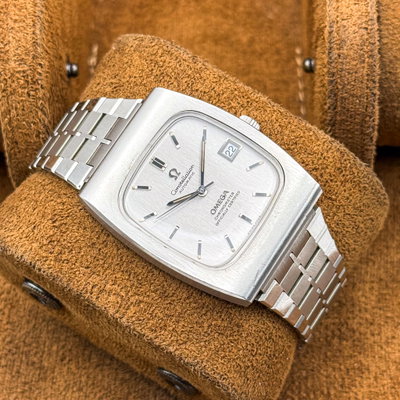
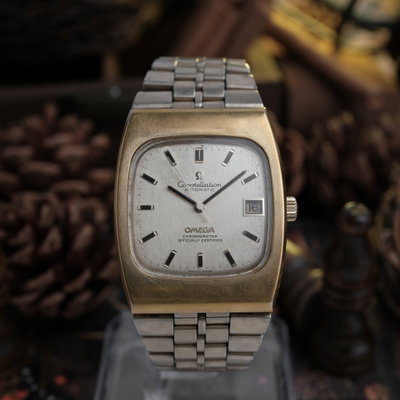
More Omega references
Related pages
Frequently asked questions
Ready to hunt for your own?
More than 100 vintage watches go under the hammer every week.