Omega Constellation 168.017 SP: C-Shape Case, Caliber 564
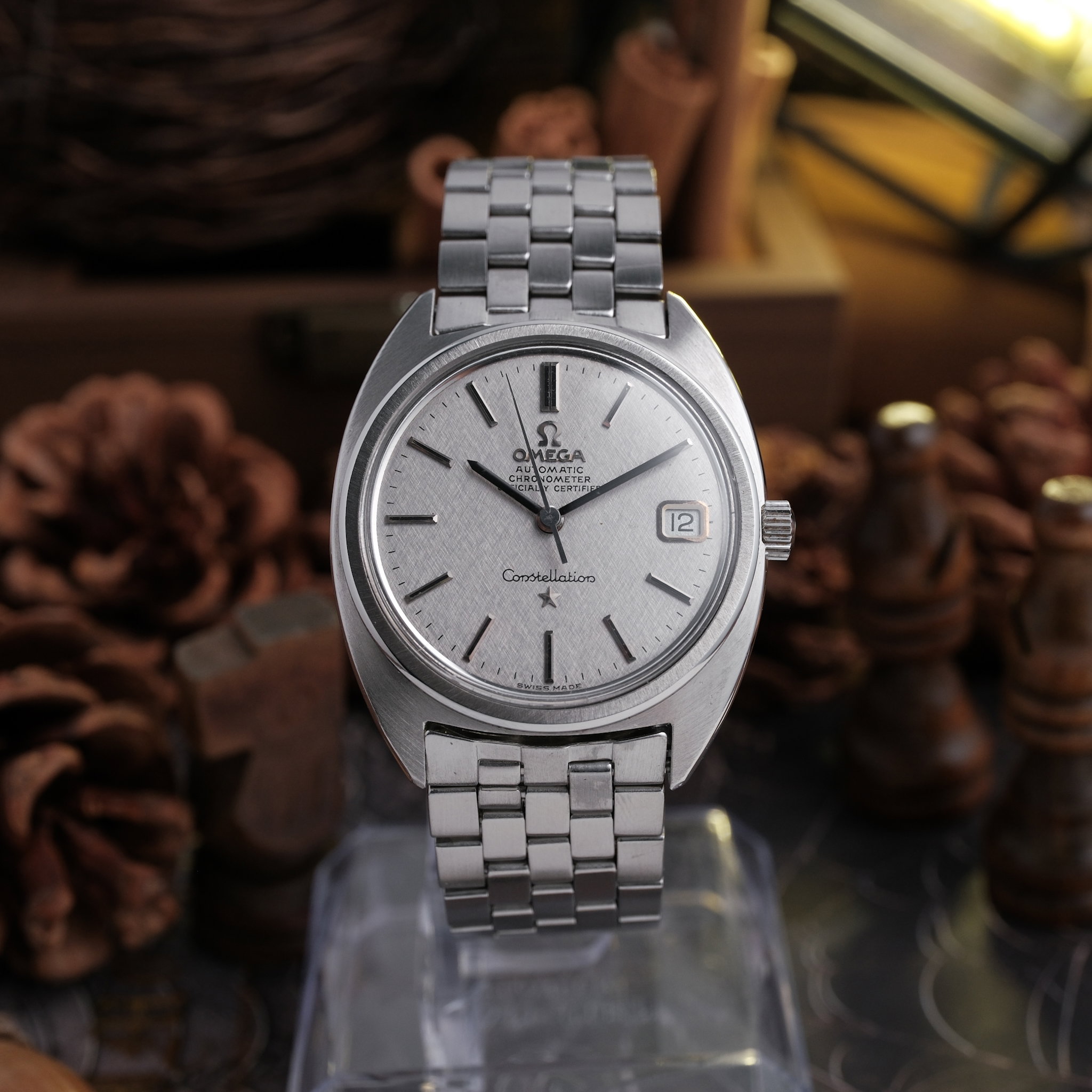
Buy the Omega 168.017 SP for its intact silver dial and defined C-shape case, not for polish, bracelet shine or an undocumented service claim.
We auction more than 100 vintage watches a week.
Get first access: new Omega 168.017 SP drops and alerts before auctions end.
Browse 52 live Omega auctionsThe Omega Constellation 168.017 SP belongs to a narrow 1968-1970 window and combines a stainless-steel C-shape case with the automatic chronometer caliber 564. It is a late-sixties dress watch with enough case architecture to feel less formal than earlier Constellation designs.
The version to want has a clean silver dial, a clearly defined case and the observatory medallion still legible on the back. Sunburst and linen-textured silver dials both occur among watches we have handled, while applied baton markers with dark inserts, an applied star and a framed date at three establish the reference's visual language.
Measured examples run from 34 mm to 36 mm excluding the crown, so the stated size needs checking against the individual watch rather than assumed from the reference alone. The broad C-shape outline gives the watch more wrist presence than the smallest measurement suggests.
Brand
Omega
Model
Constellation
Reference
168.017 SP
Known production years
1968-1970
| Case material | Stainless steel |
| Handled case sizes | 34 mm, 35 mm and 36 mm excluding the crown |
| Movement | Automatic chronometer caliber 564 |
| Jewels | 24 |
| Case form | C-shape |
| Known dial finishes | Silver sunburst and silver linen texture |
| Date position | Three o'clock |
What it was built for
The 168.017 SP was built as an automatic Constellation chronometer with a date display, not as a sports watch. Caliber 564 supplies the mechanical identity, while the framed date at three, applied Omega logo and Constellation star keep the dial formal. Stainless steel makes it easier to wear regularly than a plated case because there is no surface layer to wear through at the lug edges.
Its C-shape case places the design firmly in 1968-1970. Broad case flanks visually connect the lugs, while baton hands and dark-insert hour markers sharpen contrast against the silver surface. The result works under a cuff, but its case outline is more assertive than the restrained dial furniture.
Where the value sits
The dial carries the premium. A clean silver sunburst or linen-textured dial is worth taking over a brighter-looking redial because refinishing removes the surface and printing that distinguish these versions. Between comparable examples, buy the dial first, then the case, and treat a bracelet as a secondary benefit unless its fit and condition are established.
Case definition creates the next spread. Repeated polishing softens the transitions around the C-shape flanks and can blur the observatory medallion on the caseback, neither of which a service reverses. Of the examples we have photographed, the strongest watches combine intact dial texture with clear case geometry rather than relying on shine.
The worst fault is a refinished dial, followed by a heavily softened case. Other risks include replaced crowns, stretched bracelets and a franken assembly combining period-correct Omega parts that did not leave the factory together. The service history is unknown unless paperwork establishes it, and a timegrapher result alone does not prove a full service.
Dating and serials
Known 168.017 SP examples place the reference from 1968 through 1970. Serial ranges can support that assessment only approximately, with a tolerance of one to three years, so the movement number should agree with the case reference, caliber 564 and the watch's overall configuration rather than carry the conclusion alone.
The dating table is broad Omega guidance, not a reference-specific production ledger. It does not establish the exact assembly date of an individual Constellation, and it cannot prove that its case and movement began life together. Without supporting documentation, we prefer not to narrow a watch beyond what its movement, case and dial collectively establish.
Dating this watch
| Serial range / caliber | Year | Note |
|---|---|---|
| 1000000 | 1902 | approximate, ±1-3 years |
| 2000000 | 1908 | approximate, ±1-3 years |
| 3000000 | 1912 | approximate, ±1-3 years |
| 4000000 | 1916 | approximate, ±1-3 years |
| 5000000 | 1923 | approximate, ±1-3 years |
| 6000000 | 1925 | approximate, ±1-3 years |
| 7000000 | 1929 | approximate, ±1-3 years |
| 8000000 | 1935 | approximate, ±1-3 years |
| 9000000 | 1939 | approximate, ±1-3 years |
| 10000000 | 1944 | approximate, ±1-3 years |
| 11000000 | 1947 | approximate, ±1-3 years |
| 12000000 | 1950 | approximate, ±1-3 years |
| 13000000 | 1952 | approximate, ±1-3 years |
| 14000000 | 1954 | approximate, ±1-3 years |
| 15000000 | 1956 | approximate, ±1-3 years |
| 16000000 | 1958 | approximate, ±1-3 years |
| 17000000 | 1960 | approximate, ±1-3 years |
| 18000000 | 1961 | approximate, ±1-3 years |
| 19000000 | 1962 | approximate, ±1-3 years |
| 20000000 | 1963 | approximate, ±1-3 years |
| 21000000 | 1964 | approximate, ±1-3 years |
| 22000000 | 1965 | approximate, ±1-3 years |
| 24000000 | 1966 | approximate, ±1-3 years |
| 25000000 | 1967 | approximate, ±1-3 years |
| 26000000 | 1968 | approximate, ±1-3 years |
| 28000000 | 1969 | approximate, ±1-3 years |
| 31000000 | 1970 | approximate, ±1-3 years |
| 32000000 | 1971 | approximate, ±1-3 years |
| 33000000 | 1972 | approximate, ±1-3 years |
| 35000000 | 1973 | approximate, ±1-3 years |
| 37000000 | 1974 | approximate, ±1-3 years |
| 39000000 | 1975 | approximate, ±1-3 years |
| 40000000 | 1976 | approximate, ±1-3 years |
| 41000000 | 1977 | approximate, ±1-3 years |
| 42000000 | 1978 | approximate, ±1-3 years |
| 43000000 | 1979 | approximate, ±1-3 years |
| 44000000 | 1980 | approximate, ±1-3 years |
| 45000000 | 1982 | approximate, ±1-3 years |
| 46000000 | 1984 | approximate, ±1-3 years |
| 47000000 | 1985 | approximate, ±1-3 years |
| 48000000 | 1986 | approximate, ±1-3 years |
| 49000000 | 1988 | approximate, ±1-3 years |
| 50000000 | 1990 | approximate, ±1-3 years |
| 53000000 | 1993 | approximate, ±1-3 years |
| 54000000 | 1995 | approximate, ±1-3 years |
| 56000000 | 1996 | approximate, ±1-3 years |
| 58000000 | 1998 | approximate, ±1-3 years |
| 60000000 | 2000 | approximate, ±1-3 years |
Dating data comes from our decoder tables; treat years as approximate.
What to check before you buy
- Dial configuration: A known 168.017 SP silver dial has applied baton indices with dark inserts, an applied Omega logo, the Constellation star and a framed date at three. Flat texture, blurred printing or misplaced furniture supports a redial diagnosis.
- Hands and date display: Baton hands with dark inserts should form a coherent set with the applied markers, while the date sits inside an applied frame at three. Period-correct replacements remain possible, so matching style does not by itself prove originality.
- Case and caseback: The stainless-steel C-shape case should retain defined transitions across its broad flanks, and the observatory medallion should remain readable. Soft contours or a weak medallion indicate metal loss from polishing rather than normal patina.
- Movement and reference pairing: The movement should be the automatic chronometer caliber 564, paired with a case signed 168.017 SP. A correct movement installed in a different case is married, while unrelated period parts assembled together make a franken watch.
Other 168.017 SP examples we auctioned
5 Omega 168.017 SP auctioned
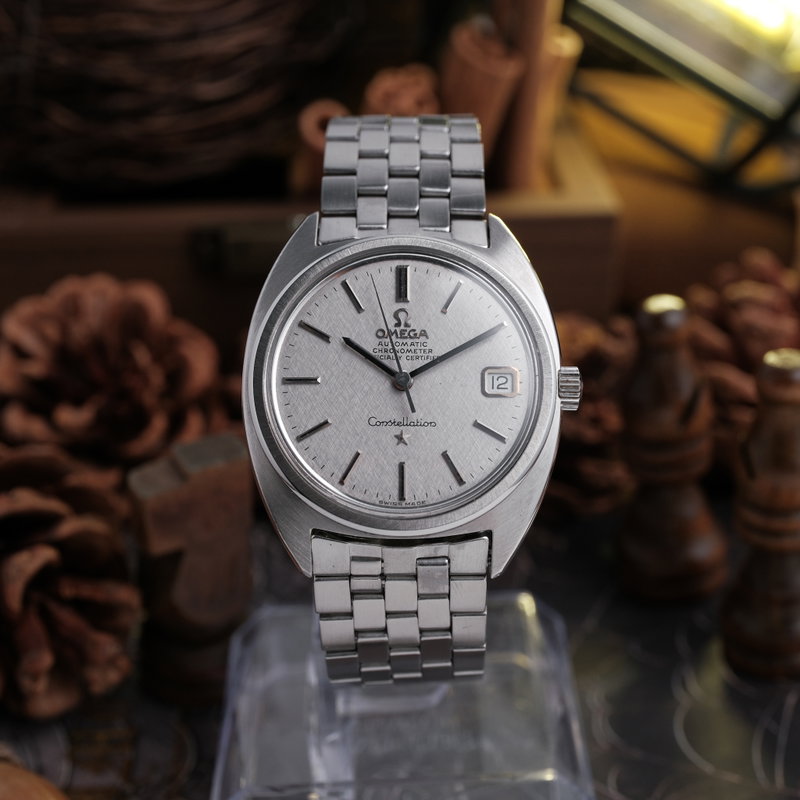
Omega · Constellation · 168.017 SP · 1969
Omega · Constellation · 168.017 SP · 1968
Omega · Constellation · 168.017 SP
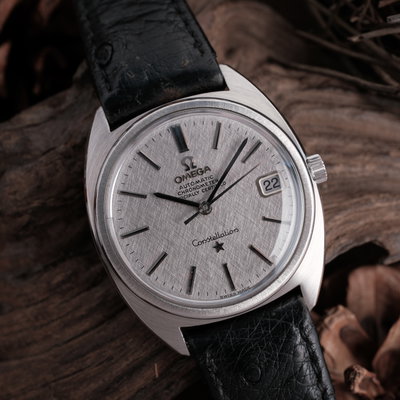
Omega · Constellation · 168.017 SP · 1970
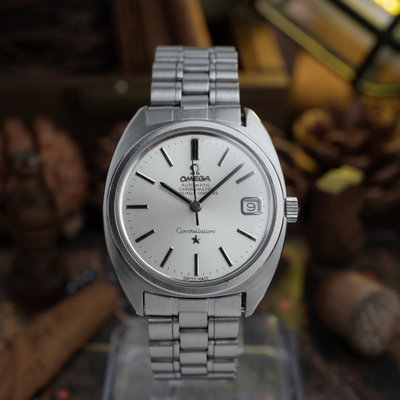
Omega · Constellation · 168.017 SP
More Omega references
Related pages
Frequently asked questions
Ready to hunt for your own?
More than 100 vintage watches go under the hammer every week.