Omega Constellation 167.005: What to Buy and What to Avoid
The Omega Constellation 167.005 is a compact 1962-1964 chronometer whose best buys pair an honest silver dial with defined dog-leg lugs and caliber 551.
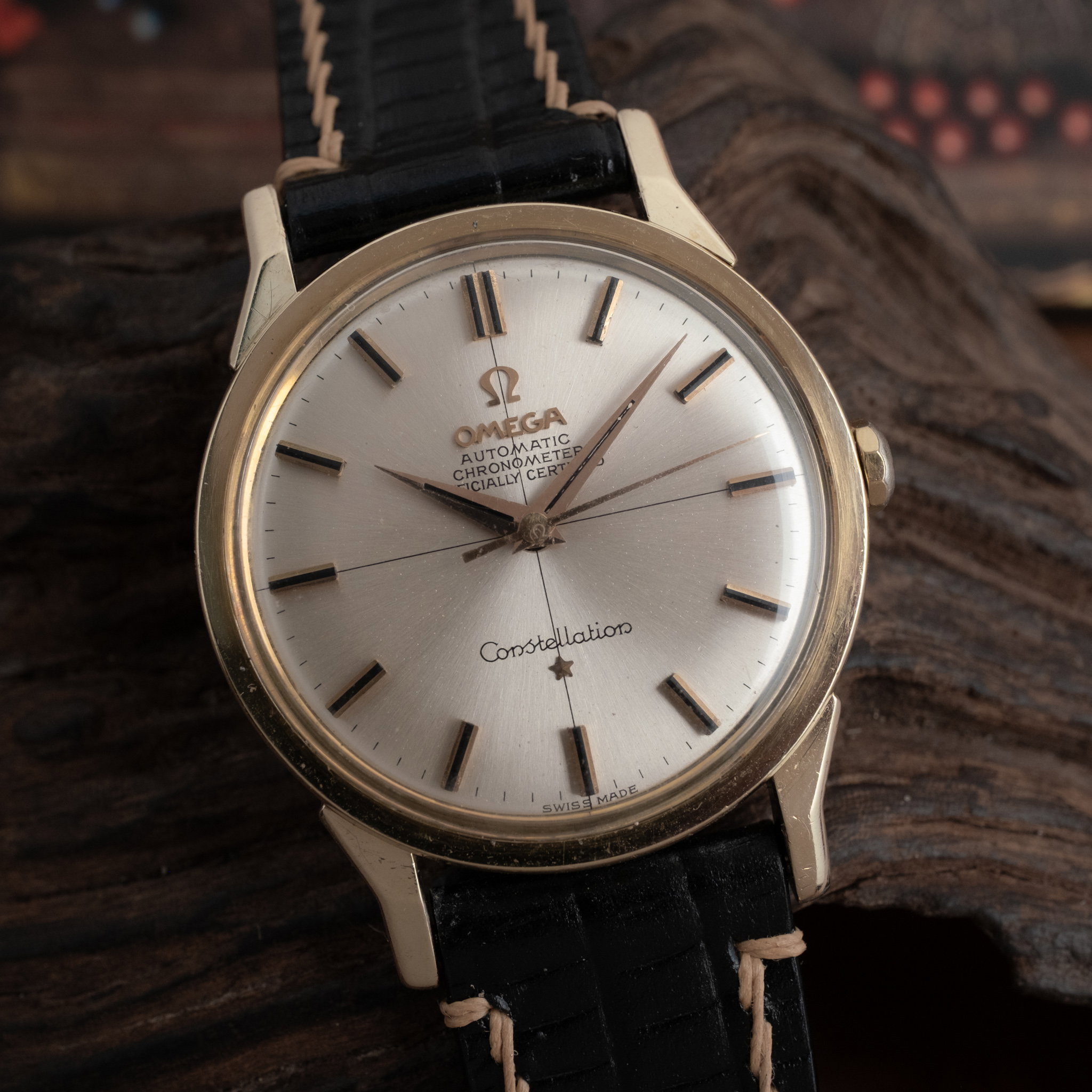
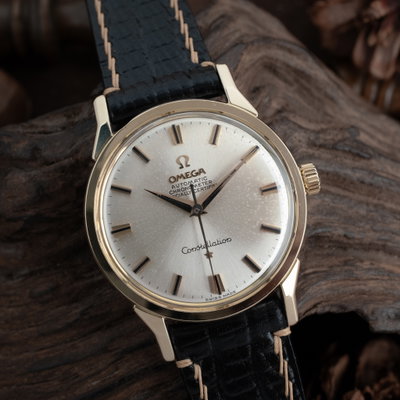
The Constellation 167.005 condenses early 1960s Omega into a 34 mm chronometer with dog-leg lugs, a gold observatory medallion and caliber 551. Examples dated from 1962 to 1964 establish the useful buying window, while the compact case gives the watch a distinctly period-correct presence.
Silver dials occur in pie-pan, crosshair and sunburst forms, so a flat rule that every 167.005 needs the same dial would be wrong. The strongest purchase is the watch whose dial, hands, case and movement make a coherent period combination, with visible damage and later intervention priced honestly.
Reference
167.005
Model
Constellation
Known production years
1962-1964
Case diameter
34 mm excluding the crown
| Movement | Automatic caliber 551 |
| Jewel count | 24 jewels |
| Case forms handled | Stainless steel and gold-tone with stainless steel caseback |
| Established dial forms | Silver pie-pan, crosshair and sunburst |
| Caseback detail | Gold observatory medallion |
| Bracelet seen | Beads of rice |
The model landscape
The pie-pan dial creates the most architectural version of the 167.005, especially with a crosshair and applied faceted indices. A silver sunburst dial is also established within the reference and gives a quieter result. Between a clean sunburst watch and a heavily spotted pie-pan at the same premium, take the sunburst unless the pie-pan ageing is unusually even.
Case material changes the character more than the dimensions. Stainless steel examples keep the dog-leg geometry visually clear, while gold-tone cases place more emphasis on surface wear and the junction with the stainless steel caseback. A beads of rice bracelet is period-appropriate on handled examples, but its fit and stretch still need judging separately from the head.
What goes wrong
Heavy dial spotting is the first financial warning. It can cover the whole surface or collect along the left outer edge, and intact applied furniture does not cancel that damage. A redial may look cleaner, but altered printing or an incorrect finish removes more confidence than honest, bounded ageing; a genuine service dial is a different category and should be described as such.
The hands can oxidise and lose surface finish, while polishing can soften the dog-leg case lines that define this reference. Beads of rice bracelets can develop stretch, and a replacement crown may remove the scalloped signed detail found on a period example. Service history is often unknown, so timing figures from one test do not establish overhaul history or future performance.
Where to start
Start with a steel 167.005 carrying an honest silver dial, clearly defined dog-leg lugs and the caliber 551 movement. Choose dial condition before chasing the pie-pan premium, and choose coherent components before paying extra for a bracelet. The 34 mm case suits a collector who wants a true early 1960s dress watch rather than modern wrist coverage.
A gold-tone example can be the better buy when its surface remains consistent and the dial is materially stronger than a steel alternative. Avoid paying the same spread for plating wear, heavy spotting or softened lugs. Without documentation, do not infer service history from a clean movement or a favourable timegrapher reading.
Dating this watch
| Serial range / caliber | Year | Note |
|---|---|---|
| 1000000 | 1902 | approximate, ±1-3 years |
| 2000000 | 1908 | approximate, ±1-3 years |
| 3000000 | 1912 | approximate, ±1-3 years |
| 4000000 | 1916 | approximate, ±1-3 years |
| 5000000 | 1923 | approximate, ±1-3 years |
| 6000000 | 1925 | approximate, ±1-3 years |
| 7000000 | 1929 | approximate, ±1-3 years |
| 8000000 | 1935 | approximate, ±1-3 years |
| 9000000 | 1939 | approximate, ±1-3 years |
| 10000000 | 1944 | approximate, ±1-3 years |
| 11000000 | 1947 | approximate, ±1-3 years |
| 12000000 | 1950 | approximate, ±1-3 years |
| 13000000 | 1952 | approximate, ±1-3 years |
| 14000000 | 1954 | approximate, ±1-3 years |
| 15000000 | 1956 | approximate, ±1-3 years |
| 16000000 | 1958 | approximate, ±1-3 years |
| 17000000 | 1960 | approximate, ±1-3 years |
| 18000000 | 1961 | approximate, ±1-3 years |
| 19000000 | 1962 | approximate, ±1-3 years |
| 20000000 | 1963 | approximate, ±1-3 years |
| 21000000 | 1964 | approximate, ±1-3 years |
| 22000000 | 1965 | approximate, ±1-3 years |
| 24000000 | 1966 | approximate, ±1-3 years |
| 25000000 | 1967 | approximate, ±1-3 years |
| 26000000 | 1968 | approximate, ±1-3 years |
| 28000000 | 1969 | approximate, ±1-3 years |
| 31000000 | 1970 | approximate, ±1-3 years |
| 32000000 | 1971 | approximate, ±1-3 years |
| 33000000 | 1972 | approximate, ±1-3 years |
| 35000000 | 1973 | approximate, ±1-3 years |
| 37000000 | 1974 | approximate, ±1-3 years |
| 39000000 | 1975 | approximate, ±1-3 years |
| 40000000 | 1976 | approximate, ±1-3 years |
| 41000000 | 1977 | approximate, ±1-3 years |
| 42000000 | 1978 | approximate, ±1-3 years |
| 43000000 | 1979 | approximate, ±1-3 years |
| 44000000 | 1980 | approximate, ±1-3 years |
| 45000000 | 1982 | approximate, ±1-3 years |
| 46000000 | 1984 | approximate, ±1-3 years |
| 47000000 | 1985 | approximate, ±1-3 years |
| 48000000 | 1986 | approximate, ±1-3 years |
| 49000000 | 1988 | approximate, ±1-3 years |
| 50000000 | 1990 | approximate, ±1-3 years |
| 53000000 | 1993 | approximate, ±1-3 years |
| 54000000 | 1995 | approximate, ±1-3 years |
| 56000000 | 1996 | approximate, ±1-3 years |
| 58000000 | 1998 | approximate, ±1-3 years |
| 60000000 | 2000 | approximate, ±1-3 years |
Dating data comes from our decoder tables; treat years as approximate.
What to check before you buy
- Reference configuration: A 167.005 should be assessed as a complete configuration: 34 mm case, dog-leg lugs, caliber 551 and an observatory medallion caseback. One matching part cannot authenticate the rest.
- Dial execution: Silver pie-pan, crosshair and sunburst dials are established for this reference. Printing must be judged against the claimed finish, while heavy spotting is damage rather than proof that a dial is untouched.
- Case geometry: The dog-leg lugs should retain clear changes of plane and defined edges. Rounded, mushy transitions point to polishing, and no later refinishing can return metal already removed.
- Movement coherence: Caliber 551 is established in 1962-1964 examples of the 167.005. A different movement requires explanation, while the right caliber alone does not exclude a married case and movement.
- External components: A gold observatory medallion belongs on the caseback, and a signed scalloped crown occurs on a period example. A changed crown or bracelet should be disclosed without automatically labelling the whole watch franken.
Other 167.005 examples we auctioned
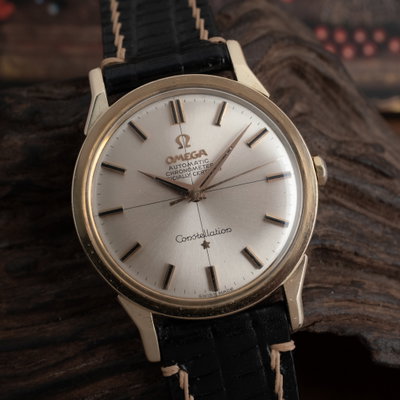
Omega · Constellation · 167.005 · 1962
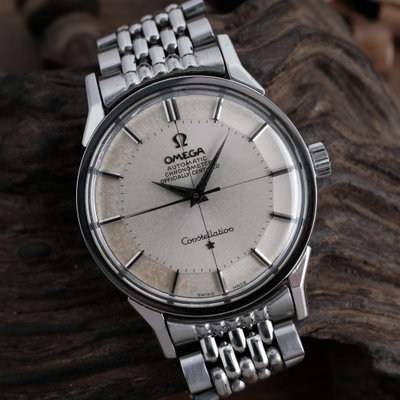
Omega · Constellation · 167.005 · 1963
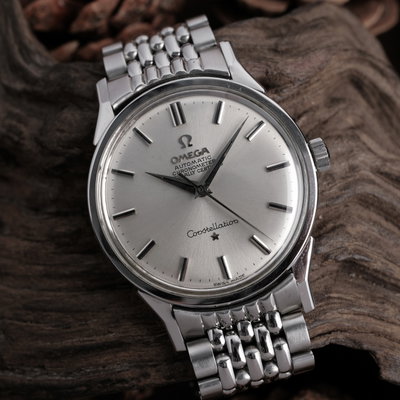
Omega · Constellation · 167.005 · 1964
Omega · Constellation · 167.005 · 1963
More Omega references
Related pages
Frequently asked questions
Ready to hunt for your own?
More than 100 vintage watches go under the hammer every week.