Seiko Crown J14091 - What to Know Before You Buy
The Seiko Crown J14091 is a 1963-1964 manual-wind dress watch whose value rests on its dial, correct caliber 560 and surviving gold plate.
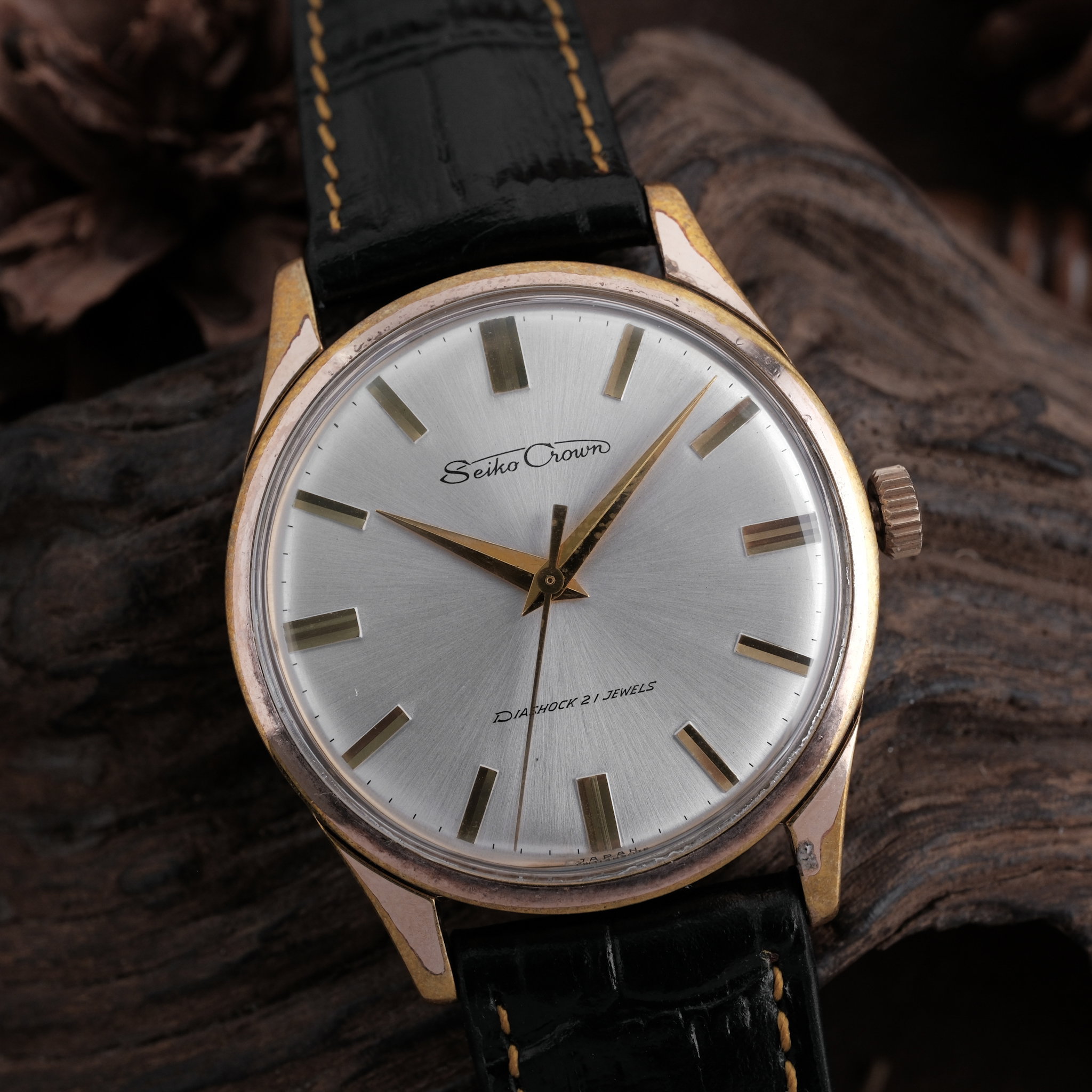
The Seiko Crown J14091 is a restrained manual-wind dress watch from 1963-1964, not a sports watch made to absorb careless wear. Its caliber 560, silver sunburst dial and gold-plated case place the emphasis on proportion and surface condition. The Crown shown in the gallery also exposes the key ownership trade-off: daily winding is simple, but worn plating cannot be returned by routine servicing.
Examples measure 35 or 36 mm excluding the crown, so the J14091 wears with the compact proportions expected of an early 1960s dress watch. Applied gold-tone indices and dauphine hands keep the silver dial legible without making it look busy. Buy the cleanest honest dial and the sharpest plated case available, rather than accepting a redial or rounded lugs for a nominally brighter finish.
Reference
J14091
Model
Crown
Known production years
1963-1964
Movement
Seiko caliber 560, manual wind
| Jewel count | 21 jewels |
| Case diameter | 35-36 mm excluding the crown |
| Case finish | Gold-plated; one handled example described as EGP 20 microns |
| Dial | Silver sunburst with applied gold-tone indices |
| Hands | Gold-tone dauphine hands |
What it was built for
The J14091 was built as a hand-wound dress watch, with caliber 560 and 21 jewels beneath a silver sunburst dial. Its 35-36 mm case slips into formal use without the bulk of a later automatic watch, while the applied indices and dauphine hands remain clear in ordinary light. It is best treated accordingly: the gold-plated case is more vulnerable to visible wear than a solid steel case, particularly around the lugs and case edges.
Daily winding is part of owning this Crown, and the crown therefore matters mechanically as well as visually. A signed crown survives on at least one 1963 example, but the evidence does not establish that every J14091 left the factory with an identical crown. A replacement crown is not proof of a fake watch, although it lowers the appeal when compared with a correctly signed example in otherwise equal condition.
Where the value sits
The dial creates the widest spread between J14091 examples. A clean silver sunburst surface with crisp Crown and Diashock 21 Jewels printing deserves a premium over scattered spotting, but an even original dial remains preferable to a cosmetically cleaner redial. A refinished dial costs more in collector value than minor hand oxidation or a replaced crystal, because neither servicing nor polishing can recreate factory printing.
Gold plate is the second major variable. Wear-through at the lug tips or case edges exposes the base metal and no normal service reverses it; aggressive polishing only softens the lugs further. Across the J14091 examples we have handled, case descriptions include gold-plated construction and an EGP 20 microns marking, so the actual case marks should govern the assessment rather than an assumed universal specification.
Where to start
Choose a 1963-1964 J14091 with an honest silver sunburst dial, caliber 560 and coherent gold-tone furniture before prioritising the nominal case measurement. Between a clean 35 mm example and a 36 mm watch with a redial, the smaller watch is the stronger purchase. One millimetre changes wrist presence, but it does not recover lost factory printing.
Then rank faults by permanence. Dial refinishing, plate loss and rounded lugs cannot be corrected through routine mechanical work, while a scratched crystal or tired strap can be replaced. The service history of surviving examples is often unknown, and without documentation it is safer not to infer service quality from a favourable timegrapher reading alone. Buy the watch itself, then budget for inspection of the hand-wound movement.
What to check before you buy
- Dial surface and text: A correct configuration combines a silver sunburst surface with applied gold-tone indices and Crown and Diashock 21 Jewels text. Repainted lettering or a sunburst finish flattened by refinishing indicates a redial, not patina.
- Hands and dial furniture: Gold-tone dauphine hands should form a coherent set with the applied gold-tone indices. Different hand shapes, mismatched finishes or newly luminous hands on a non-luminous-looking dial warrant concern about later parts or a franken assembly.
- Movement identity: The movement should be the manual-wind Seiko caliber 560 with 21 jewels. A different caliber means the watch does not match the handled J14091 configuration and may be married or assembled from parts that never shipped together.
- Case plating and geometry: Assess plate loss at the lug tips and case edges before judging shine. Soft lugs or rounded edges indicate polishing, while exposed base metal is permanent wear; neither fault is corrected by routine servicing.
- Crown evidence: A signed crown is documented on a 1963 J14091, but it is supporting evidence rather than a standalone test. An unsigned replacement crown lowers coherence without automatically making the case, dial or movement false.
Other J14091 examples we auctioned
More Seiko references
Related pages
Frequently asked questions
Ready to hunt for your own?
More than 100 vintage watches go under the hammer every week.