Rado 11816 Golden Horse - variants, value and faults
Rado reference 11816 is a 1970s, 38 mm cushion-case automatic whose dial condition and correct model-specific caseback decide the purchase.
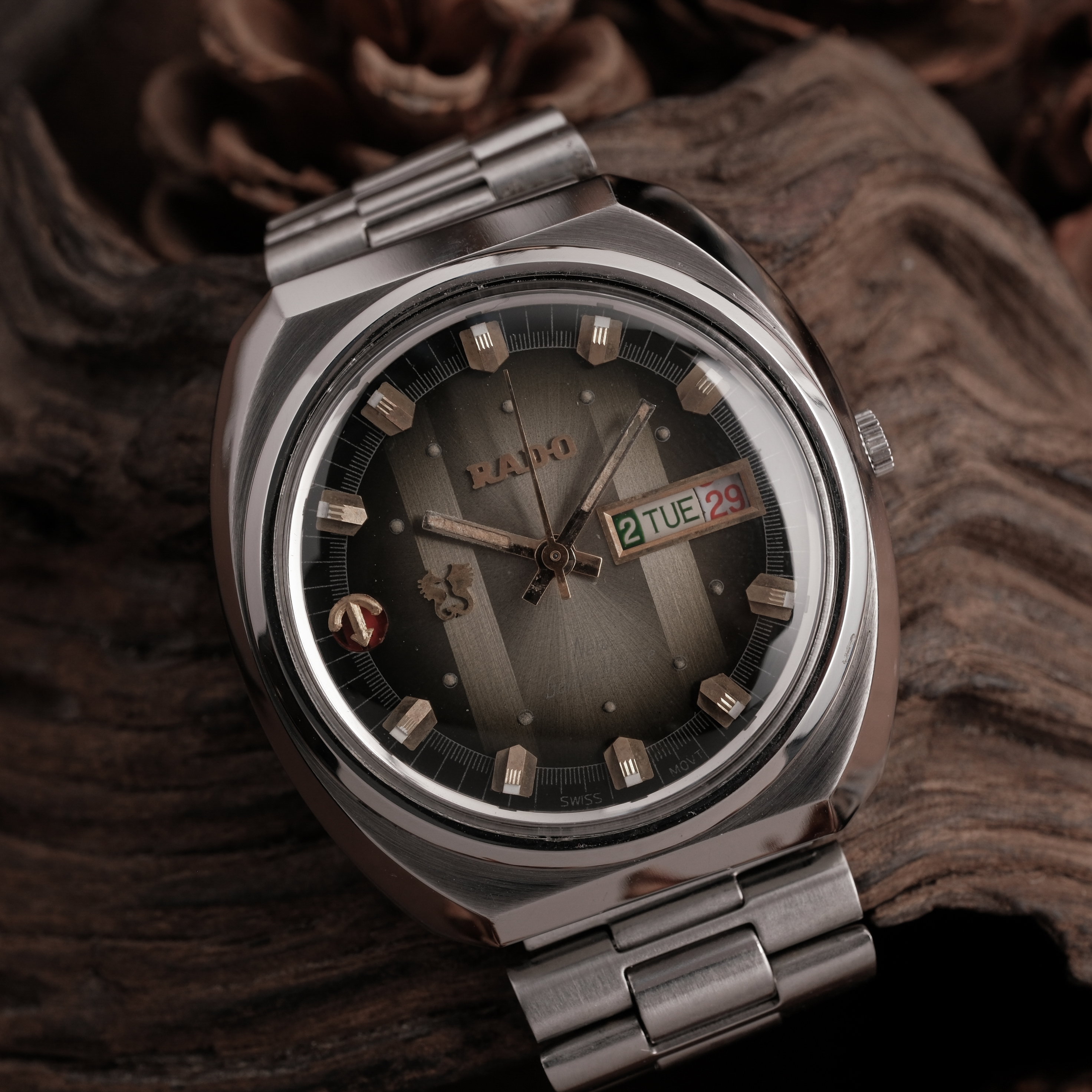
Rado reference 11816 belongs to the 1970s moment when a 38 mm cushion case, vertically worked dials and an automatic day-date movement made the watch feel deliberately modern. New Golden Horse examples make the design clearest: silver or olive and dark grey dials sit inside a broad case, with applied furniture, the rotating anchor and twin seahorses supplying the Rado identity.
The buying decision is less simple than the shared reference suggests. Reference 11816 is found with New Golden Horse, Green Horse and Golden Horse names, in stainless steel and gold-tone cases. The evidence does not establish whether every naming difference marks a factory-defined subtype, so the dial, caseback and movement must agree as a watch. A Green Horse with a Golden Horse caseback is not a harmless variation - it is a franken configuration.
Reference
11816
Production period
1970s
Movement
Automatic ETA caliber 2789
Jewel count
25 jewels
| Case size | 38 mm excluding the crown |
| Case form | Cushion case |
| Case materials | Stainless steel or gold-tone |
| Model names found | New Golden Horse, Green Horse and Golden Horse |
| Dial formats | Vertically brushed silver or vertical olive and dark grey two-tone |
| Calendar layout | Day-date, including a vertical display at 6 o'clock on the Green Horse configuration |
What it was built for
The 38 mm cushion case gives reference 11816 the broad stance associated with 1970s daily watches rather than an earlier, smaller dress format. An automatic ETA caliber 2789 drives the display, while the 25-jewel construction and day-date function make the watch more practical than its decorative dial treatment first suggests. On the Green Horse configuration, the day and date are arranged vertically at 6 o'clock.
The New Golden Horse is the clearest starting point because its visual identity is supported by several distinct but consistent dial treatments. A vertically brushed silver dial is quieter and exposes refinishing quickly; the olive and dark grey two-tone dial is more expressive but can carry conspicuous spotting. Stainless steel is the safer case choice against gold-tone, because worn plating at the lug edges cannot be recovered by routine servicing.
Where the value sits
The dial decides the spread within used Rado 11816 examples. A clean vertically brushed surface with coherent applied furniture deserves a premium over a spotted two-tone dial, even when the latter has the more unusual colour. Refinishing removes the original brushing and can flatten the contrast between the olive centre and dark grey edges, so a redial costs more than ordinary case wear.
Correct configuration comes next. A Green Horse dial paired with a Rado-signed Golden Horse caseback is assembled from components that did not belong together in that form, and the signed back does not rescue it. Between that franken watch and a more worn example whose model identity agrees across dial and caseback, take the coherent watch. The service history is unknown unless an invoice accompanies the individual watch.
What goes wrong
The most serious fault is a mismatched caseback because it changes the identity of the complete watch, not merely its cosmetic condition. Dial spotting across the olive and dark grey surface is permanent evidence of damage, while metal exposure on the rotating anchor removes colour from a focal detail. Gold-tone cases add another irreversible risk: plating can wear through around the lugs and case edges.
Cushion cases also lose their geometry when repeatedly polished. Rounded transitions and soft edges matter because the broad case supplies much of the reference's period character. On silver dials, uneven brushing, blurred model text or paint crossing onto applied furniture points toward a redial; on two-tone dials, an unnaturally uniform boundary can signal the same problem. A replacement crown may be period-correct, but that does not make it original.
What to check before you buy
- Movement identity: The movement should carry the ETA caliber 2789 designation and correspond to the stated 25-jewel specification. A different caliber requires an explanation and may indicate a replacement movement or a married watch.
- Green Horse caseback: A Green Horse configuration should not be accepted as coherent when it carries a Rado-signed Golden Horse caseback. The signature is genuine branding, but the model mismatch makes the complete watch franken.
- Silver dial surface: The silver New Golden Horse dial should retain a visible vertical brushing pattern. Uneven grain, paint-filled texture or blurred printing can indicate refinishing rather than honest surface wear.
- Two-tone dial boundaries: On the olive and dark grey New Golden Horse dial, the vertical colour division should remain structurally consistent even when spotting is present. Fresh paint, bleeding edges or lost texture are redial tells.
- Rotating anchor and applied furniture: The dial should carry the Rado rotating anchor and applied furniture appropriate to the shown configuration. Metal exposure on the anchor is damage, while mismatched metal tones or poorly seated parts can indicate later assembly.
- Case and crown limits: The 38 mm cushion case should retain defined transitions rather than rounded, mushy edges from polishing. No crown specification is established here, so a signed crown must not be used as proof that the watch remains original.
Other 11816 examples we auctioned
Related pages
Frequently asked questions
Ready to hunt for your own?
More than 100 vintage watches go under the hammer every week.