Rado Voyager 11814 - What to Know Before You Buy
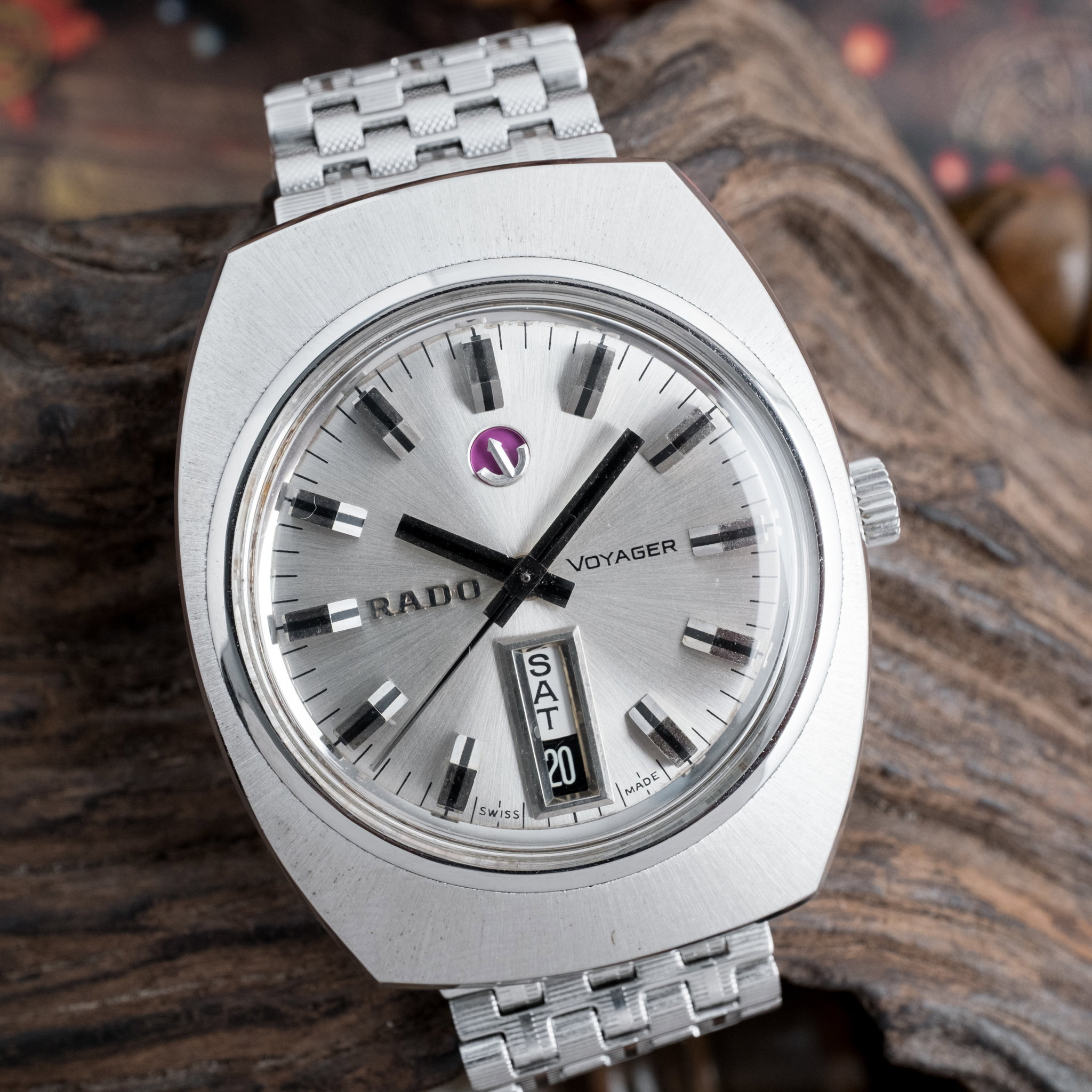
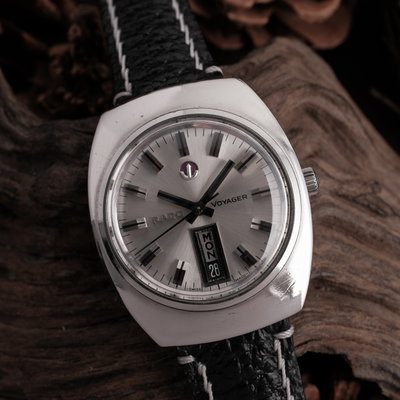
Rado Voyager reference 11814 is a 1970s steel automatic best bought with a clean dial, coherent vertical day-date display and intact cushion-case geometry.
We auction more than 100 vintage watches a week.
Get first access: new Rado 11814 drops and alerts before auctions end.
Browse 15 live Rado auctionsThe Voyager reference 11814 makes its case through one unusual decision: the day and date sit vertically at six o'clock. Combined with a stainless-steel cushion case and rotating anchor emblem, that layout places the watch firmly in Rado's 1970s design vocabulary without making it difficult to read.
The version to want is the cleanest coherent example, not automatically the most colourful one. Silver sunburst dials offer the clearest baseline, while grey and brown dials with fine concentric texture bring more visual variation. A refinished dial costs more in lost value than ordinary case wear, and moisture marks or spotting must be priced as damage rather than softened into patina.
Model
Voyager
Reference
11814
Production period
1970s
Case material
Stainless steel
| Case diameter | 35-36 mm excluding the crown |
| Movement type | Automatic |
| Known caliber | Rado-signed ETA caliber 2789 |
| Known jewel count | 25 jewels |
| Calendar | Vertical day and date at 6 o'clock |
| Known dial variants | Silver sunburst; grey and brown with fine concentric texture |
The model landscape
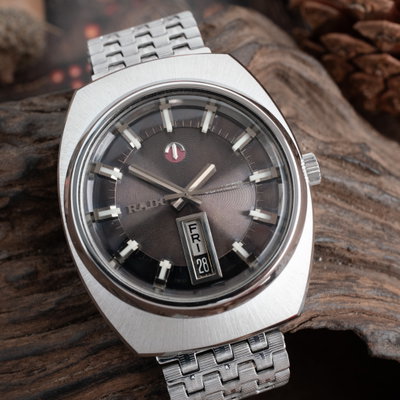
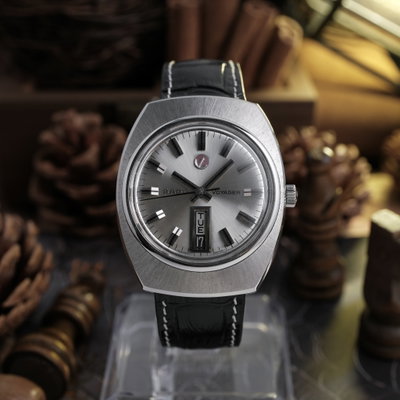
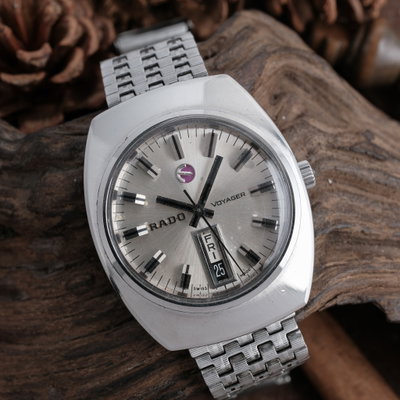
Reference 11814 is found with silver sunburst dials and with grey and brown dials carrying a fine concentric circular texture. Both use applied faceted indices, baton hands and the vertical calendar at six. The rotating Rado anchor adds movement near twelve, while the heavy calendar frame gives the lower half of the dial its weight.
Silver is the safer purchase against a damaged textured dial because its printing and surface are easier to compare across examples. The grey and brown configuration earns its premium only when the concentric finish remains clear and the colour is even. Brown alone is not evidence of a tropical dial, and this reference provides no basis for applying that term to its coloured variants.
On the wrist
Known steel examples measure 35-36 mm excluding the crown, but the cushion case carries more visual mass than a round case at the same diameter. Applied indices with contrasting inserts and straight baton hands keep the display legible, while the calendar frame makes six o'clock the visual anchor. This is a compact watch with a distinctly geometric face, not a small dress watch pretending to be neutral.
The one-millimetre spread matters less than the surviving case shape. Softened cushion edges make the watch look broader and flatter, whereas defined transitions preserve the architecture that gives the Voyager its character. Between a sharper 35 mm case and a heavily polished 36 mm case at the same level, take the smaller watch.
What goes wrong
Dial damage is the first financial fault. Silver examples can show spotting, moisture marks and broader surface wear, none of which should be described as patina when the marks are irregular. A redial is worse: altered printing or a recreated sunburst surface removes the factory dial that carries most of the watch's value.
Over-polishing softens the cushion-case transitions, and repeated abrasion can make the geometry look mushy. The calendar is another practical checkpoint: both day and date must align vertically in the framed aperture rather than sitting high, low or partly hidden. The service history is often unknown, so an attractive timegrapher reading cannot establish when the automatic movement was last dismantled or lubricated.
Hands, dial and movement must also make sense together. Known examples use baton hands with contrasting inserts, applied faceted markers and Rado-signed automatic movements, including ETA caliber 2789 in one handled watch. That does not prove every reference 11814 left the factory with that caliber, so without documentation we prefer not to turn one confirmed configuration into a universal rule.
What to check before you buy
- Dial layout and finish: Reference 11814 examples use a vertical day-date aperture at six with a substantial faceted frame. Silver sunburst and grey-brown concentric finishes are known; flat paint, weak printing or lost texture points toward a redial.
- Hands and hour furniture: Applied faceted indices and straight baton hands with contrasting inserts should read as one design. Mismatched lume treatment, unrelated hand shapes or uneven replacement furniture can indicate a franken assembly.
- Case geometry: The stainless-steel cushion case should retain defined transitions around its broad geometric outline. Soft, indistinct edges are evidence of polishing and reduce value even when the measured diameter remains within the known 35-36 mm range.
- Movement and calendar: A handled example carries a Rado-signed ETA caliber 2789 with 25 jewels, but that evidence does not establish one caliber for every 11814. Signing must be judged alongside clean vertical alignment of both calendar indications.
Other 11814 examples we auctioned
17 Rado 11814 auctioned

Rado · Voyager · 11814
Rado · Voyager · 11814
Rado · Voyager · 11814
Rado · Voyager · 11814
Rado · Voyager · 11814 · 1973
More Rado references
Related pages
Frequently asked questions
Ready to hunt for your own?
More than 100 vintage watches go under the hammer every week.