Vintage Rado Conway: Versions, Value and Buying Advice
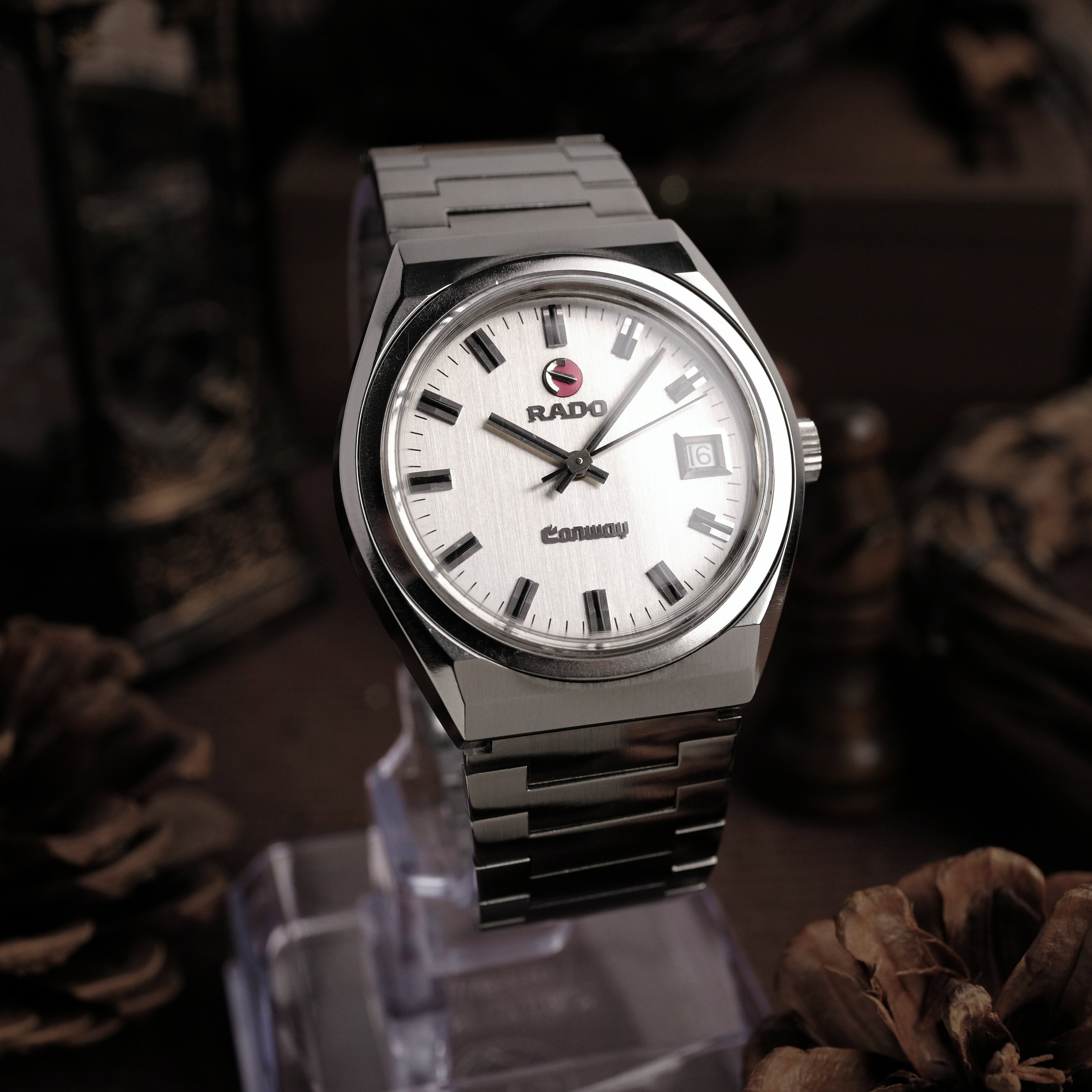
The vintage Rado Conway is a bold 1970s automatic best bought for its dial, sharp case geometry and correct movement rather than surface shine.
We auction more than 100 vintage watches a week.
Get first access: new Rado watch drops and alerts before auctions end.
Browse 31 live Rado auctionsConway examples span cushion and tonneau forms, while silver brushing, horizontal stripes and repeating anchor patterns make the dial the decisive feature.
The version to want is a steel Conway with crisp case lines and a clean, distinctive dial, not the brightest watch after polishing. A refinished dial costs more in lost appeal than ordinary case wear, while oxidation on the hands must be priced as damage rather than described as patina. The movement must also agree with the reference and display.
Production period documented
1970s
Case material documented
Stainless steel
Case sizes documented
35 mm, 36 mm and 37 mm excluding the crown
Movement type
Automatic
| Named calibers documented | ETA 2782, ETA 2783 and ETA 2789 |
| Documented jewel count | 17 jewels on ETA 2783 and ETA 2789 examples |
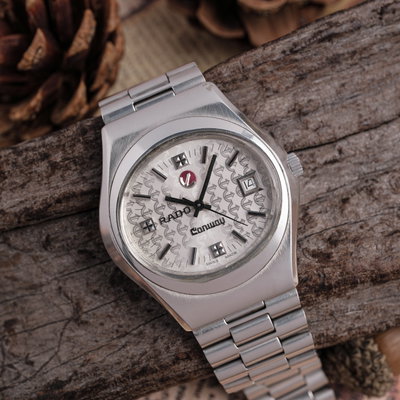
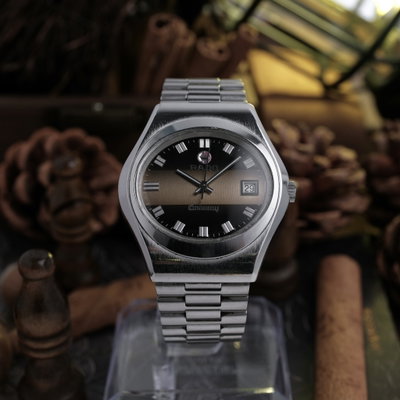
| Documented dial treatments | Vertical brushing, horizontal stripes, repeating anchor motif and two-tone horizontal split |
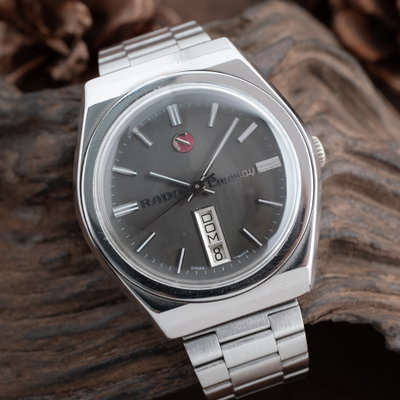
| Calendar configuration documented | Vertical day-date on reference 2091329 |
The model landscape
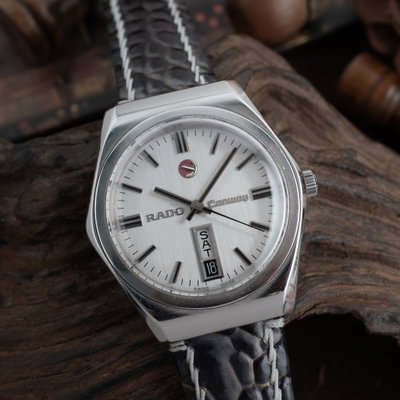
The Conway is not one uniform design. Reference 1091036 pairs a 36 mm steel case with a vertically brushed silver dial and ETA caliber 2782, while reference 2091329 uses a 35 mm cushion case, ETA caliber 2789 and a vertical day-date display. The latter gives the watch a more overtly 1970s face, but its calendar layout also makes incorrect replacement parts easier to spot.
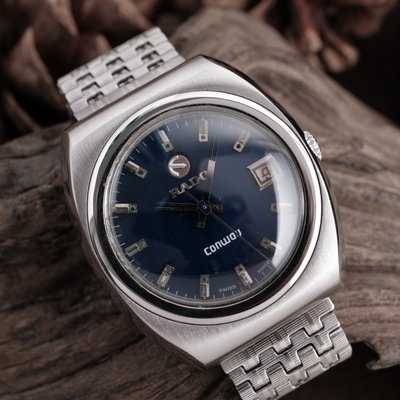
Dial choice changes the character more than a millimetre of case width. Reference 3030210 is 37 mm with a stamped repeating anchor motif, while reference 623.3151 combines a 36 mm case, ETA caliber 2783 and broad horizontal stripes. Reference 3030555 uses the same stated caliber and size with a brown-and-black split dial. For a first Conway, take the cleaner patterned dial over a rarer-looking dial with oxidation.
On the wrist
At 35 to 37 mm excluding the crown, the Conway wears through shape rather than diameter. Cushion and tonneau cases occupy more wrist area than a round watch of the same width, and the vertically brushed or striped dials reinforce that broad stance. The 36 mm references sit in the useful middle: assertively 1970s, but not dependent on oversized dimensions.
Legibility varies with the dial. Silver vertical brushing and applied faceted indices give reference 1091036 a cleaner read, while the repeating anchor surface of reference 3030210 puts texture first. The blue striped reference 623.3151 remains easy to identify, though oxidation on its hands weakens the contrast. An integrated-style or signed bracelet completes the period shape, but its fit and stretch matter more than the signature alone.
What goes wrong
Damaged dials and oxidised hands are the costliest visual faults because the Conway depends on surface treatment. A redial can flatten vertical brushing, soften the repeating anchor motif or disturb the relationship between applied indices and printed text. A genuine service dial is different from a redial, but without documentation its replacement date is unknown and should not be guessed.
Over-polishing rounds the cushion or tonneau edges first, leaving soft case lines where the geometry should remain distinct. Bracelet stretch can make a signed bracelet uncomfortable, and worn end-link fitment breaks the integrated look. Check for plating wear only where the specific case is plated, not on the steel examples described here. The service history is unknown unless supported by records, so running accuracy alone does not establish recent work.
What to check before you buy
- Dial print and surface: Vertical brushing should remain coherent beneath the printing on reference 1091036, while reference 3030210 should retain a clearly stamped repeating anchor field. Blurred text or texture interrupted around the logo points toward a redial.
- Hands and dial relationship: The applied faceted indices and hands should belong visually to the same configuration. Oxidation on the hands of reference 623.3151 is damage, not proof of originality, and newly finished hands against an aged dial warrant scrutiny.
- Case geometry: The cushion and tonneau cases depend on defined edges and even brushing. Rounded transitions, soft corners and an unnaturally glossy surface indicate polishing, especially when the dial remains sharply geometric.
- Caseback and reference: The caseback reference must be checked against the movement and dial layout rather than accepted alone. A caseback from one Conway attached to a different case or caliber creates a married or franken watch.
- Crown and rotating anchor: The rotating anchor is a useful model cue, but it does not authenticate the complete watch. A replacement crown is a service part; describe it as such rather than using it to reject an otherwise coherent Conway.
- Movement configuration: Known examples pair reference 1091036 with ETA 2782, reference 623.3151 and reference 3030555 with ETA 2783, and reference 2091329 with ETA 2789. Conflicts require explanation, not assumption.
Recent Rado results
25 Rado watches auctioned
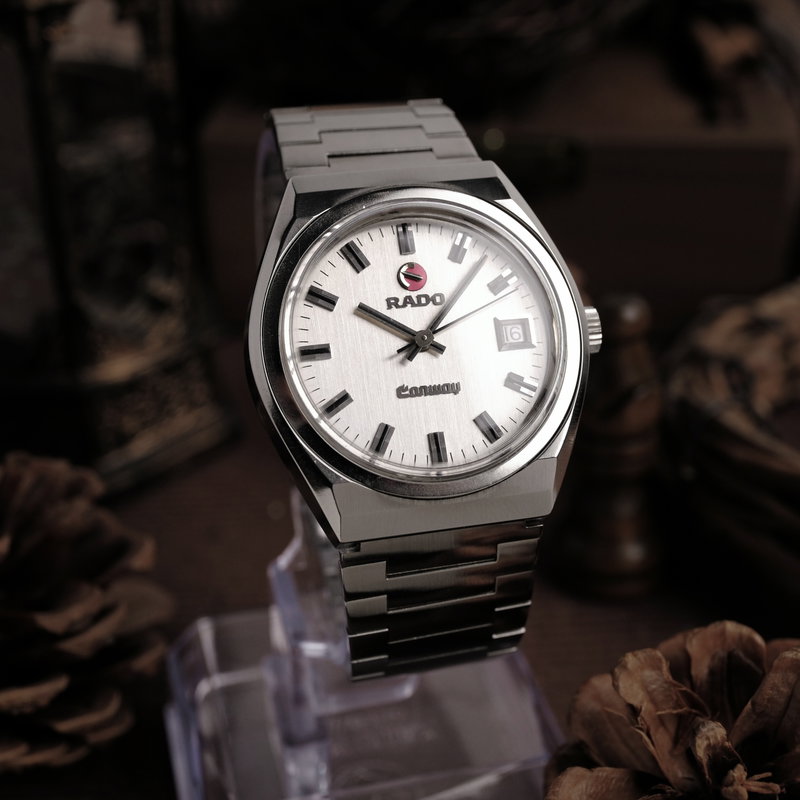
Rado · Conway · 1091036
Rado · Conway · 3050091
Rado · Conway · 2091329
Rado · Conway · 3030210
Rado · Conway · 3030555
Rado · Conway · 11918
Rado · Conway · 625.7941.4
Rado · Conway · 1061785
More Rado references
Related pages
Frequently asked questions
Ready to hunt for your own?
More than 100 vintage watches go under the hammer every week.