Rado Golden Horse 11675/2 - A Collector's Buying Guide
Rado Golden Horse reference 11675/2 is a 34-35 mm steel automatic best bought for its dial, case definition and coherent movement configuration.
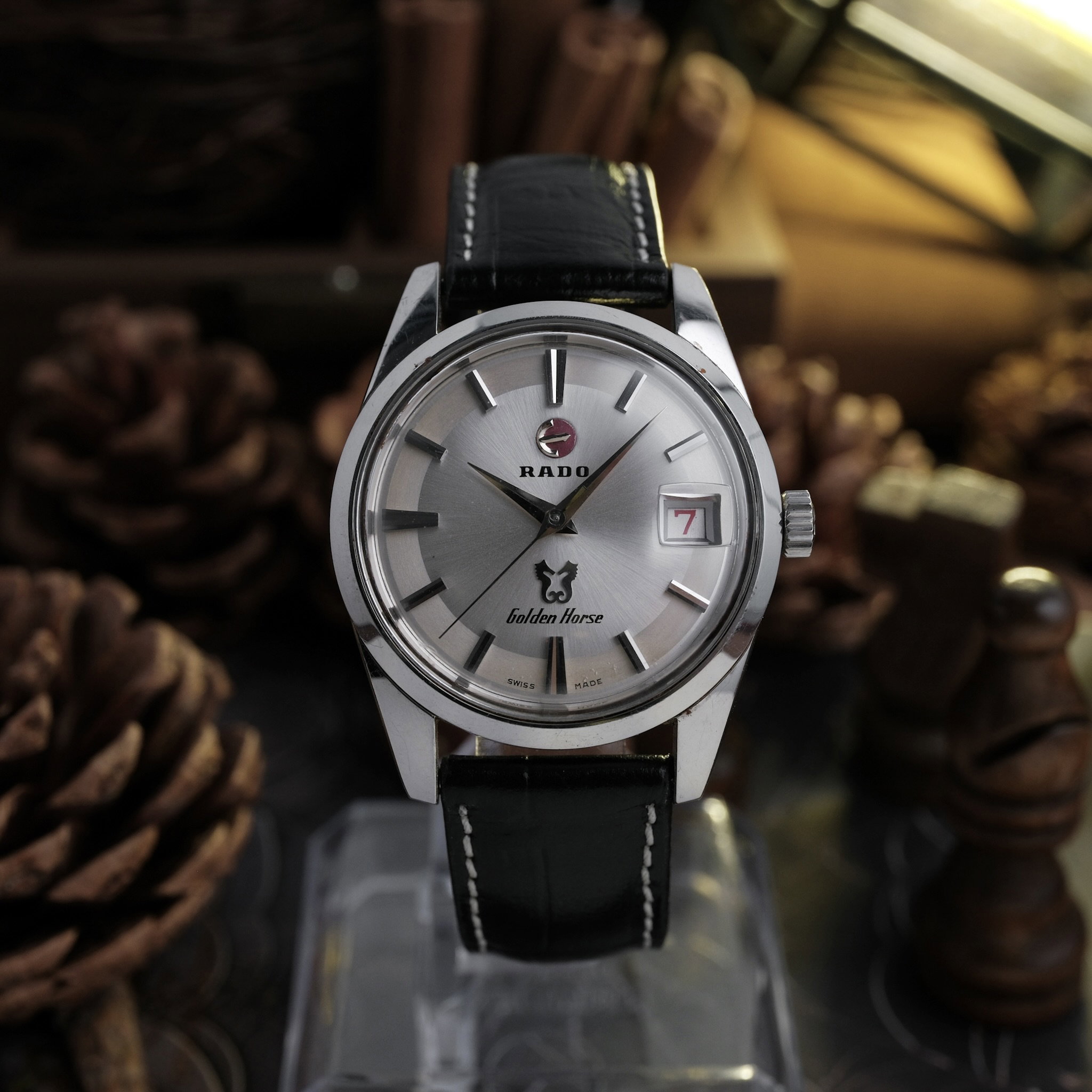
The Rado Golden Horse 11675/2 is a compact stainless-steel automatic built around a silver sunburst dial, applied markers and a date at three. Handled examples belong to the 1960s and 1970s, but the available evidence does not establish a tighter factory production window.
The dial decides which example to buy. A clean sunburst finish matters more than choosing between the red date display and a less conspicuous date wheel, while localized bubbling or finish loss at the outer edge cuts straight into the watch's appeal. Of the examples we have handled, cases measure either 34 mm or 35 mm excluding the crown, so condition should settle the choice rather than that one-millimetre difference.
Reference
11675/2
Model
Golden Horse
Production period represented
1960s and 1970s examples handled
Case diameter
34 mm or 35 mm, excluding the crown
| Case material | Stainless steel |
| Movement | Automatic |
| Recorded calibers | Caliber 2797 and ETA 2783 |
| Dial | Silver sunburst with applied indices |
| Date display | Date at three, with red date wheels on some examples |
| Dial emblems | Rotating anchor and twin seahorse emblem |
The model landscape
Reference 11675/2 is consistent in its basic architecture: stainless-steel case, automatic movement, silver sunburst dial and date at three. The visible variation sits mainly in the date display and condition. A red date wheel gives the face a stronger accent, but it should not command your decision when the alternative has a cleaner dial and better-defined case.
Movement descriptions among handled watches are not uniform. One is identified as Caliber 2797 and another as ETA 2783, while other examples are recorded only as automatic. Without factory documentation linking each configuration to a precise period, it would be wrong to declare one caliber universally correct for every 11675/2. The movement, dial and case must make sense together, and unexplained mixtures carry franken or married-watch risk.
On the wrist
The silver sunburst surface opens the dial visually, while the applied indices and dark hands keep the time readable. The red date version has more contrast at three, making that small aperture a deliberate part of the design.
The one-millimetre case variation is less important than lug definition and dial health. A 34 mm case with crisp edges will look more deliberate than a 35 mm case polished into soft contours. No thickness measurement is available from the watches handled, so cuff clearance should not be claimed from the present evidence.
What goes wrong
Dial damage is the costliest fault to accept. One handled example had spotting, bubbling and finish loss concentrated around the outer edge between four and six, showing where moisture or coating failure can break up the sunburst surface. A redial removes the factory finish entirely, while a genuine service dial would be a replacement rather than original equipment. The two should never be described as the same thing.
Over-polishing softens the case lines, and repeated work can also reduce the depth of the seahorse engraving on the back. Compare the lug shape from side to side and treat rounded edges as permanent metal loss. A replacement crown is less serious than a refinished dial, but its status should be stated rather than hidden inside an unqualified claim of originality.
Automatic movements also need evidence rather than adjectives. Two handled watches were reported at roughly +29 to +35 seconds per day and -12 to -15 seconds per day, but those readings describe individual watches, not the reference as a whole. Service history is unknown unless supported by documentation. Between a sharp 34 mm example with an honest dial and a polished 35 mm watch with bubbling, take the 34 mm watch.
What to check before you buy
- Dial layout and finish: Reference 11675/2 should be assessed against its silver sunburst dial, applied indices, rotating anchor and twin seahorse emblem. Flat paint, incorrect furniture or missing emblems can indicate a redial or incompatible replacement.
- Date display: Some handled examples have a red date wheel, while others do not establish that detail. Red printing is therefore a version clue, not proof by itself. Its alignment and condition should agree with the rest of the dial.
- Case and caseback: The stainless-steel case should retain defined lug edges, and the back should show a clear seahorse motif. Soft lugs or shallow engraving indicate polishing, while a mismatched back raises concern about a married or franken configuration.
- Movement configuration: Handled examples include Caliber 2797 and ETA 2783, so neither marking alone settles authenticity. The caliber, dial and case must be evaluated as one configuration, and the precise factory combinations remain unconfirmed without documentation.
Other 11675/2 examples we auctioned
More Rado references
Related pages
Frequently asked questions
Ready to hunt for your own?
More than 100 vintage watches go under the hammer every week.