Rado Cornell 11916: A Buyer's Reference Guide
The Rado Cornell 11916 is a 1970s automatic in a 35-36 mm steel cushion case, best bought with a clean brushed dial and sharp case edges.
We auction more than 100 vintage watches a week.
Get first access: new Rado 11916 drops and alerts before auctions end.
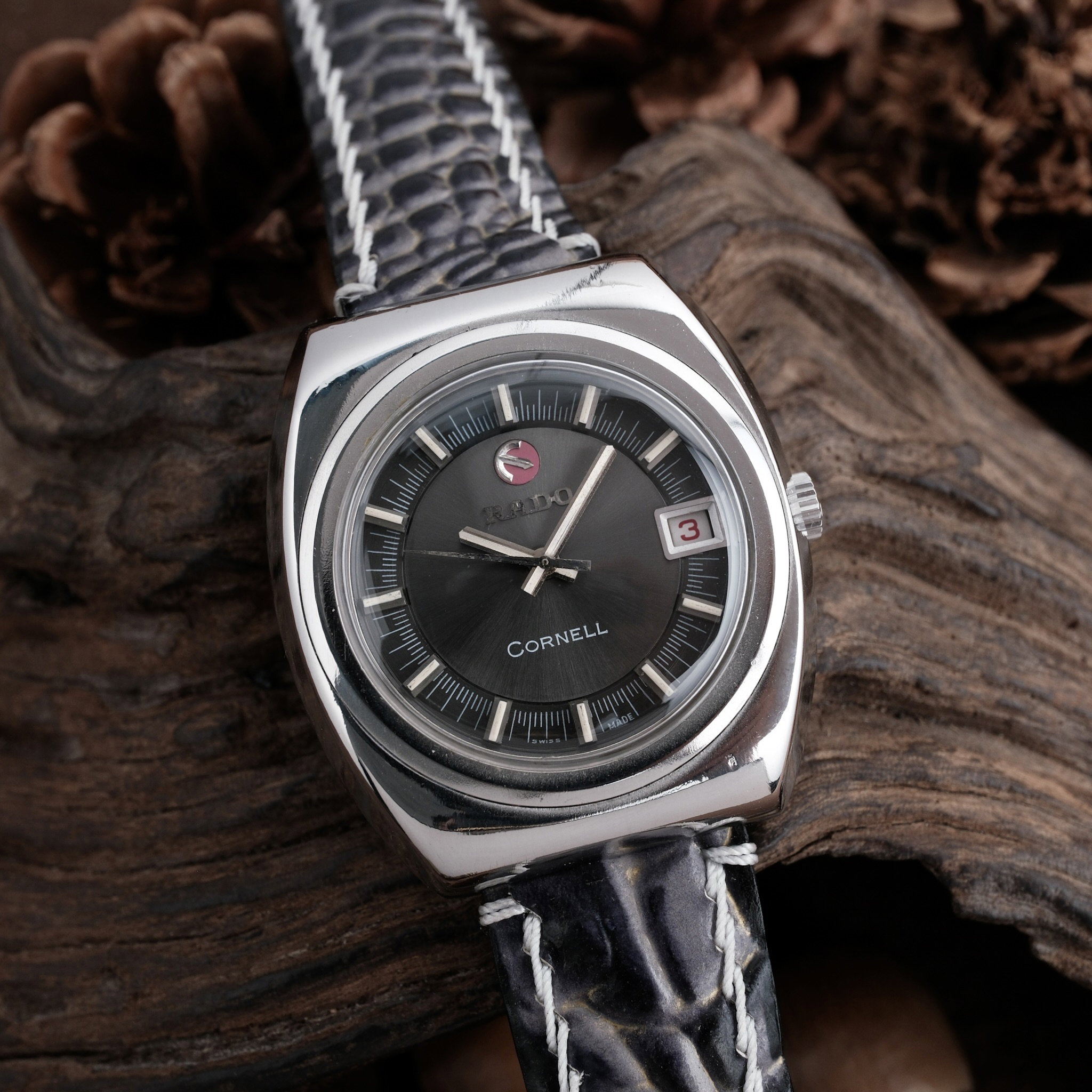
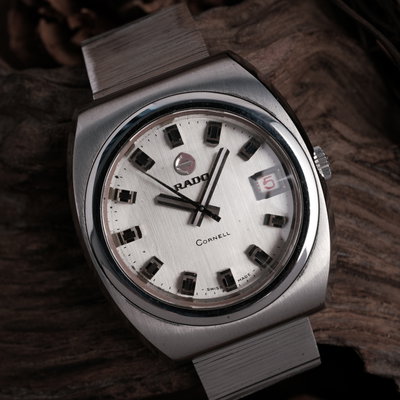
Browse 10 live Rado auctionsThe vintage Rado Cornell 11916 is a 1970s automatic built around a polished stainless steel cushion case and a strongly architectural dial. Its red date at 3 o'clock, applied faceted indices and rotating anchor give the watch its identity without making it difficult to wear.
The examples we have handled measure 35-36 mm without the crown, so this is a compact period watch rather than an oversized cushion case. Silver vertically brushed and sunburst dials are known, alongside a grey radial brushed version. Buy the cleanest convincing dial first because a redial costs more in lost appeal than light hand oxidation or ordinary case wear.
Brand
Rado
Model
Cornell
Reference
11916
Production period documented
1970s
| Case material | Stainless steel |
| Observed case width | 35-36 mm excluding the crown |
| Movement type | Automatic |
| Jewel count | 25 jewels |
| Observed caliber | A. Schild AS 1858 |
| Documented dial finishes | Silver vertical brushed, silver sunburst, grey radial brushed |
| Date display | Red numerals at 3 o'clock |
The model landscape
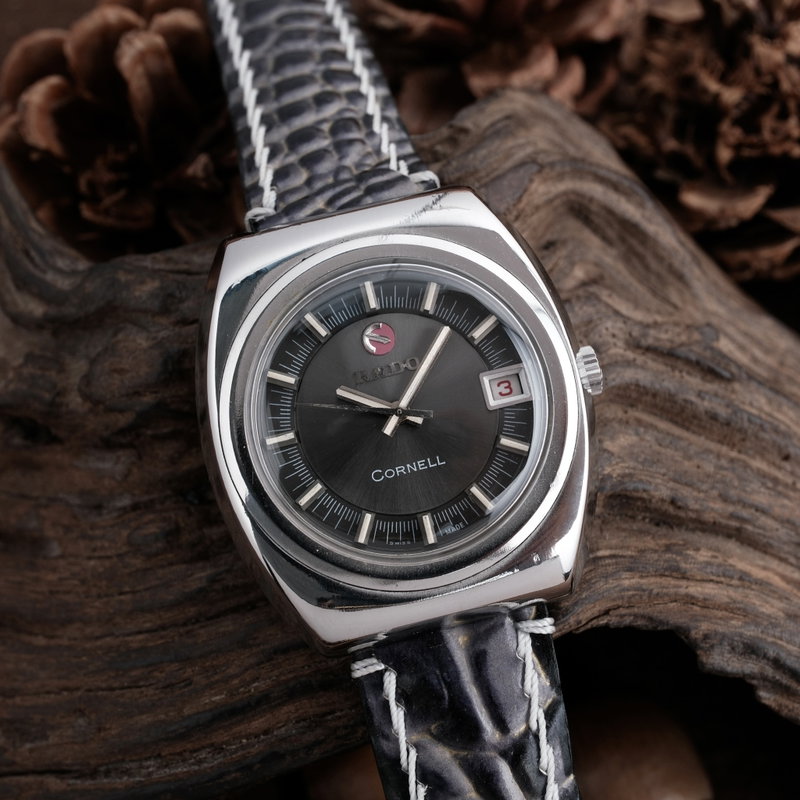
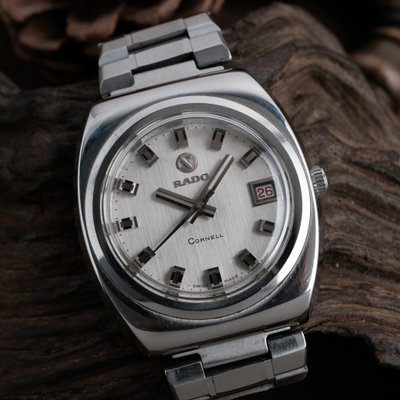
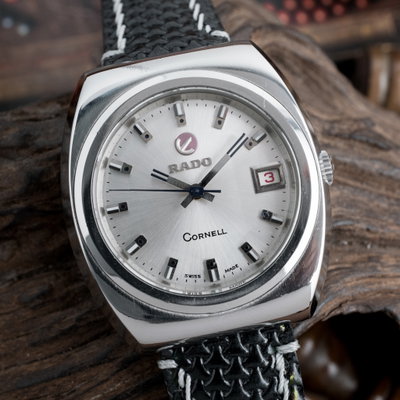
Reference 11916 has enough dial variation to make comparison essential. Silver examples can carry vertical brushing or a sunburst finish, while grey dials use radial brushing. Applied faceted indices have contrasting inserts, and the red date at 3 o'clock supplies the clearest shared accent.
An automatic 25-jewel movement is established for the reference, and A. Schild caliber AS 1858 is documented in a 1970s example. That does not prove every Cornell 11916 left the factory with AS 1858, so a different caliber needs careful assessment rather than an automatic franken verdict. Without factory documentation for an individual watch, no stronger claim is justified.
The silver dial is the safer starting point because its brushing, applied furniture and black-striped baton hands remain legible in changing light. Between a polished grey example with a questionable dial and a sharper silver watch with minor hand oxidation, take the silver watch. The dial carries the larger share of value.
On the wrist
At 35-36 mm excluding the crown, the Cornell wears with more presence than a round watch of equal width because the cushion case carries metal into its corners. The bold indices and baton hands keep the compact format readable, while the red date remains a small but conspicuous period detail.
The case and dial do most of the visual work, so a plain strap suits the reference better than anything that competes with its broad polished surfaces. No thickness measurement is established here, and the available evidence does not support a claim about cuff clearance. The watch should be judged by its measured dimensions, not by a generic assumption about 1970s automatics.
What goes wrong
The worst fault is a refinished dial. Incorrect brushing, a static or poorly fitted anchor, weak text and mismatched date presentation can turn a coherent Cornell into a redial or franken watch, even when the individual parts look plausible. A genuine service dial is different from a redial, but no service-dial specification is established for reference 11916.
Polishing is the next concern. The cushion case depends on clear transitions around its broad upper surface, and repeated work leaves the edges soft or mushy. Hands can oxidise, lume can be replaced, and dust or spotting can sit on the dial. Plating wear is not relevant to the documented stainless steel cases, but replacement crowns and married movements still require scrutiny.
Running figures from old listings are not service records. A watch can run steadily and still need maintenance, while a strong daily rate does not establish movement originality. Unless an invoice accompanies the watch, the service history is unknown. Buy the dial and case first, then budget according to the movement's present test results.
What to check before you buy
- Dial configuration: Reference 11916 is documented with silver vertical-brushed, silver sunburst and grey radial-brushed dials. Applied faceted indices, a rotating anchor and a red date at 3 o'clock should read as one coherent design.
- Hands and dial furniture: Known examples use baton hands with contrasting central stripes that coordinate with the applied indices. Mismatched hand style, fresh relume or inconsistent ageing can indicate replacement parts or a franken assembly.
- Cushion case: The documented case is stainless steel and measures 35-36 mm without the crown. Repeated polishing softens the transitions around the broad cushion form, so mushy edges matter more than surface scratches.
- Movement: An automatic 25-jewel movement belongs to the documented specification, and A. Schild AS 1858 is confirmed in one example. That caliber supports the assessment but cannot authenticate every Cornell 11916 by itself.
- Redial and replacement tells: Incorrect brushing, weak or uneven printing, a poorly seated anchor and a date treatment that conflicts with the rest of the dial are redial or franken warnings. A genuine service dial is not the same as a refinished dial.
Other 11916 examples we auctioned
13 Rado 11916 auctioned
More Rado references
Related pages
Frequently asked questions
Ready to hunt for your own?
More than 100 vintage watches go under the hammer every week.