Rado Marco Polo 11836/1 Reference Guide
Buy the Rado Marco Polo 11836/1 for its steel cushion case and strongest surviving dial, with silver sunburst and gold-tone brushed versions documented.
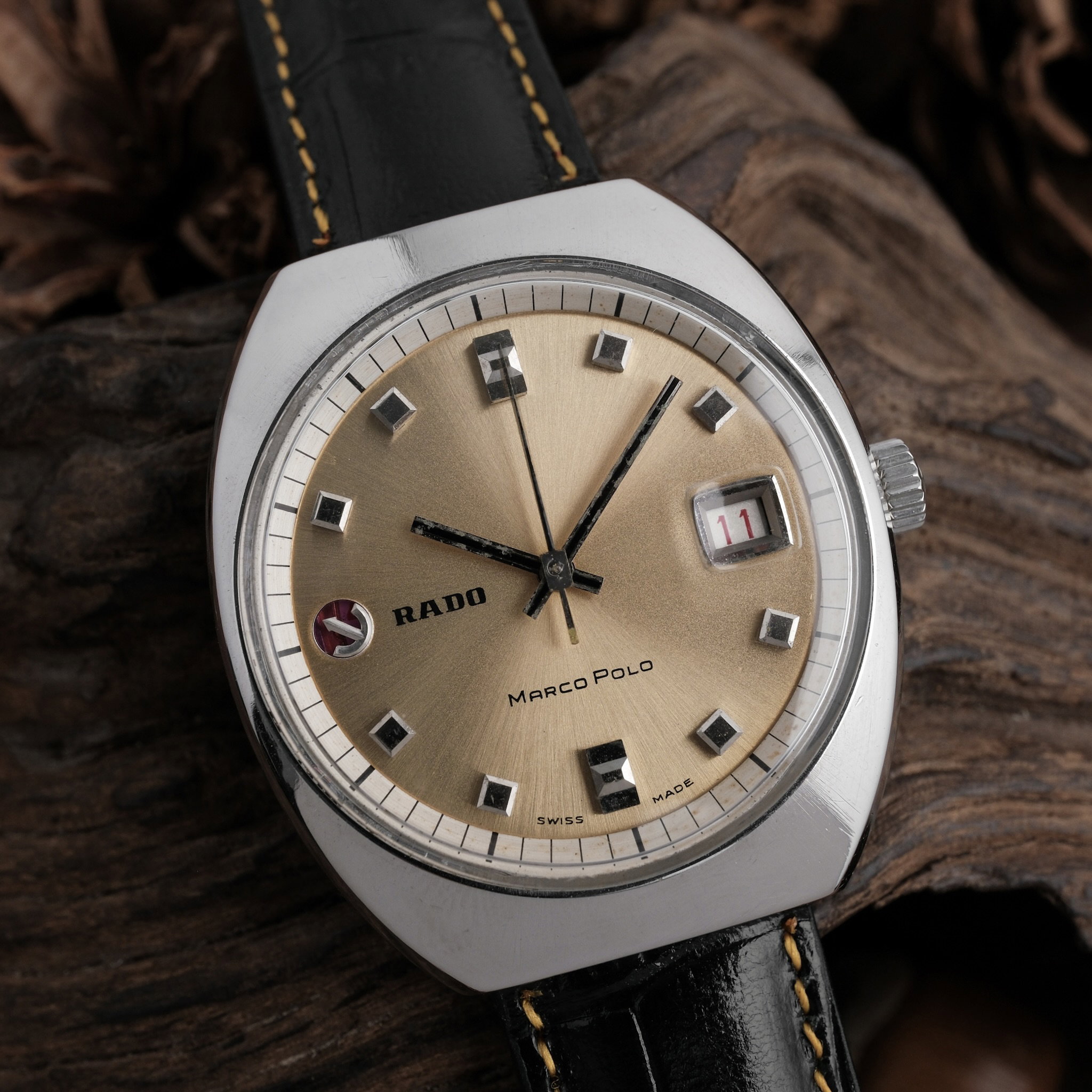
The Rado Marco Polo reference 11836/1 belongs squarely to the 1970s shaped-watch moment, with a stainless steel cushion-tonneau case rather than a conventional round profile. Its automatic movement, faceted applied indices and rotating anchor give it a recognisable identity without relying on oversized proportions. The red date adds the strongest colour accent, so a correct, clean dial matters more than superficial case shine.
At 36 mm excluding the crown, the watch remains compact, but the broad case geometry gives it more wrist presence than the measurement suggests. Examples handled as both Marco Polo and Marco Polo 747 share the same reference, while dial treatment varies between silver sunburst and gold-tone vertical brushing. Buy on dial quality first, then case definition and movement consistency.
Brand
Rado
Model
Marco Polo, also named Marco Polo 747
Reference
11836/1
Production period
1970s
| Case size | 36 mm excluding the crown |
| Case material | Stainless steel |
| Case form | Cushion-tonneau |
| Movement | Automatic, with AS 1859 and AS 1906 documented |
| Jewel count | 25 jewels on documented AS 1859 and Marco Polo 747 examples |
| Dial variants | Silver sunburst or gold-tone vertically brushed |
| Dial furniture | Faceted applied indices and rotating Rado anchor |
| Date display | Red date at 3 o'clock |
The model landscape
The clearest choice is between the silver sunburst dial and the gold-tone vertically brushed dial. Both use faceted applied indices, a rotating Rado anchor and a red date display, but they age differently. Silver makes scattered spots and marks easy to see, while the directional brushing on the gold-tone version can expose refinishing when the grain loses its even vertical path.
Automatic examples bearing this reference have been handled with AS 1859 and AS 1906 movements. That variation means a caliber difference is not, by itself, proof of a franken watch. The movement marking must be disclosed and assessed with the dial, handset and case as a complete configuration. Without supporting documentation, the original factory pairing of any individual watch should not be guessed.
Value sits first in the dial. A clean sunburst or evenly brushed surface with intact applied furniture commands the premium, while spotting, loose dust and broad marks widen the spread between otherwise similar watches. Case geometry comes next because softened cushion edges cannot be recovered by servicing. Between a bright polished case and a sharper case with honest surface wear, take the sharper case.
On the wrist
The 36 mm case wears wider than a round watch of the same stated diameter because the cushion-tonneau body carries metal toward the corners. Faceted indices catch light strongly against both recorded dial finishes, while black-striped baton hands on silver examples preserve contrast. The red date remains visually prominent, so poor date alignment is noticeable during ordinary wear.
What goes wrong
A refinished dial is the costliest fault because the vertical brush or sunburst effect is central to this reference. Honest examples can have scattered spotting, marks and dust, including particles visible only under macro photography. Those flaws should be described plainly rather than renamed patina. Uneven grain, disturbed printing or applied furniture that no longer sits coherently with the dial finish deserves more concern than light surface spotting.
Over-polishing softens the cushion-tonneau outline and removes the transitions that make the case work. Movement swaps create a separate risk: AS 1859 and AS 1906 have both occurred, but that does not make every combination original. A watch assembled from period-correct parts can still be franken, and a case and movement from different watches are married. The service history is unknown unless paperwork establishes it.
What to check before you buy
- Dial finish and furniture: Known dials are silver sunburst or gold-tone with vertical brushing, paired with faceted applied indices, a rotating anchor at 9 o'clock and a red date at 3 o'clock. Inconsistent grain or disturbed printing points toward a redial.
- Hands: A documented silver-dial configuration uses baton hands with black central stripes. A different handset is not automatic proof of a fake, but it needs explanation because period-correct parts are not necessarily original to that watch.
- Case geometry: The reference uses a 36 mm stainless steel cushion-tonneau case. Soft outer contours and blurred transitions indicate polishing, while a round case or a different stated size does not match the handled configuration.
- Movement marking: Automatic movements marked AS 1859 and AS 1906 have both been handled in this reference. The caliber should be identified directly rather than assumed, and an undocumented case-movement pairing should not be presented as certainly original.
- Franken and married signs: The dial finish, red date, applied indices, handset, steel case and movement must make sense together. Correct individual parts do not prove a correct watch, and a case and movement sourced from different watches make it married.
Other 11836/1 examples we auctioned
More Rado references
Related pages
Frequently asked questions
Ready to hunt for your own?
More than 100 vintage watches go under the hammer every week.