Omega De Ville 511.0428: What to Know Before Buying
Omega De Ville 511.0428 is a compact 1972 manual-wind dress watch best bought with a clean geometric dial and a case whose edges remain defined.
We auction more than 100 vintage watches a week.
Get first access: new Omega 511.0428 drops and alerts before auctions end.
Browse 60 live Omega auctionsThe Omega De Ville 511.0428 makes its case through proportion rather than scale. Its rectangular case measures 20 mm excluding the crown, so this is a compact 1972 dress watch rather than a smaller substitute for a round everyday Omega.
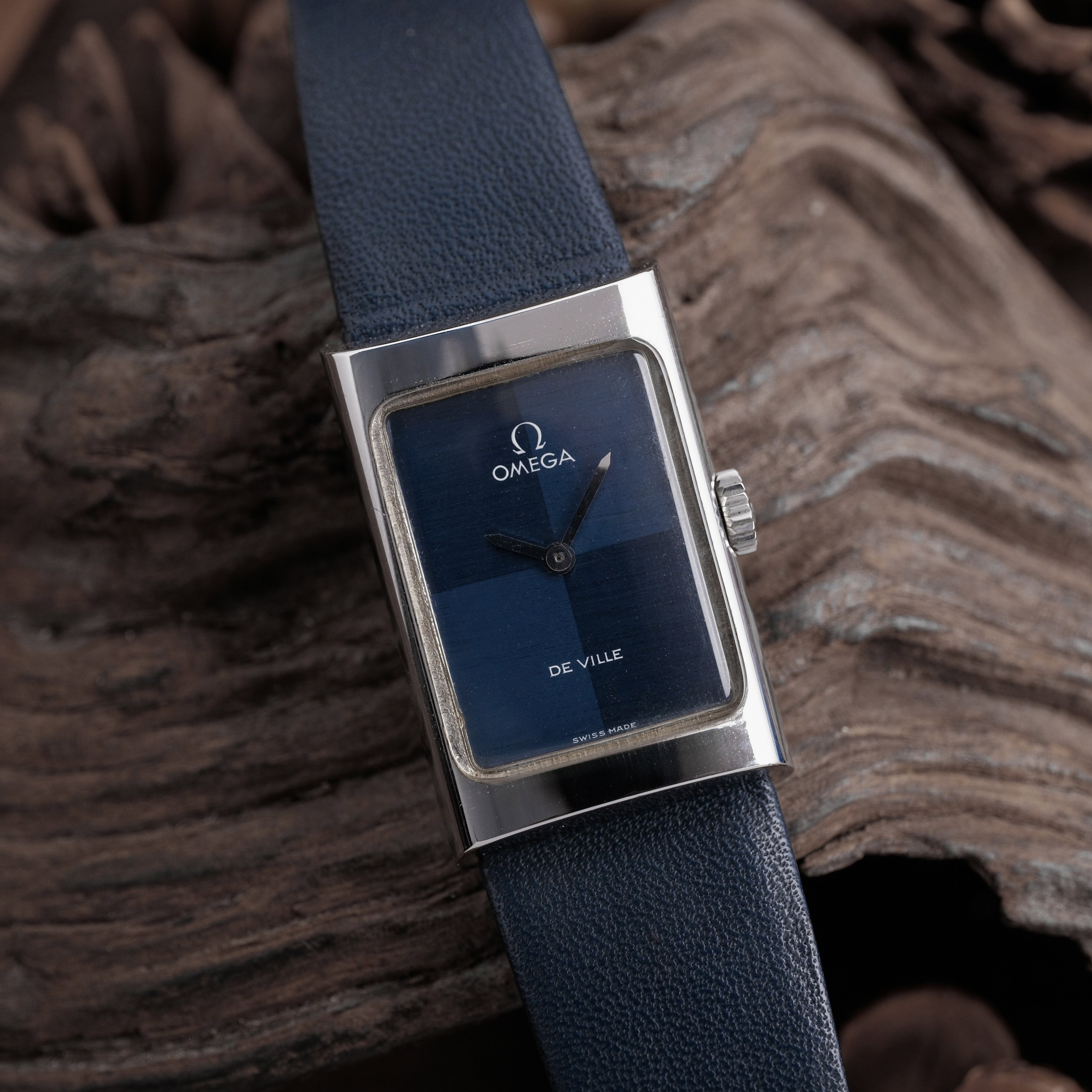
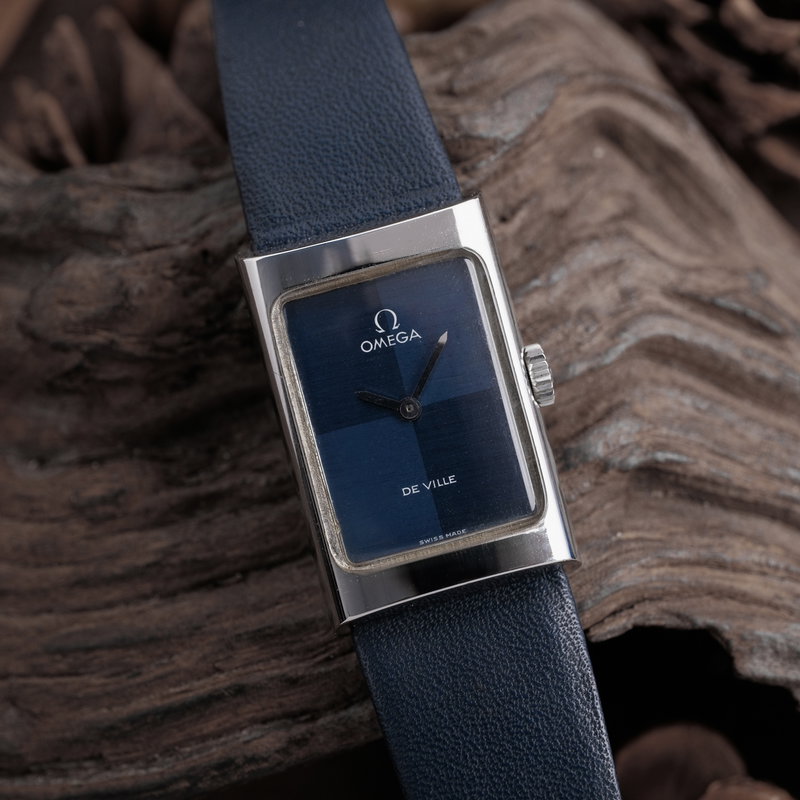
Two distinct executions establish the choice: stainless steel with a deep blue quadrant dial, or gold-plated with a dark grey and black horizontally brushed dial. Both use the manual-wind Caliber 485 with 17 jewels. Buy the dial first, then choose the case material, because damaged plating and refinished printing change the watch more decisively than routine mechanical work.
Brand
Omega
Model
De Ville
Reference
511.0428
Production year
1972-1972
| Case size | 20 mm excluding the crown |
| Case materials | Stainless steel or gold-plated |
| Movement | Manual-wind Omega Caliber 485 |
| Jewels | 17 |
| Known dial executions | Deep blue quadrant, or dark grey and black with horizontal brushing |
What it was built for
Reference 511.0428 belongs to the geometric side of 1972 dress-watch design. The rectangular case and sector-like dial treatment make it a formal object, while manual winding keeps the case visually restrained. Its purpose is clear: discreet timekeeping with the dial carrying nearly all the visual weight.
At 20 mm excluding the crown, the watch wears deliberately small and slips easily beneath a cuff. The compact format suits a narrow strap and formal clothing better than casual sportswear, while the light stick hands keep the dark dial legible without disturbing its geometry. Anyone expecting the wrist presence of a round De Ville should choose against this reference.
The model landscape
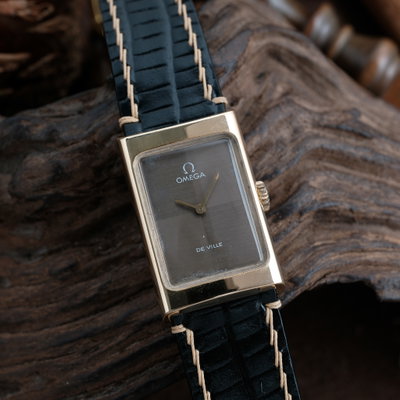
The stainless-steel version has the stronger graphic contrast: a deep blue quadrant dial with crisp white typography. The gold-plated alternative uses a dark grey and black horizontal brushing with an applied Omega logo and gold-tone stick hands. These are materially different looks, not minor colour variations, and the steel watch is the safer choice when long-term case wear matters.
Value sits first in the dial. A clean quadrant or horizontally brushed surface retains the design that defines 511.0428, whereas a redial removes more value than hand oxidation or an undocumented service history. Among gold-plated examples, exposed base metal at the lugs matters because no service can replace lost factory plating without refinishing the case.
Between a sharp steel case with a clean blue dial and a shinier gold-plated case with plating loss, take the steel watch. The gold-plated version earns its place when the brushing, applied logo and matching gold-tone hands remain coherent. Period-correct parts are not automatically original, so a watch assembled from individually plausible components can still be franken.
What goes wrong
Dial damage is the first concern. Dark horizontally brushed dials can show spotting, while gold-tone stick hands can develop oxidation visible under magnification. A redial is worse: altered typography or lost brushing changes the defining surface, and a genuine service dial must not be described as the watch's original dial.
Plating wear, softened case edges and scratched crystals are separate faults. The rectangular case depends on defined lines, so polishing that rounds its corners changes the proportion even when the surface looks bright. On gold-plated cases, wear-through around the lugs is permanent unless the case is replated, which itself removes the surviving factory finish.
Caliber 485 should wind, set and run, but running is not proof of healthy performance. One handled gold-plated example measured roughly 55 to 58 seconds slow per day, enough to justify mechanical attention rather than optimistic wording. Unless an invoice accompanies the watch, the service history is unknown and should remain described that way.
Dating this watch
| Serial range / caliber | Year | Note |
|---|---|---|
| 1000000 | 1902 | approximate, ±1-3 years |
| 2000000 | 1908 | approximate, ±1-3 years |
| 3000000 | 1912 | approximate, ±1-3 years |
| 4000000 | 1916 | approximate, ±1-3 years |
| 5000000 | 1923 | approximate, ±1-3 years |
| 6000000 | 1925 | approximate, ±1-3 years |
| 7000000 | 1929 | approximate, ±1-3 years |
| 8000000 | 1935 | approximate, ±1-3 years |
| 9000000 | 1939 | approximate, ±1-3 years |
| 10000000 | 1944 | approximate, ±1-3 years |
| 11000000 | 1947 | approximate, ±1-3 years |
| 12000000 | 1950 | approximate, ±1-3 years |
| 13000000 | 1952 | approximate, ±1-3 years |
| 14000000 | 1954 | approximate, ±1-3 years |
| 15000000 | 1956 | approximate, ±1-3 years |
| 16000000 | 1958 | approximate, ±1-3 years |
| 17000000 | 1960 | approximate, ±1-3 years |
| 18000000 | 1961 | approximate, ±1-3 years |
| 19000000 | 1962 | approximate, ±1-3 years |
| 20000000 | 1963 | approximate, ±1-3 years |
| 21000000 | 1964 | approximate, ±1-3 years |
| 22000000 | 1965 | approximate, ±1-3 years |
| 24000000 | 1966 | approximate, ±1-3 years |
| 25000000 | 1967 | approximate, ±1-3 years |
| 26000000 | 1968 | approximate, ±1-3 years |
| 28000000 | 1969 | approximate, ±1-3 years |
| 31000000 | 1970 | approximate, ±1-3 years |
| 32000000 | 1971 | approximate, ±1-3 years |
| 33000000 | 1972 | approximate, ±1-3 years |
| 35000000 | 1973 | approximate, ±1-3 years |
| 37000000 | 1974 | approximate, ±1-3 years |
| 39000000 | 1975 | approximate, ±1-3 years |
| 40000000 | 1976 | approximate, ±1-3 years |
| 41000000 | 1977 | approximate, ±1-3 years |
| 42000000 | 1978 | approximate, ±1-3 years |
| 43000000 | 1979 | approximate, ±1-3 years |
| 44000000 | 1980 | approximate, ±1-3 years |
| 45000000 | 1982 | approximate, ±1-3 years |
| 46000000 | 1984 | approximate, ±1-3 years |
| 47000000 | 1985 | approximate, ±1-3 years |
| 48000000 | 1986 | approximate, ±1-3 years |
| 49000000 | 1988 | approximate, ±1-3 years |
| 50000000 | 1990 | approximate, ±1-3 years |
| 53000000 | 1993 | approximate, ±1-3 years |
| 54000000 | 1995 | approximate, ±1-3 years |
| 56000000 | 1996 | approximate, ±1-3 years |
| 58000000 | 1998 | approximate, ±1-3 years |
| 60000000 | 2000 | approximate, ±1-3 years |
Dating data comes from our decoder tables; treat years as approximate.
What to check before you buy
- Dial execution: A known 511.0428 dial is either deep blue with a geometric quadrant layout and white printing, or dark grey-black with horizontal brushing. Flat paint, lost brushing or altered typography indicates a redial.
- Hands and applied furniture: The dark brushed execution is paired with an applied Omega logo and gold-tone stick hands. Oxidation can be honest wear, but mismatched hand colour or proportions may indicate replacement parts or a franken assembly.
- Movement specification: The movement should be the manual-wind Omega Caliber 485 with 17 jewels. A different caliber conflicts with the handled 511.0428 examples and raises the possibility of a replacement or married movement.
- Case material and geometry: Known cases are stainless steel or gold-plated and measure 20 mm excluding the crown. Defined rectangular edges support the intended geometry, while rounded corners disclose polishing rather than factory finish.
- Gold-plated case wear: On the plated version, inspect the lugs and corners for exposed base metal. Brightness does not prove preservation, and replating can conceal wear while removing the surviving factory surface.
Other 511.0428 examples we auctioned
2 Omega 511.0428 auctioned
More Omega references
Related pages
Frequently asked questions
Ready to hunt for your own?
More than 100 vintage watches go under the hammer every week.