Seiko Crown J14036: dials, cases and the caliber 560
The Seiko Crown J14036 is a 1959-1960 manual-wind dress watch whose strongest buys pair an honest dial with a coherent case and caliber 560.
We auction more than 100 vintage watches a week.
Get first access: new Seiko J14036 drops and alerts before auctions end.
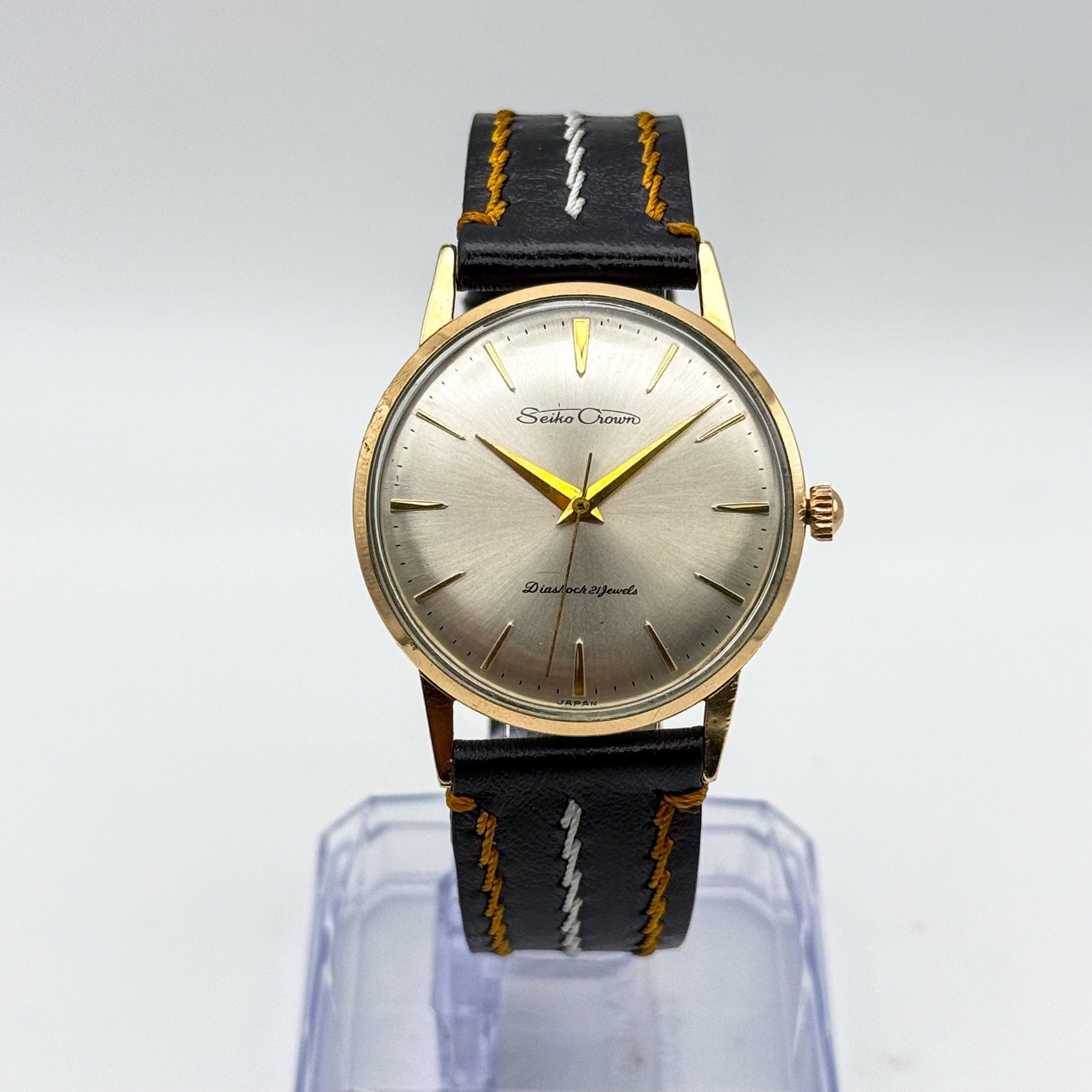
Browse 14 live Seiko auctionsThe Crown J14036 belongs to a narrow 1959-1960 window and makes its point through proportion rather than complication. Its manual-wind caliber 560 sits behind either a silver sunburst dial with applied gold-tone indices or a black dial with gilt typography. That combination places the reference firmly in Seiko's late-1950s dress-watch language.
The buying decision is less simple than the reference number suggests. Known J14036 examples include stainless steel, a 14K gold-filled front with stainless steel back, and gold-plated cases with stainless steel backs, while case diameters run from 33 to 34 mm excluding the crown. The best used Seiko Crown J14036 is therefore the most internally coherent one, not automatically the blackest dial or brightest case.
Brand and model
Seiko Crown
Reference
J14036
Known production years
1959-1960
Movement type
Manual wind
| Caliber | Seikosha caliber 560 |
| Known jewel counts | 19 or 21 jewels |
| Known case diameters | 33 or 34 mm, excluding the crown |
| Known case materials | Stainless steel, 14K gold-filled front with stainless steel back, or gold-plated with stainless steel back |
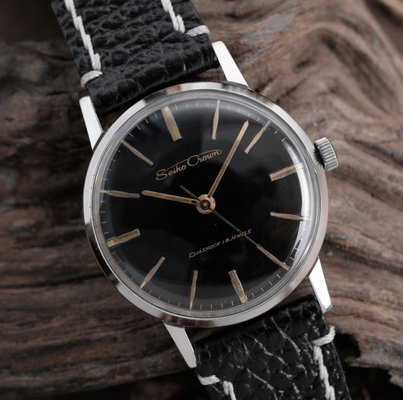
| Known dial configurations | Silver sunburst with applied gold-tone faceted indices, or black with gilt typography and applied gold-tone faceted indices |
What it was built for
The J14036 is a compact manual-wind dress watch from 1959-1960, with no complication competing with the dial. At 33 or 34 mm excluding the crown, it wears as a period object rather than a reduced modern watch. The silver sunburst version is quieter under a cuff, while the black dial uses gilt typography and gold-tone furniture for stronger contrast.
Daily ownership revolves around caliber 560 and its hand-wound routine. Examples handled with this reference have carried either 19 or 21 jewels, so jewel count alone cannot settle authenticity. The movement, dial, case material and caseback must make sense together, and unexplained mixtures raise a franken or married-watch concern.
Where the value sits
The dial carries the widest spread in the J14036. A clean silver sunburst dial preserves the reference's restrained dress-watch character, while the black dial with gilt typography is the more visually distinctive option. Black surfaces also expose spotting readily, and one known 1960 example has light spotting, so rarity language should never substitute for a direct condition description.
Case material creates a second divide. Stainless steel avoids plating loss, while gold-filled and gold-plated examples can wear through at the lug edges, where no service can replace the lost surface without materially altering the case. Between a sharp steel example and a brighter plated watch with exposed base metal, the steel watch is the safer purchase. A refinished dial costs more in collector appeal than ordinary case wear.
Where to start
Start with the dial-case combination rather than the jewel count. Silver sunburst with applied gold-tone faceted indices is the straightforward route, particularly when the printing remains intact and the gold-filled or plated surface has not broken through at the lugs. The black-and-gilt configuration deserves a premium only when the dial surface and typography survive without refinishing.
Then judge the case diagnostically. Soft lug edges indicate polishing, exposed base metal identifies plating loss, and an ill-fitting replacement crown can disturb the compact proportions even though crowns are consumable parts. Movement service history is often unknown; without documentation, the watch itself establishes caliber and visible condition, but not when it was last serviced. For a first J14036, choose the honest silver dial over a more dramatic black redial.
What to check before you buy
- Dial configuration: A J14036 can carry a silver sunburst dial with applied gold-tone faceted indices or a black dial with gilt typography. Any other configuration needs evidence rather than an assumption that it is original.
- Dial surface and printing: On the silver version, refinishing can flatten the sunburst effect or replace aged printing with unnaturally fresh text. On the black version, distinguish honest spotting from a repainted surface with newly applied gilt-style lettering.
- Movement identity: The movement should be a manual-wind Seikosha caliber 560. Known examples carry either 19 or 21 jewels, so a mismatch cannot be declared from jewel count alone; the complete movement and watch configuration must agree.
- Case construction: Known J14036 cases include stainless steel, a 14K gold-filled front with stainless steel back, and gold-plated construction with a stainless steel back. Solid-gold claims are not supported by these configurations.
- Case wear: Gold-filled and gold-plated examples should be checked first at the lug edges for exposed base metal. On any case, softened lug edges indicate polishing, while crisp remaining geometry provides more useful evidence than an unpolished claim.
- Crown and parts coherence: The winding crown may have been replaced because crowns are consumable. An ill-fitting crown should be disclosed, and a combination of unrelated dial, case and movement parts should be treated as franken rather than merely serviced.
Other J14036 examples we auctioned
7 Seiko J14036 auctioned
More Seiko references
Related pages
Frequently asked questions
Ready to hunt for your own?
More than 100 vintage watches go under the hammer every week.