Seiko 5216-6040 LM Special reference guide
The vintage Seiko 5216-6040 is a compact, high-beat LM Special whose value rests on dial integrity, sharp case geometry and a correct caliber 5216A.
We auction more than 100 vintage watches a week.
Get first access: new Seiko 5216-6040 drops and alerts before auctions end.
Browse 32 live Seiko auctionsThe Seiko 5216-6040 LM Special put a high-beat automatic movement and sharply geometric styling into a compact stainless-steel watch. Made across 1973-1974, it sits in the Lord Matic Special line below King Seiko and Grand Seiko, with the technical interest supplied by caliber 5216A rather than by a large case or overtly formal design.
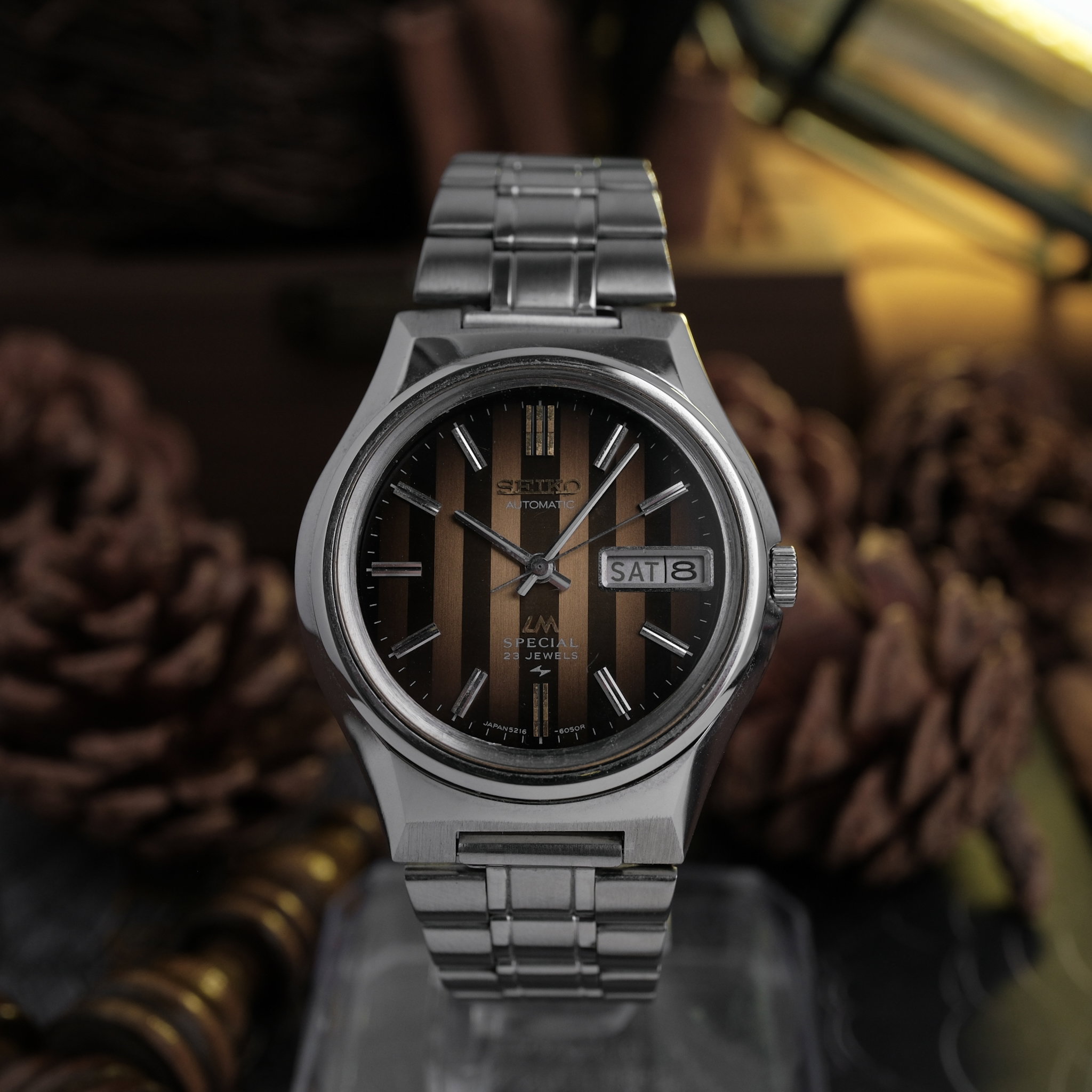
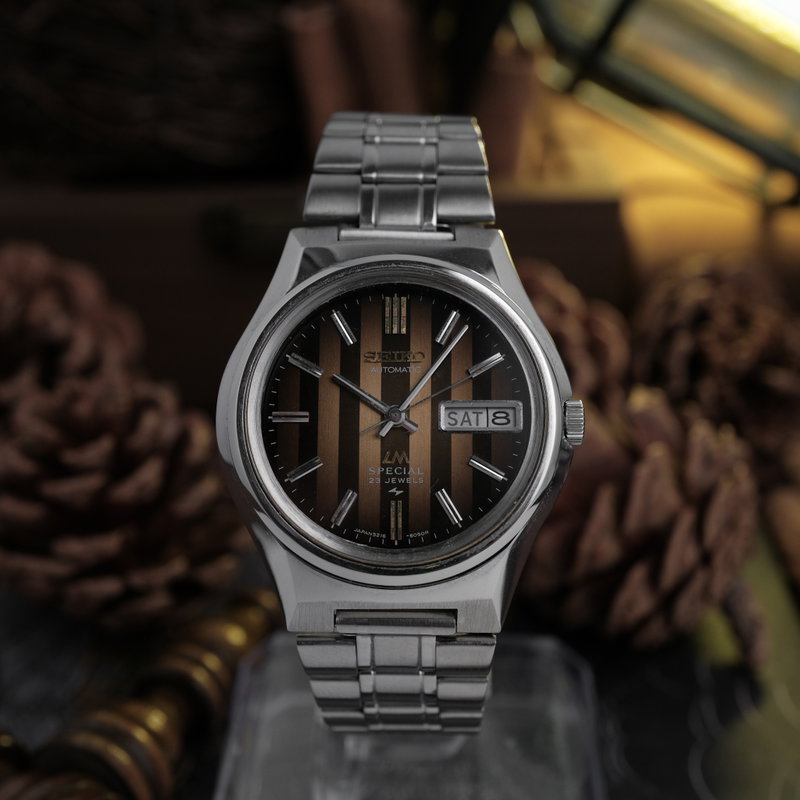
The choice is not simply between one clean example and another. Silver sunburst dials and brown vertically striped dials give the reference different characters, while English and Kanji day display adds a practical period detail. Dial damage costs more than light external wear, but softened case lines and a compromised faceted crystal can remove much of what makes this used Seiko distinctive.
Reference
5216-6040
Model
LM Special - Lord Matic Special
Production years
1973-1974
Case material
Stainless steel
| Case size | 35-36 mm excluding the crown |
| Movement | Automatic Seiko caliber 5216A |
| Jewels | 23 jewels |
| Display | Day and date, including English and Kanji examples |
| Dial variants | Silver sunburst or brown vertically striped |
| Crystal | Faceted crystal |
What it was built for
The Lord Matic Special was Daini's high-grade watch for a professional buyer who wanted more than a standard automatic without moving into King Seiko or Grand Seiko. Reference 5216-6040 uses the automatic caliber 5216A with 23 jewels, a high-beat movement paired with day and date display. That combination makes the movement central to the watch's identity, not an interchangeable detail.
Its 1970s design is equally specific. Applied faceted indices, applied Seiko and LM signatures and a faceted crystal create hard changes of light across a small surface. The silver sunburst dial is the quieter choice. The brown vertically striped dial has greater visual depth, but its textured finish also makes refinishing harder to disguise convincingly.
On the wrist
Handled examples measure between 35 and 36 mm without the crown, so the 5216-6040 wears as a compact dress-leaning automatic rather than a modern sports watch. The faceted crystal and angular case give it more presence than the diameter suggests, while the day-date display keeps the dial useful rather than austere.
Between the two dial treatments, silver sunburst slips more easily under formal clothing and makes the applied furniture immediately legible. Brown vertical striping is the more distinctive version and changes more dramatically in angled light. If both watches have equally honest dials and sharp case lines, take the brown dial against silver for character, but never trade a clean silver dial for a stained or refinished brown one.
What goes wrong
Dial damage is the costliest fault. Spotting, staining or an unevenly refinished surface weakens the sunburst or striped texture, and blurred Seiko or LM printing confirms that the visual loss is not harmless patina. A genuine service dial is different from a redial, but no service dial is established by the available evidence, so its status should not be guessed from cleanliness alone.
Over-polishing softens the case's sharp lines, especially around the lugs, and no later correction restores the original geometry. The faceted crystal can acquire chips or lose definition through polishing, reducing the angular effect that distinguishes the reference. Replaced crowns, hands or day wheels also need to be judged against the rest of the watch, because period-correct parts are not proof that those parts shipped together.
Movement condition cannot be inferred from the dial. Caliber 5216A should be identified directly, while any claimed service requires dated documentation rather than a seller's adjective. Without that documentation, the service history is unknown. Buy the strongest dial and case first, then budget for mechanical attention according to measured performance.
What to check before you buy
- Dial print and surface: Applied Seiko and LM signatures should sit cleanly on an intact silver sunburst or brown vertically striped surface. Blurred printing, lost texture or uneven colour points toward a redial or damage, not attractive patina.
- Hands, indices and calendar: The hands should make visual sense beside the applied faceted indices, and the day-date display should align within its aperture. English and Kanji wheels are known, but a correct language wheel alone does not prove originality.
- Case and faceted crystal: The stainless-steel case should retain distinct angular lines around the lugs, while the faceted crystal should preserve its geometry. Soft or mushy lugs and rounded crystal facets indicate polishing that has removed definition.
- Movement identity: The movement must be identified as automatic caliber 5216A with 23 jewels. A different caliber makes the watch incorrect for reference 5216-6040, while matching caliber markings still do not rule out a married or franken assembly.
- Crown and service claims: A replacement crown can be period-correct without being original to the watch. The service history remains unknown unless dated paperwork supports it, and cleanliness inside the case is not evidence of a documented service.
Other 5216-6040 examples we auctioned
9 Seiko 5216-6040 auctioned
More Seiko references
Related pages
Frequently asked questions
Ready to hunt for your own?
More than 100 vintage watches go under the hammer every week.