Seiko 7017-8000 Speed-Timer 5 Sports Chronograph
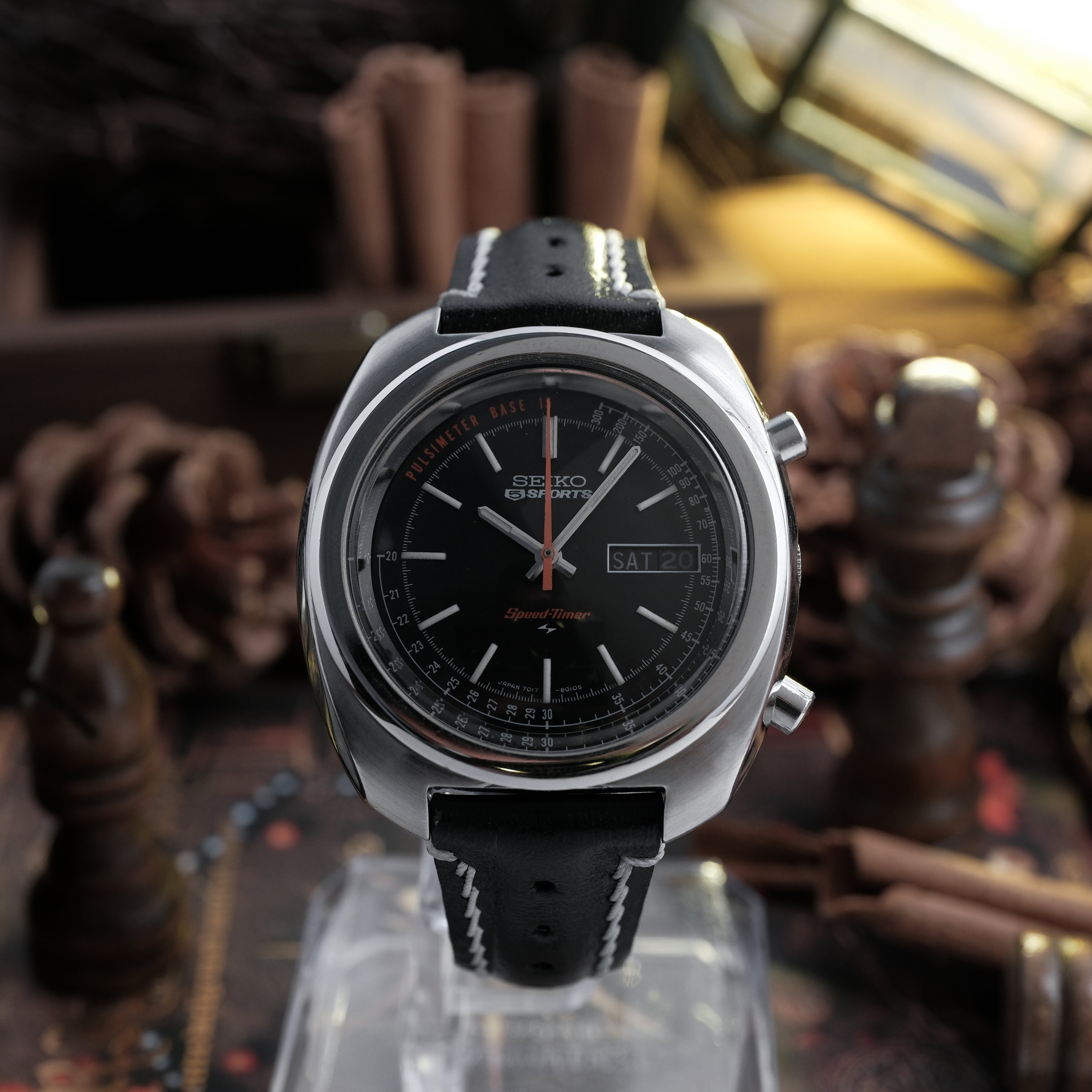
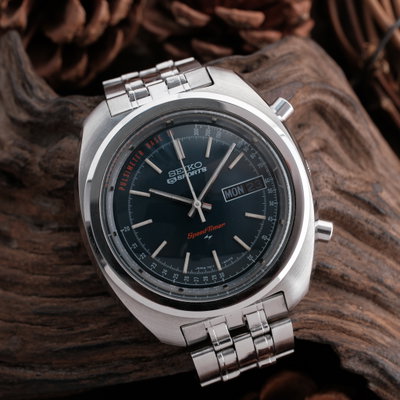
The Seiko 7017-8000 is a 1970-1971 automatic flyback chronograph whose strongest form pairs a clean pulsimeter dial with a sharp 40 mm steel case.
We auction more than 100 vintage watches a week.
Get first access: new Seiko 7017-8000 drops and alerts before auctions end.
Browse 33 live Seiko auctionsThe Seiko 7017-8000 compresses an automatic flyback chronograph into a 40 mm stainless-steel sports case, then gives the dial a practical pulsimeter scale. Made in 1970-1971, the 5 Sports Speed-Timer Chronograph belongs to the early Japanese sports-watch period rather than the later wave of bulky mechanical chronographs.
The version to want has a clean matte black or deep matte blue dial, intact orange accents and case lines that remain clearly defined. Early 1970 dials marked "Water 70m Proof" form a distinct variant, while 1971 examples establish that the reference continued with the same caliber 7017A architecture. A refinished dial costs more in lost appeal than minor case wear, so buy the dial before chasing surface shine.
Reference
7017-8000
Production years
1970-1971
Movement
Automatic flyback chronograph, caliber 7017A
Jewel count
21 jewels
| Case size | 40 mm excluding the crown |
| Case material | Stainless steel |
| Dial configurations | Matte black or deep matte blue with orange pulsimeter scale |
| Early dial wording | Water 70m Proof on a 1970 example |
The model landscape
Reference 7017-8000 appears under the names 5 Sports Speed-Timer Chronograph, 5 Sports Speed-Timer and Speed-Timer Chronograph, but the underlying proposition remains consistent: caliber 7017A, a flyback chronograph and a pulsimeter dial. Black dials with orange inner scales provide the clearest sports-watch look, while deep matte blue gives the same layout a cooler cast.
The early distinction is the "Water 70m Proof" text found on a 1970 example. That wording matters because it belongs to a specific dial configuration, not because it guarantees present-day water resistance. Between an early correctly printed dial in an honest case and a brighter refinished dial, take the former.
Value concentrates in the dial, the defined case geometry and a period-correct signed bracelet. The premium should follow crisp original printing, intact applied indices and coherent lume rather than a polished case or unsupported service claim. A factory service dial would still be genuine, but it would not carry the same originality as the dial fitted when the watch was made.
On the wrist
At 40 mm excluding the crown, the 7017-8000 has more wrist presence than many watches from 1970-1971. The tonneau-style cushion case spreads that size across a broad steel outline, while the matte dial and orange pulsimeter scale keep the display legible rather than decorative.
The automatic caliber 7017A gives the watch daily convenience, and the flyback mechanism lets the chronograph restart without a separate stop and reset sequence. That makes the used Seiko 7017-8000 more than a period design object, although any vintage chronograph should be judged by how cleanly its controls operate. A signed folded-link or branded multi-link bracelet completes the intended sports-watch profile, but stretch and poor end-link fit can make it feel less controlled on the wrist.
What goes wrong
The worst fault is a redial, especially where the orange pulsimeter track, minute printing or "Water 70m Proof" wording has been recreated. Uneven lume colour between the applied indices and hands can indicate a relume or replacement parts, while a dial and handset that never belonged together make the watch franken rather than simply serviced.
Over-polishing softens the broad case lines and rounds the transitions around the lugs. Folded-link bracelets can develop stretch, and replaced crowns or bracelets reduce coherence even when the substitutes function properly. Chronograph reset trouble is more consequential than cosmetic wear because caliber 7017A includes a flyback mechanism that must start, stop, return and restart correctly.
The service history is unknown unless supported by documentation, and no old "Water 70m Proof" dial should be treated as a current depth rating. Check the movement identity, flyback action and bracelet fit before giving weight to exterior brightness. A clean dial in a case with defined lines is the safer purchase than a polished watch with uncertain internals.
What to check before you buy
- Dial print and scale: The matte black or deep matte blue dial should carry a sharply defined orange pulsimeter scale and applied indices. Blurred tracks, uneven lettering or recreated "Water 70m Proof" text point toward a redial.
- Hands and lume: The handset and applied-index lume should age coherently with the dial. Strong colour mismatch, fresh luminous material or inconsistent application can indicate a relume, replacement hands or a franken assembly.
- Case geometry: The 40 mm stainless-steel tonneau-style cushion case should retain defined transitions and clear lines around the lugs. Rounded edges and soft surfaces indicate polishing that cannot be reversed.
- Movement and flyback: The movement must be caliber 7017A, and the chronograph should start, stop, reset and perform its flyback action cleanly. A different movement would make the watch incorrect for reference 7017-8000.
- Bracelet and fittings: Known examples use signed folded-link or branded multi-link bracelets. Check for stretch, distorted links and poor end-link fit, while remembering that period-correct fitment does not by itself prove the bracelet left the factory with the watch.
Other 7017-8000 examples we auctioned
6 Seiko 7017-8000 auctioned
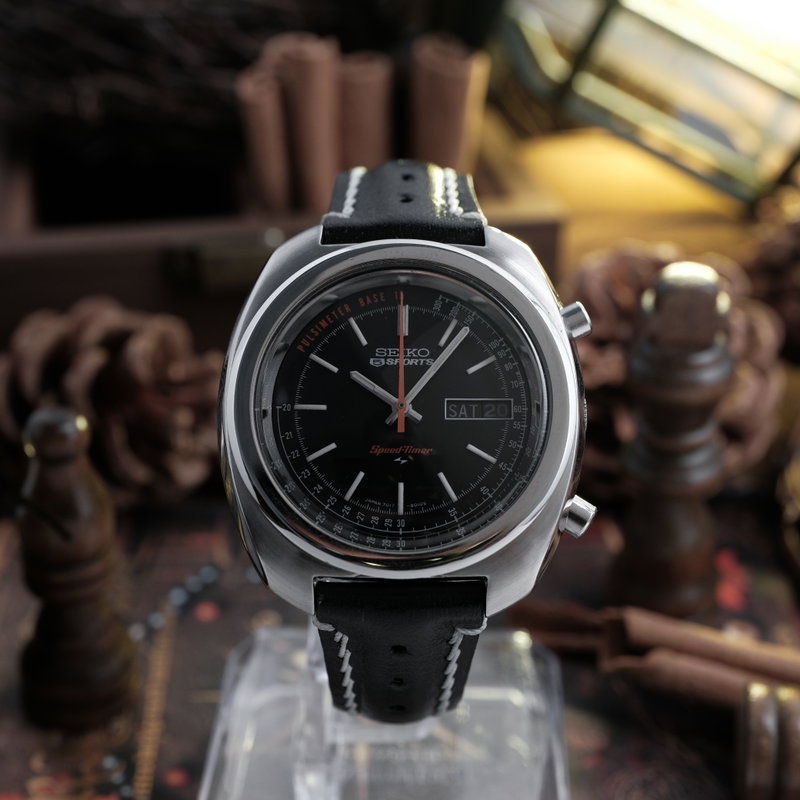
Seiko · 5 Sports Speed-Timer Chronograph · 7017-8000 · 1971
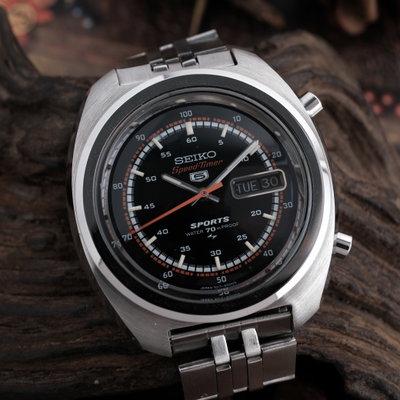
Seiko · 5 Sports Speed-Timer · 7017-8000 · 1970
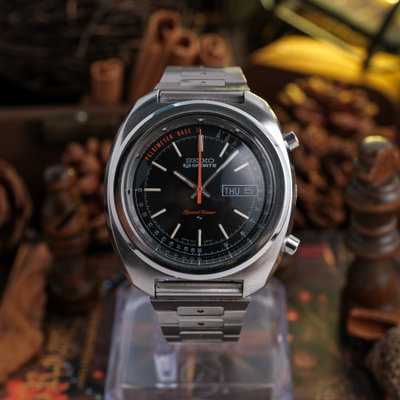
Seiko · 5 Sports Speed-Timer · 7017-8000 · 1971
Seiko · Speed-Timer Chronograph · 7017-8000 · 1971
More Seiko references
Related pages
Frequently asked questions
Ready to hunt for your own?
More than 100 vintage watches go under the hammer every week.