Seiko Lord Marvel 5740-8000 Reference Guide
The Seiko 5740-8000 is a 35 mm manual-wind Lord Marvel whose value depends chiefly on dial integrity, case definition and the correct 5740C movement.
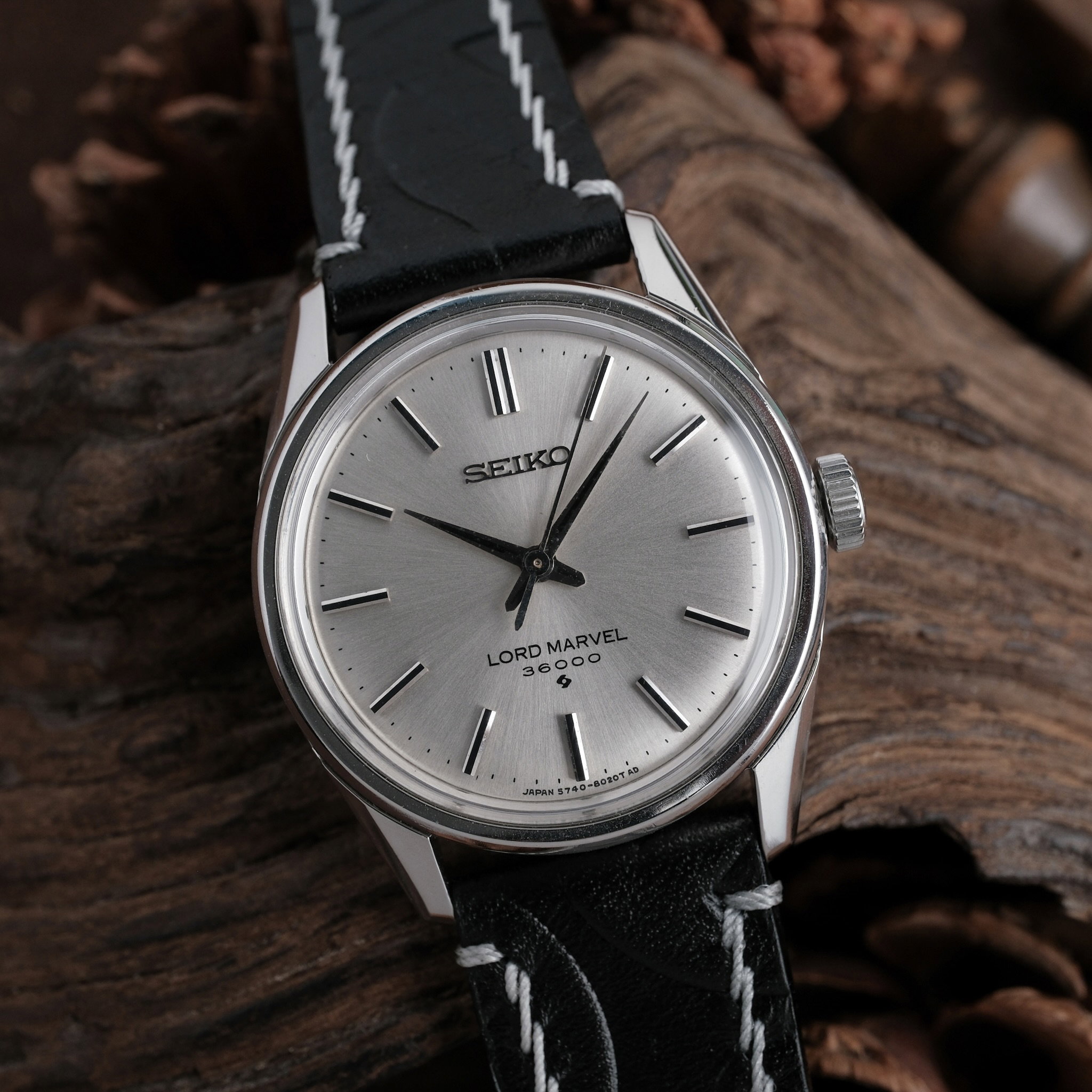
The Lord Marvel 36000 reference 5740-8000 put Seiko's first 36,000 beats-per-hour movement into a restrained stainless-steel watch. Its caliber 5740C is manually wound, and the 35 mm case keeps the engineering quieter than the name suggests. A used Seiko Lord Marvel from this family makes sense when you want the technical importance of early Japanese high-beat watchmaking without a large or complicated case.
The choice is between condition and dial character, not between good and bad versions. Silver sunburst dials with applied faceted indices give the Lord Marvel its cleaner formal face, while the silver linen dial with black Arabic numerals is more graphic. Between a clean sunburst dial and a damaged linen dial, take the sunburst. Refinishing, moisture damage and softened case edges matter more than the apparent scarcity of either configuration.
Reference
5740-8000
Model
Lord Marvel 36000
Known production span
1965-1978
Case diameter
35 mm excluding the crown
| Case material | Stainless steel |
| Movement | Seiko caliber 5740C |
| Winding | Manual winding |
| Jewels | 23 jewels |
| Frequency | 36,000 beats per hour |
| Known dial configurations | Silver sunburst with applied faceted indices; silver linen with black printed Arabic numerals |
What it was built for
The 5740-8000 was built around caliber 5740C, Seiko's first movement running at 36,000 beats per hour. That frequency was the point of the Lord Marvel 36000, but the watch remained manually wound and visually restrained. The result is not a sports watch disguised as a dress watch. It is a high-frequency mechanical watch in a compact stainless-steel case.
Production examples run from 1965 through 1978, placing the reference across more than one dial treatment rather than a single frozen design. A 1967 Lord Marvel is known with a silver linen dial and printed Arabic numerals, while 1969 and 1970 watches are known with silver sunburst dials and applied indices. Those dates establish valid configurations, but they do not prove that every dial was available in every year.
The model landscape
The sunburst dial is the straightforward version to buy against a linen dial with staining, damaged printing or replacement hands. Applied faceted indices catch more light and make the 35 mm case feel dressier. The linen configuration uses black printed Arabic numerals, a matching minute track and black dauphine hands, producing stronger contrast without making the watch physically larger.
At 35 mm excluding the crown, the 5740-8000 wears compactly by current standards. The broad silver dial keeps it readable, while manual winding makes the crown part of daily ownership rather than an occasional control. The black hands and numerals of the linen version give clearer contrast; the applied furniture of the sunburst version changes more with the light.
Value sits first in an undamaged dial, then in a case that still shows defined lugs, and finally in a correct caliber 5740C that performs properly. A presentation engraving can be legitimate: a 1970 example bears a Kawasaki Heavy Industries award for thirty years of service. Without supporting documentation, however, the engraving itself should not attract a provenance premium.
What goes wrong
A refinished or moisture-damaged dial is the costliest fault because neither the silver linen texture nor the sunburst finish is easy to recreate convincingly. On the linen version, blurred Arabic numerals or an inconsistent minute track point toward a redial. On either version, spotting and staining are damage, while an even warm shift on a silver sunburst dial can be honest ageing when the printing remains intact.
Over-polishing removes definition from the stainless-steel case, leaving soft lugs and weak transitions around the bezel. A replacement crown may be functional and period-correct, but that does not make it original to the watch. Mixed dial, hand and movement components can create a franken example, while a case and movement taken from separate watches make it married rather than fake.
Caliber 5740C needs more than proof that it runs. One operational 1967 example measured approximately 45 to 47 seconds fast per day, so running condition alone does not establish acceptable performance. The service history of an undocumented watch is unknown, and the high-frequency movement should be judged on measured performance. Buy the cleaner dial and sharper case against a supposedly serviced example with no receipt.
What to check before you buy
- Dial configuration and printing: Known configurations include a silver sunburst dial with applied faceted indices and a silver linen dial with black printed Arabic numerals. Blurred numerals, uneven tracks or a missing linen texture support a redial diagnosis.
- Movement identity: The correct movement is the manual-wind Seiko caliber 5740C with 23 jewels and a frequency of 36,000 beats per hour. A different caliber makes the watch incorrect and may indicate a franken or married assembly.
- Case dimensions and definition: The reference uses a 35 mm stainless-steel case measured without the crown. Soft lugs and weak case transitions diagnose polishing, although polishing alone does not prove that the case is counterfeit or unrelated.
- Hands on the linen dial: The documented silver linen configuration pairs black printed Arabic numerals with black dauphine hands and a matching minute track. Different hands are not automatically false, but they need evidence before being called original.
- Caseback engraving: A presentation engraving is not automatically evidence of tampering: a 1970 watch is known with a Kawasaki Heavy Industries thirty-year service inscription. Without documents, the engraving establishes only what is cut into the caseback.
Other 5740-8000 examples we auctioned
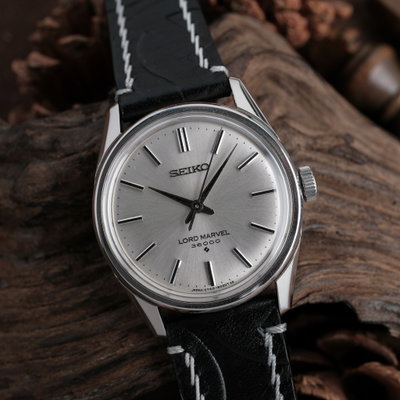
Seiko · Lord Marvel 36000 · 5740-8000 · 1970
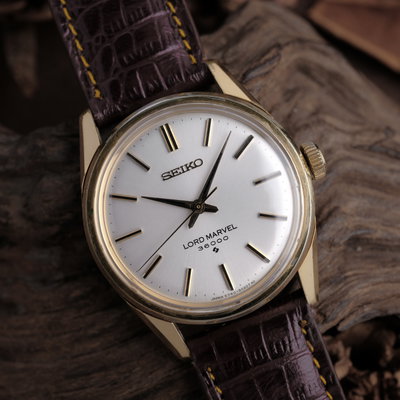
Seiko · Lord Marvel · 5740-8000 · 1970
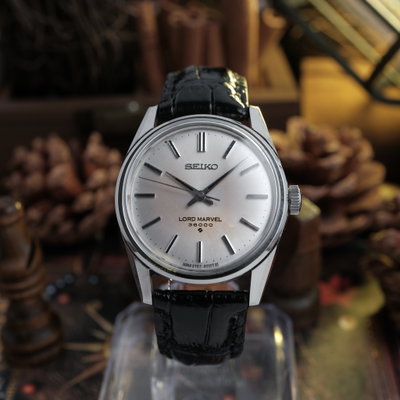
Seiko · Lord Marvel 36000 · 5740-8000 · 1969
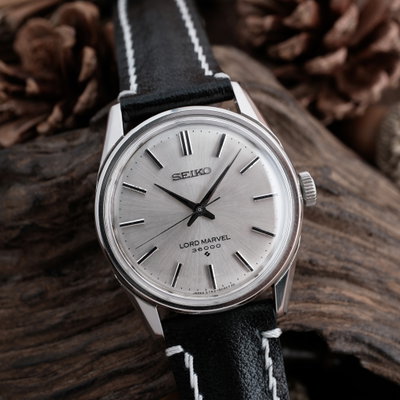
Seiko · Lord Marvel · 5740-8000 · 1975
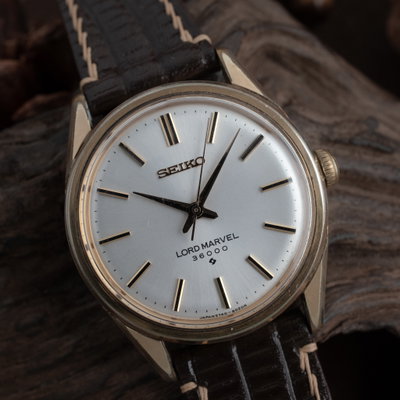
Seiko · Lord Marvel · 5740-8000 · 1974
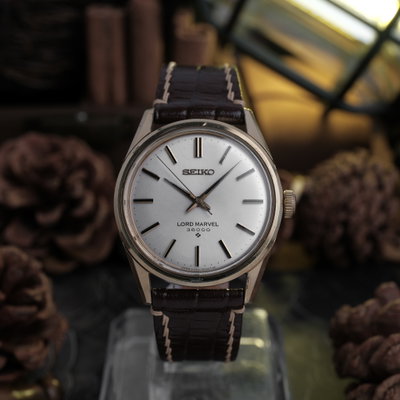
Seiko · Lord Marvel · 5740-8000 · 1968
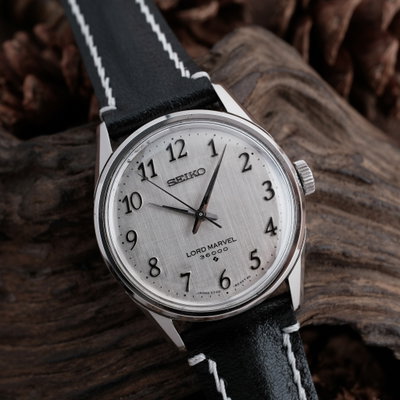
Seiko · Lord Marvel 36000 · 5740-8000 · 1968
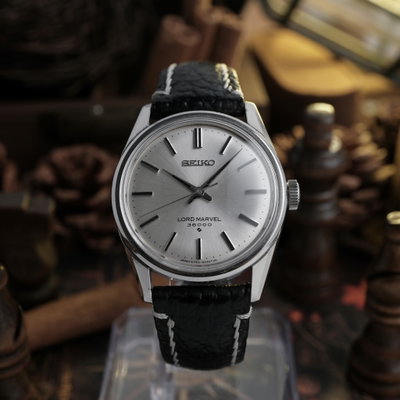
Seiko · Lord Marvel 36000 · 5740-8000 · 1969
More Seiko references
Related pages
Frequently asked questions
Ready to hunt for your own?
More than 100 vintage watches go under the hammer every week.