Seiko 5626-7180 King Seiko Vanac Reference Guide
Buy the Seiko 5626-7180 for its dial, faceted crystal and sharp case geometry, but favor coherent parts and documented movement condition over surface shine.
We auction more than 100 vintage watches a week.
Get first access: new Seiko 5626-7180 drops and alerts before auctions end.
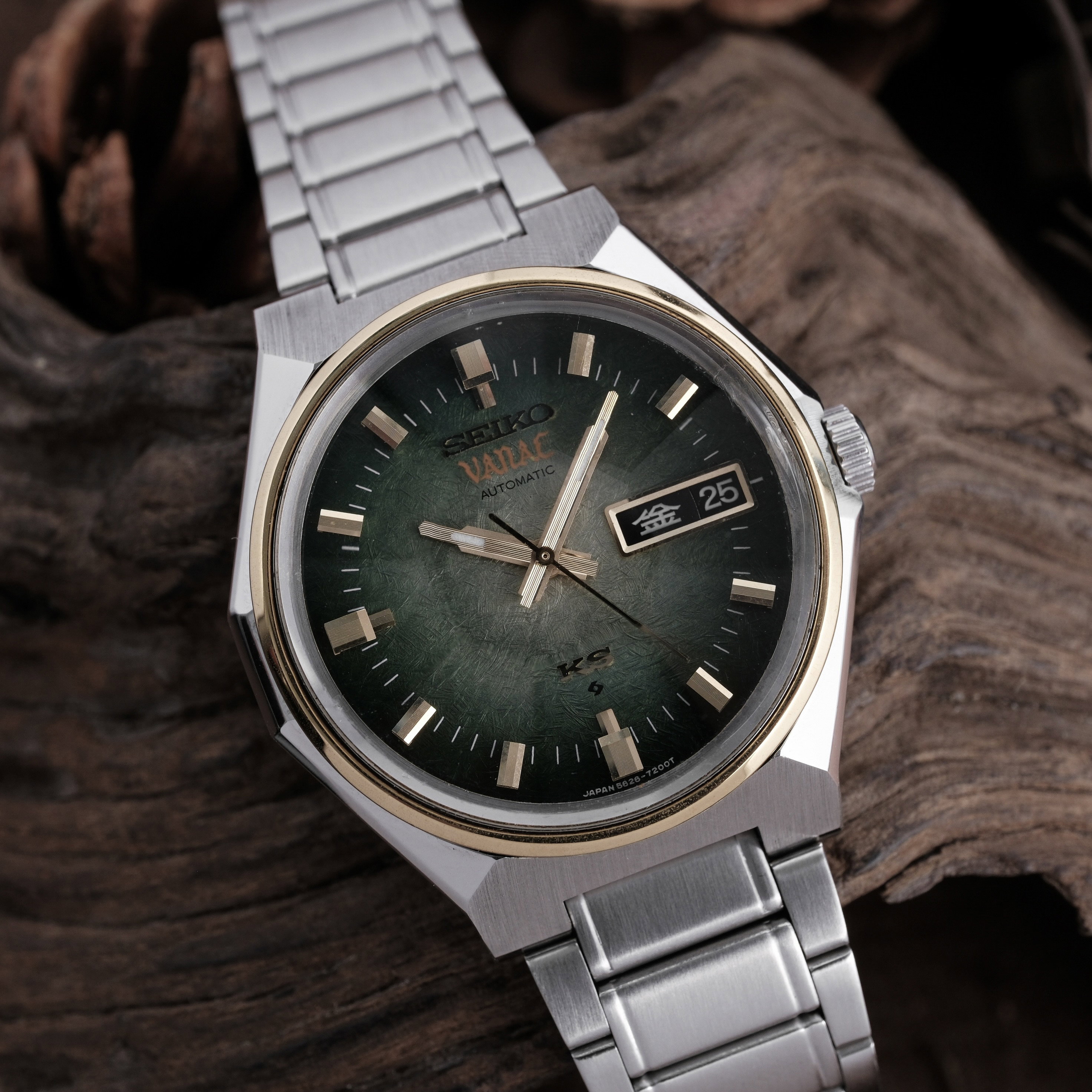
Browse 24 live Seiko auctionsThe 1973 King Seiko Vanac 5626-7180 pairs an automatic caliber 5626B with a faceted crystal and a strongly angular stainless-steel case. Known examples measure 36 or 37 mm without the crown, so this is a compact watch whose dial and crystal supply most of its visual presence.
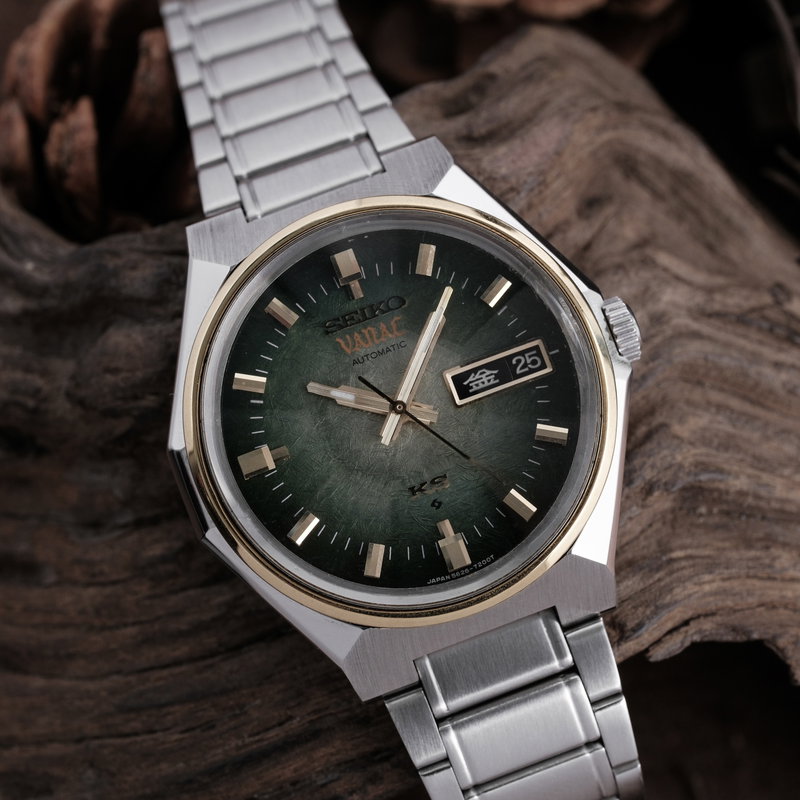
Dial choice defines the reference. Electric blue, red sunburst and emerald-green sunburst versions are known, with applied indices and contrasting accents varying the effect. A period-correct Seiko bracelet strengthens the design, but period-correct does not prove that the bracelet originally left the factory with that particular watch.
Brand
Seiko
Model
King Seiko Vanac
Reference
5626-7180
Production year
1973
| Movement | Automatic caliber 5626B |
| Case material | Stainless steel |
| Known case sizes | 36 mm or 37 mm, excluding the crown |
| Known dial executions | Electric blue, red sunburst, emerald-green sunburst |
| Crystal | Faceted crystal |
| Display | Framed day-date at 3 o'clock |
What it was built for
The King Seiko Vanac 5626-7180 belongs squarely to 1973, when its faceted crystal, angular steel case and saturated dial colors made geometry part of the time display. The crystal breaks reflections across the dial rather than presenting one uninterrupted surface. That effect is central to the watch, which means crystal damage changes more than condition - it weakens the design itself.
Caliber 5626B provides automatic winding and a framed day-date display at 3 o'clock. The movement and calendar make the 5626-7180 practical enough for regular wear, but no service interval or water-resistance figure is established by the watches handled. The service history is unknown unless paperwork accompanies the individual watch, and vintage gaskets should never be treated as proof of water resistance.
The model landscape
The electric-blue dial works through the faceted crystal, while the red and emerald-green sunburst dials add directional light and gold-tone accents. Between two similarly preserved examples, dial color is the legitimate preference; between an untouched dial and a refinished one, take the untouched dial regardless of color. A redial costs more in lost coherence than moderate case wear.
Case measurements recorded for the 5626-7180 vary between 36 and 37 mm without the crown. That single millimetre may reflect measurement method, so it should not be used to divide the reference into unsupported variants. Bracelet configuration matters more: a period-correct Seiko bracelet completes the integrated 1970s appearance, while a replacement strap changes the watch's stance without making the head itself inauthentic.
What goes wrong
Crystal wear is the first visible weakness because scratches interrupt the facets and scatter light across the dial. Case polishing is next: softened planes and rounded transitions reduce the angular architecture that identifies the 5626-7180. Bracelet stretch and loose fitment also matter, while replacement crowns or a married case and movement can turn an attractive watch into a parts assembly.
The dial still carries the largest share of the value. Uneven printing, disturbed signatures or a finish inconsistent with the known blue, red sunburst and emerald-green sunburst executions can indicate a redial or franken assembly, though a genuine service dial is a different category from refinishing. Movement performance cannot be inferred from appearance, and one recorded example running substantially slow shows why a timegrapher result and service documentation are separate evidence.
Dating this watch
| Serial range / caliber | Year | Note |
|---|---|---|
| 5626 | 1968-1975 | caliber production window |
Dating data comes from our decoder tables; treat years as approximate.
What to check before you buy
- Dial configuration: Known 5626-7180 dials include electric blue, red sunburst and emerald-green sunburst executions with applied indices. Printing and signatures should remain coherent with the finish, without evidence of a redial.
- Hands and calendar: Known examples pair the dial with applied indices, contrasting hands and a framed day-date display at 3 o'clock. Mismatched color treatment or an incoherent handset can indicate replaced parts or a franken assembly.
- Case and crystal: The stainless-steel case should retain angular planes that work with the faceted crystal. Rounded transitions indicate polishing, while heavy scratches across the facets materially alter the reference's intended display.
- Movement coherence: Handled examples use the automatic caliber 5626B. That caliber alone does not authenticate the watch, so its relationship to the 5626-7180 case and the 1973 date must remain coherent rather than merely period-correct.
- Bracelet and crown: A period-correct Seiko bracelet supports the 1970s configuration but does not prove original fitment. Bracelet stretch, loose end fit and a replacement crown should be disclosed separately from the authenticity of the watch head.
Other 5626-7180 examples we auctioned
8 Seiko 5626-7180 auctioned
More Seiko references
Related pages
Frequently asked questions
Ready to hunt for your own?
More than 100 vintage watches go under the hammer every week.