Seiko 5606-5040 Lord Matic: Dial, Case and Buying Guide
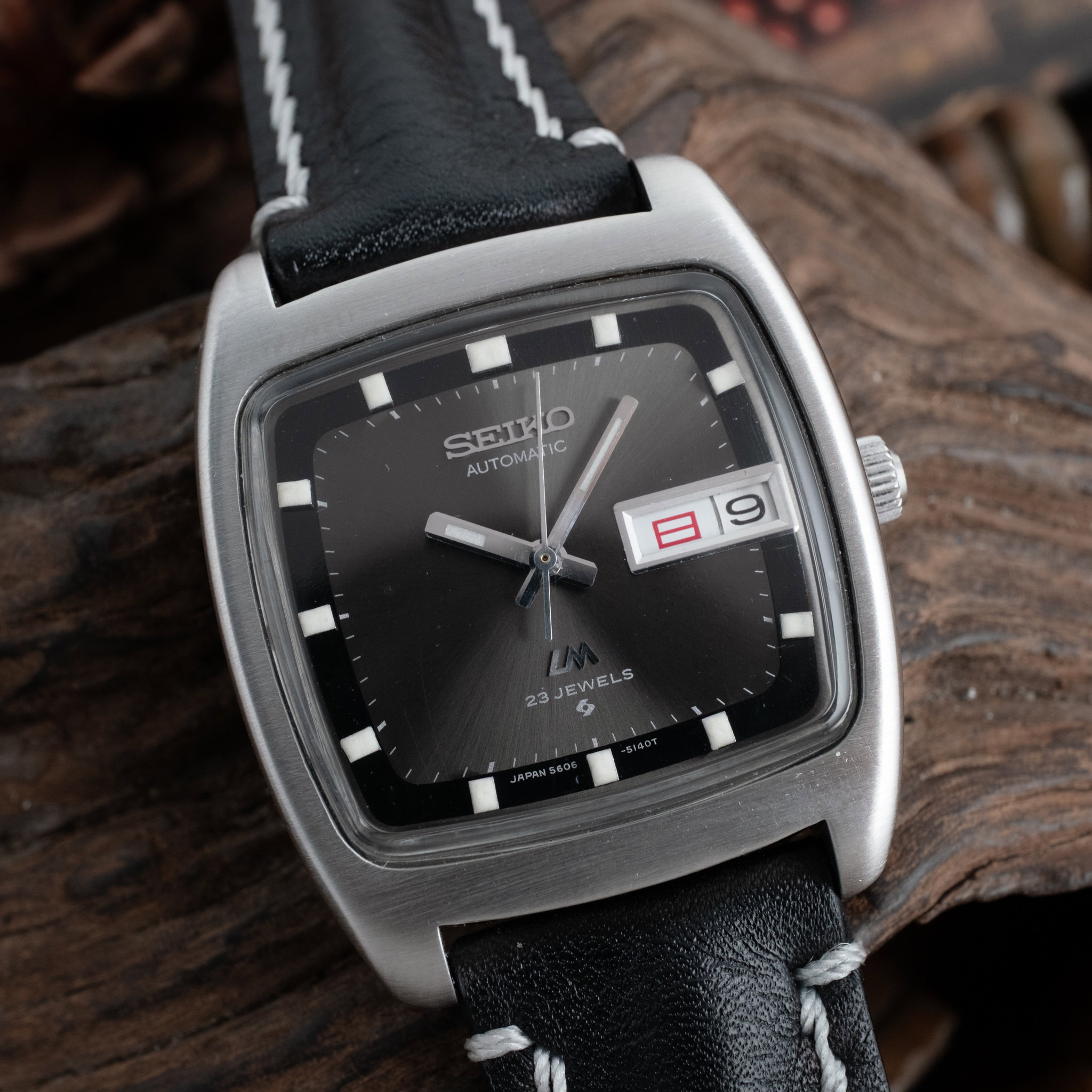
The Seiko 5606-5040 is a compact 1971-1972 Lord Matic whose value rests on its textured dark dial, faceted crystal and sharp cushion case.
We auction more than 100 vintage watches a week.
Get first access: new Seiko 5606-5040 drops and alerts before auctions end.
Browse 27 live Seiko auctionsThe Seiko 5606-5040 compresses early 1970s design into a compact stainless steel Lord Matic. Its square cushion case, faceted crystal and dark dial make more visual impact than the 32-33 mm measurement suggests, while the automatic caliber 5606 supplies the day and date display at three o'clock.
The version to buy has a clean textured dial and enough case definition to preserve the angular design. Dark grey linen, vertically brushed and grey-to-black sunburst dials have all passed through our hands, with applied indices and silver-tone baton hands providing contrast. A refinished dial costs more in lost character than ordinary case wear, especially on a reference whose identity depends on surface texture.
Model
Lord Matic
Reference
5606-5040
Known production years
1971-1972
Case material
Stainless steel
| Case size | 32-33 mm excluding the crown |
| Movement | Automatic caliber 5606 |
| Observed jewel counts | 23 or 25 jewels |
| Display | Day and date at three o'clock |
| Crystal | Faceted crystal |
| Observed dial finishes | Dark grey linen, vertical brushed, and grey-to-black sunburst |
What it was built for
The 5606-5040 belongs to 1971-1972 and places its automatic caliber 5606 inside a stainless steel cushion case. The framed day and date display at three o'clock makes it practical as a daily watch, but the faceted crystal and architectural case separate it from a conventional round dress watch.
Its proportions suit a collector who wants a used Seiko with clear 1970s geometry rather than modern wrist presence. At 32-33 mm excluding the crown, the case reads compactly, yet the broad square outline gives the dial more visual area than a similarly measured round case. The faceted crystal adds height and reflected edges without changing the restrained footprint.
Where the value sits
The dial carries the premium on the Seiko 5606-5040. Linen crosshatching produces a different effect from the vertical brushed finish, while the dark grey-to-black sunburst version changes with the light. None should be treated as interchangeable during repair, because fitting another period-correct 5606-5040 dial would still make the watch a franken if that dial did not ship with it.
Between a sharply defined case with ordinary scratches and a heavily polished case with a cleaner surface, take the sharper case. The cushion outline needs distinct planes around the crystal; soft edges make the entire watch look flatter. Jewel count alone does not decide value, since handled examples contain both 23-jewel and 25-jewel caliber 5606 movements.
What goes wrong
The most expensive fault is a redial that replaces the original linen, brushed or sunburst surface with a generic dark finish. Moisture spotting, damaged printing and oxidation on the silver-tone baton hands also matter, but they should be described separately rather than hidden under the word patina. A genuine service dial is different from a redial, although no service-dial status should be claimed without evidence.
Case polishing removes the crisp transitions that give the 5606-5040 its square cushion shape, while chips or heavy scratches on the faceted crystal disrupt the dial view. Replaced crowns and mismatched day wheels can also turn an otherwise coherent watch into a parts assembly. The service history is unknown unless paperwork establishes it, and an attractive timegrapher reading is not a substitute for documented movement work.
Dating this watch
| Serial range / caliber | Year | Note |
|---|---|---|
| 5606 | 1968-1976 | caliber production window |
Dating data comes from our decoder tables; treat years as approximate.
What to check before you buy
- Dial layout and surface: The observed 5606-5040 dials are dark grey linen, vertically brushed or grey-to-black sunburst, with applied indices and applied Seiko and LM logos. A smooth generic finish can indicate a redial.
- Hands and calendar: Silver-tone baton hands with central white stripes belong with the handled dial layouts. The framed day and date window sits at three o'clock, and known examples include an English and Kanji day wheel.
- Case geometry and crystal: The stainless steel case has a square cushion profile around a faceted crystal. Rounded transitions or a flattened outline indicate polishing that has removed metal from the design's defining planes.
- Movement identity: The reference has been handled with automatic caliber 5606 movements in both 23-jewel and 25-jewel form. The caliber should be assessed with the case and dial, since jewel count alone does not establish a correct watch.
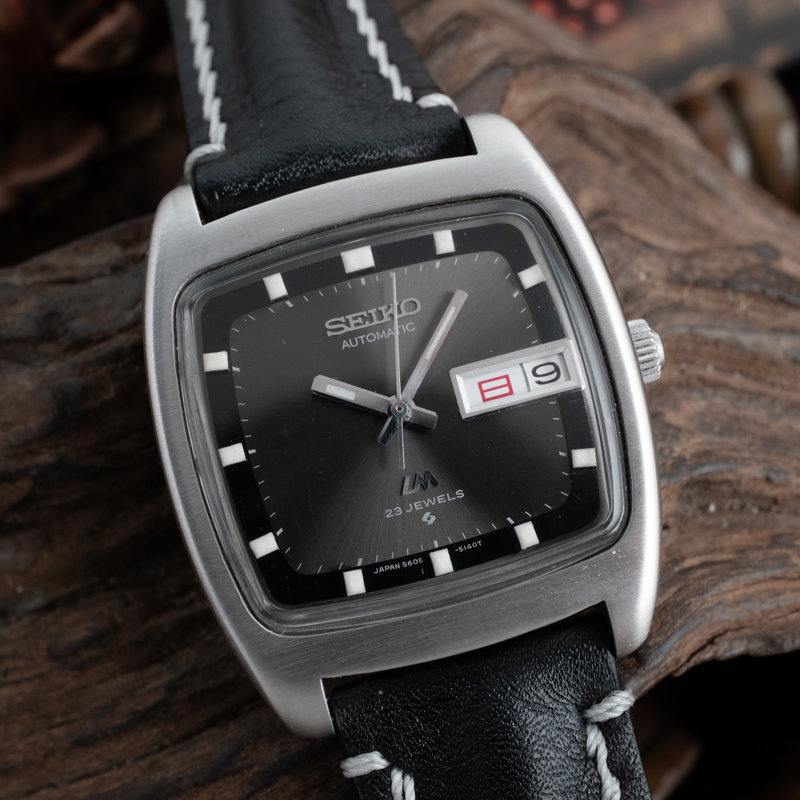
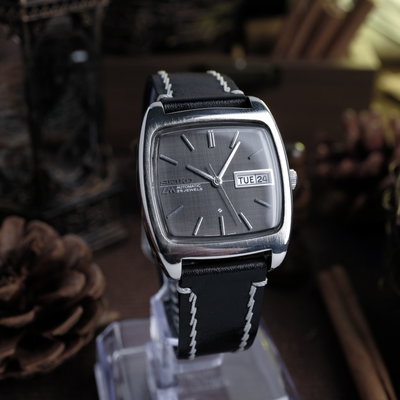
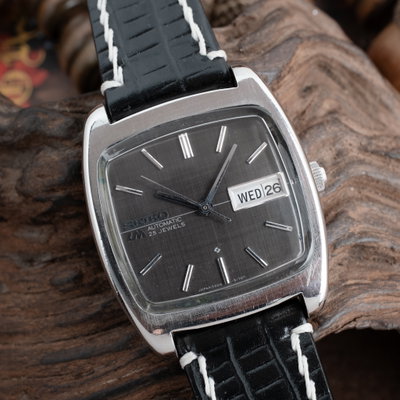
Other 5606-5040 examples we auctioned
15 Seiko 5606-5040 auctioned
More Seiko references
Related pages
Frequently asked questions
Ready to hunt for your own?
More than 100 vintage watches go under the hammer every week.