King Seiko Vanac 5626-5050: what to know before buying
Buy the King Seiko Vanac 5626-5050 for its dial and angular case, but favor sharp geometry, an intact faceted crystal and the correct bracelet over louder color.
We auction more than 100 vintage watches a week.
Get first access: new Seiko 5626-5050 drops and alerts before auctions end.
Browse 27 live Seiko auctionsThe vintage King Seiko Vanac 5626-5050 changes character more than its reference number suggests. Electric blue faceting and gold sunburst make the watch assertive, while textured and two-tone silver dials look cooler and more architectural. All four executions have been found in this stainless steel reference.
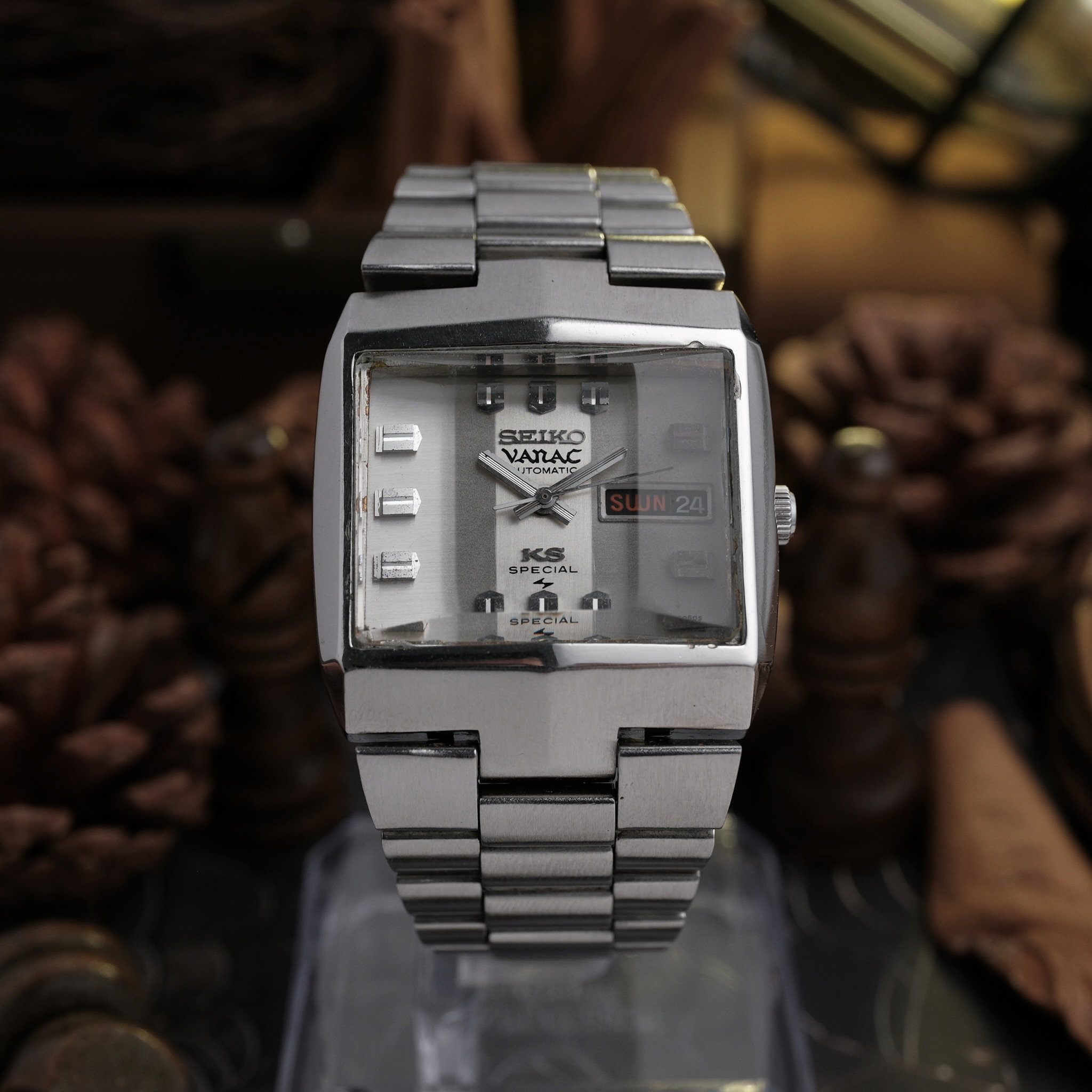
Examples we have handled date to 1972 and 1973 and use the automatic caliber 5626 beneath a faceted crystal. Recorded cases measure 35 mm or 36 mm excluding the crown, so a one-millimetre difference is not an authentication test. On the King Seiko Vanac shown here, the buying decision rests mainly on the dial, preserved case edges, crystal facets and bracelet completeness.
Reference
5626-5050
Model
King Seiko Vanac
Known production years
1972-1973
Movement
Automatic caliber 5626
| Case material | Stainless steel |
| Observed case size | 35 mm or 36 mm, excluding the crown |
| Crystal | Faceted crystal |
| Known dial executions | Electric blue faceted, gold sunburst, textured silver, and two-tone silver with vertical brushing |
| Known bracelet detail | Integrated stainless steel bracelet with Vanac-signed clasp |
The model landscape
The electric blue dial has a faceted texture, while the gold version uses a sunburst finish and a blue Vanac signature at 6 o'clock. Silver takes two forms: a textured execution and a two-tone dial with vertical brushing. A 1973 two-tone example also carries the Daini Seikosha mark and a 5206 dial code, so that code alone does not condemn a dial fitted above caliber 5626.
Value concentrates in the parts that define this reference and cannot be casually substituted. The dial carries the widest penalty when damaged or refinished, the faceted crystal supplies much of the visual effect, and the integrated stainless steel bracelet completes the case design. A Vanac-signed clasp is known on the correct bracelet. Against a brighter example with a soft case or missing bracelet, take the sharper silver watch.
On the wrist
At 35 mm or 36 mm excluding the crown, the 5626-5050 sounds restrained by current standards, but its square-edged case and broad dial opening give it more visual area than a round watch of similar width. The faceted crystal, applied geometric markers and angular hands break reflected light across the dial. This is not a discreet dress-watch shape, even when the dial is silver.
Ownership depends heavily on movement state rather than cosmetic preservation. Timegrapher readings recorded on running examples ranged from roughly +13 to +45 seconds per day, a spread too wide to treat operation as proof of proper servicing. Caliber 5626 is automatic, but the service history of an individual used King Seiko Vanac is unknown without documentation. A rate reading describes that test only, not future performance.
What goes wrong
A refinished dial costs more in lost appeal than ordinary case wear, because color and surface treatment distinguish the 5626-5050 variants. Original dials can also be damaged: handled examples include visible dial wear, while oxidation and dust have been found on the hands under magnification. Patina means even ageing, not missing finish or staining. No service-dial pattern is established here, so an unfamiliar dial should not be confidently called a factory replacement.
Polishing removes the case geometry first, leaving softened edges where the Vanac design should look deliberate and angular. The faceted crystal also accumulates wear, and replacing it with a plain profile changes the watch immediately. Integrated bracelets can develop stretch, while a replacement clasp removes the known Vanac signature. None of these faults proves the watch is fake, but mixed parts that never shipped together make it a franken rather than an honest used Seiko 5626-5050.
Dating this watch
| Serial range / caliber | Year | Note |
|---|---|---|
| 5626 | 1968-1975 | caliber production window |
Dating data comes from our decoder tables; treat years as approximate.
What to check before you buy
- Dial execution and printing: Known executions include electric blue faceting, gold sunburst with a blue Vanac signature at 6 o'clock, textured silver, and two-tone silver with vertical brushing. An unfamiliar surface needs evidence before it is called a service dial.
- Dial code context: A 1973 two-tone silver dial is known with the Daini Seikosha mark and a 5206 dial code despite the watch using caliber 5626. Treat that code as configuration evidence, not an automatic sign of a redial or franken watch.
- Hands and hour markers: The reference is known with applied faceted geometric indices and angular hands. A two-tone silver example uses faceted baton hands with black center stripes, while oxidation or dust on genuine hands is wear rather than proof of replacement.
- Case geometry: The stainless steel case should retain deliberate angular transitions and strong edges. Polishing first softens those lines, so mushy corners are a condition fault even when the case dimensions remain within the observed 35 mm to 36 mm range.
- Crystal profile: The faceted crystal is part of the 5626-5050 design rather than a generic cover. Heavy abrasion can obscure the dial, while a plain replacement profile removes the light-breaking geometry expected on a King Seiko Vanac.
- Movement identity: The correct movement is the automatic caliber 5626. A different caliber can indicate a married or franken watch, and a positive rate reading does not prove the movement was serviced or that the case and movement originally left the factory together.
- Bracelet and clasp: The reference is known on an integrated stainless steel bracelet with a Vanac-signed clasp. A replacement bracelet does not make the watch counterfeit, but mismatched fitment, stretch or an unsigned clasp should be reflected in the assessment of completeness.
Other 5626-5050 examples we auctioned
5 Seiko 5626-5050 auctioned
More Seiko references
Related pages
Frequently asked questions
Ready to hunt for your own?
More than 100 vintage watches go under the hammer every week.