Seiko 5626-7113: What Matters Before You Buy
Buy the Seiko 5626-7113 for a clean silver sunburst dial, sharp case geometry and correct caliber 5626B, not for polish or an unsupported service claim.
We auction more than 100 vintage watches a week.
Get first access: new Seiko 5626-7113 drops and alerts before auctions end.
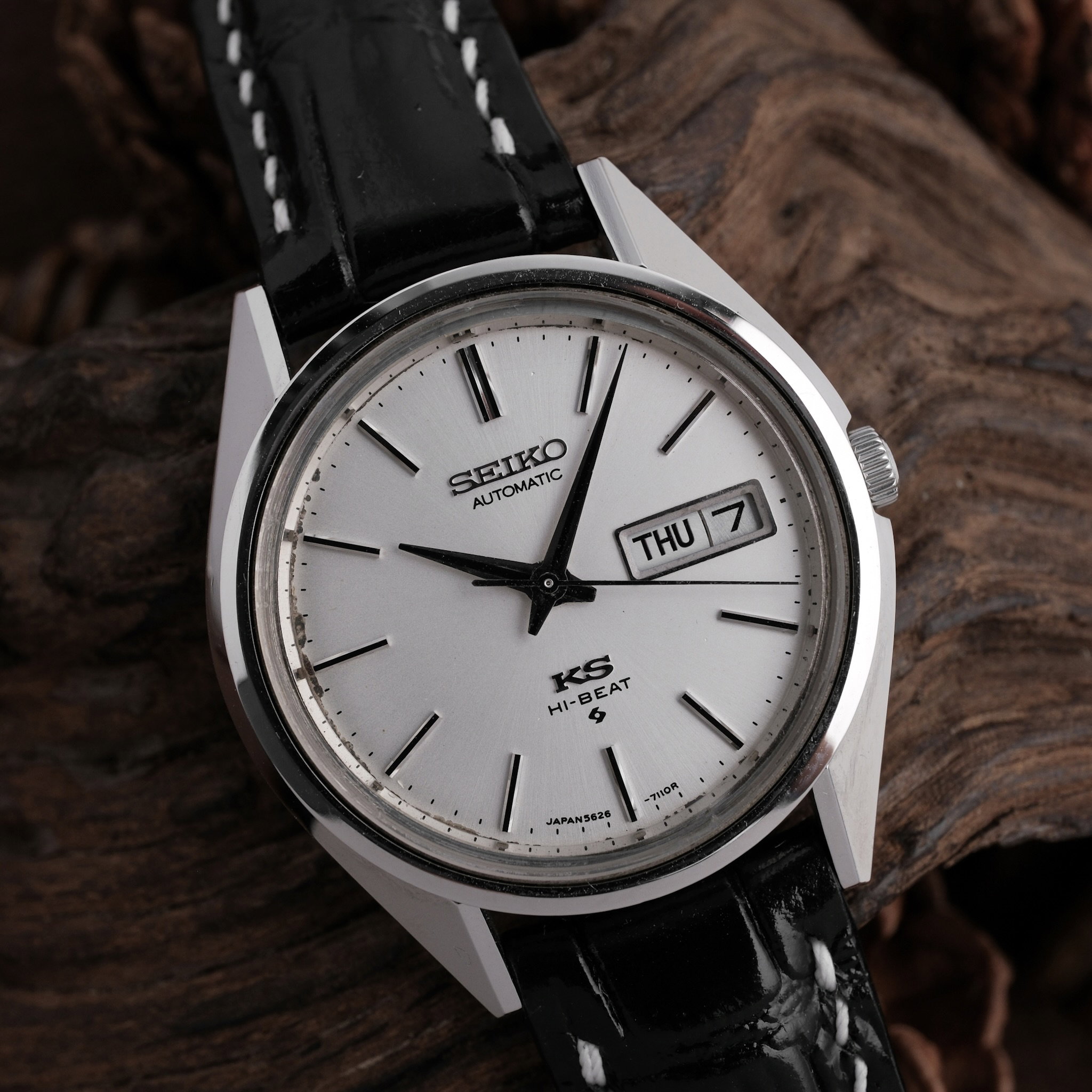
Browse 14 live Seiko auctionsThe Seiko 5626-7113 compresses the King Seiko Hi-Beat formula into a 36 mm stainless steel case with a silver sunburst dial, applied furniture and automatic caliber 5626B. Examples handled from 1973 and 1974 establish a compact, sharply faceted watch whose character depends more on surviving case geometry than nominal diameter. The version to want pairs clean dial furniture with distinct brushed and polished surfaces.
A used Seiko 5626-7113 can look convincing after heavy polishing because the broad dial and bright indices still photograph well. That is the trap. Rounded facets permanently weaken the case design, while dark corrosion around the applied KS emblem can cost more than minor marks elsewhere. An English and Kanji day wheel adds period character, but it should never compensate for a damaged dial or a soft case.
Reference
5626-7113
Model
King Seiko Hi-Beat
Supported production years
1973-1974
Movement
Automatic caliber 5626B
| Jewel count | 25 jewels |
| Case diameter | 36 mm excluding the crown |
| Case material | Stainless steel |
| Dial | Silver sunburst with applied indices |
| Calendar | Day-date display |
| Known day wheel | English and Kanji |
What it was built for
The 5626-7113 belongs to the 1973-1974 King Seiko range established by the watches handled here. Its automatic caliber 5626B drives a day-date display, and known examples combine that practical calendar with dauphine hands carrying black central stripes. This is a precise, formal daily watch rather than a sports case disguised by a silver dial.
At 36 mm excluding the crown, the case wears compactly, but its angular surfaces give it more presence than a round case of equal width. The silver sunburst finish changes with light, while applied indices and black-striped hands preserve legibility. Exact thickness is not established by the available evidence, so cuff clearance should not be claimed from measurements we do not have.
Where the value sits
The dial takes priority because damage around the applied KS emblem is conspicuous and cannot be treated as attractive patina. We have handled examples ranging from clean silver surfaces to significant dark corrosion around that emblem, with lesser faults including edge wear, spotting and trapped debris. Between a sharp watch with light edge ageing and a brighter redial, take the sharp watch with its period dial intact.
Case geometry comes next. Distinct brushed and polished planes, crisp transitions and defined facets carry the design, while polishing makes those boundaries soft and cannot be reversed by servicing. A signed crown and English and Kanji day wheel strengthen a coherent example, but neither proves that every component left the factory together. No production total is established, so rarity claims for the reference or a particular day wheel are not justified.
Dating and serials
Handled 5626-7113 examples date from 1973 through 1974, which is the bounded production range supported for this reference here. The broader caliber 5626 production window runs from 1968 through 1975, but that window dates the caliber family rather than every watch carrying it. It should not be used to stretch the reference beyond the years established by complete examples.
A movement marked 5626B is the expected mechanical match for the 5626-7113 watches described here. The service history remains unknown unless dated documentation accompanies the individual watch, and a timegrapher result alone does not establish what work was performed. Without such paperwork, the movement's identity and current performance can be stated, but its prior maintenance should not be guessed.
Dating this watch
| Serial range / caliber | Year | Note |
|---|---|---|
| 5626 | 1968-1975 | caliber production window |
Dating data comes from our decoder tables; treat years as approximate.
What to check before you buy
- Movement identity: The expected movement is the automatic caliber 5626B. A different caliber requires an explanation and may indicate a franken or married watch rather than a coherent 5626-7113.
- Dial construction: Known dials use a silver sunburst surface with applied indices, an applied Seiko signature and an applied KS emblem. Flat paint, crude printing or misplaced furniture points toward a redial or incompatible dial.
- Hands and calendar: Dauphine hands with black central striping are consistent with handled examples, as is a day-date display. An English and Kanji wheel is known, but its presence alone does not establish originality.
- Case geometry: The stainless steel case should retain clear separation between brushed and polished planes with defined angular facets. Soft transitions and rounded edges diagnose polishing, not a different factory case shape.
- Crown and component coherence: A signed crown is known on the reference, but crowns are service components and can be replaced. Treat the signature as supporting evidence only, then compare the dial, case and caliber as one watch.
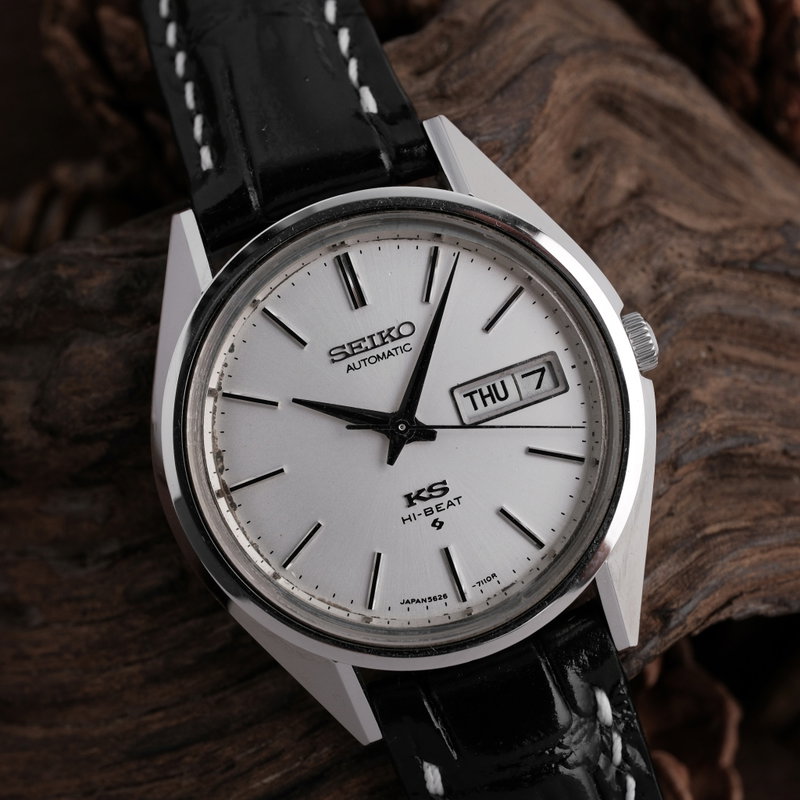
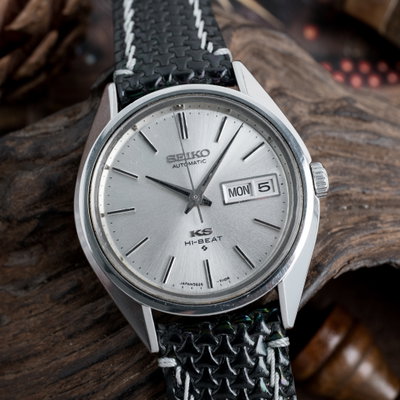
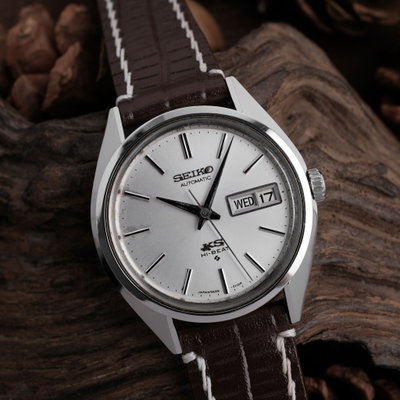
Other 5626-7113 examples we auctioned
More Seiko references
Related pages
Frequently asked questions
Ready to hunt for your own?
More than 100 vintage watches go under the hammer every week.