Seiko 5216-7040 LM Special Reference Guide
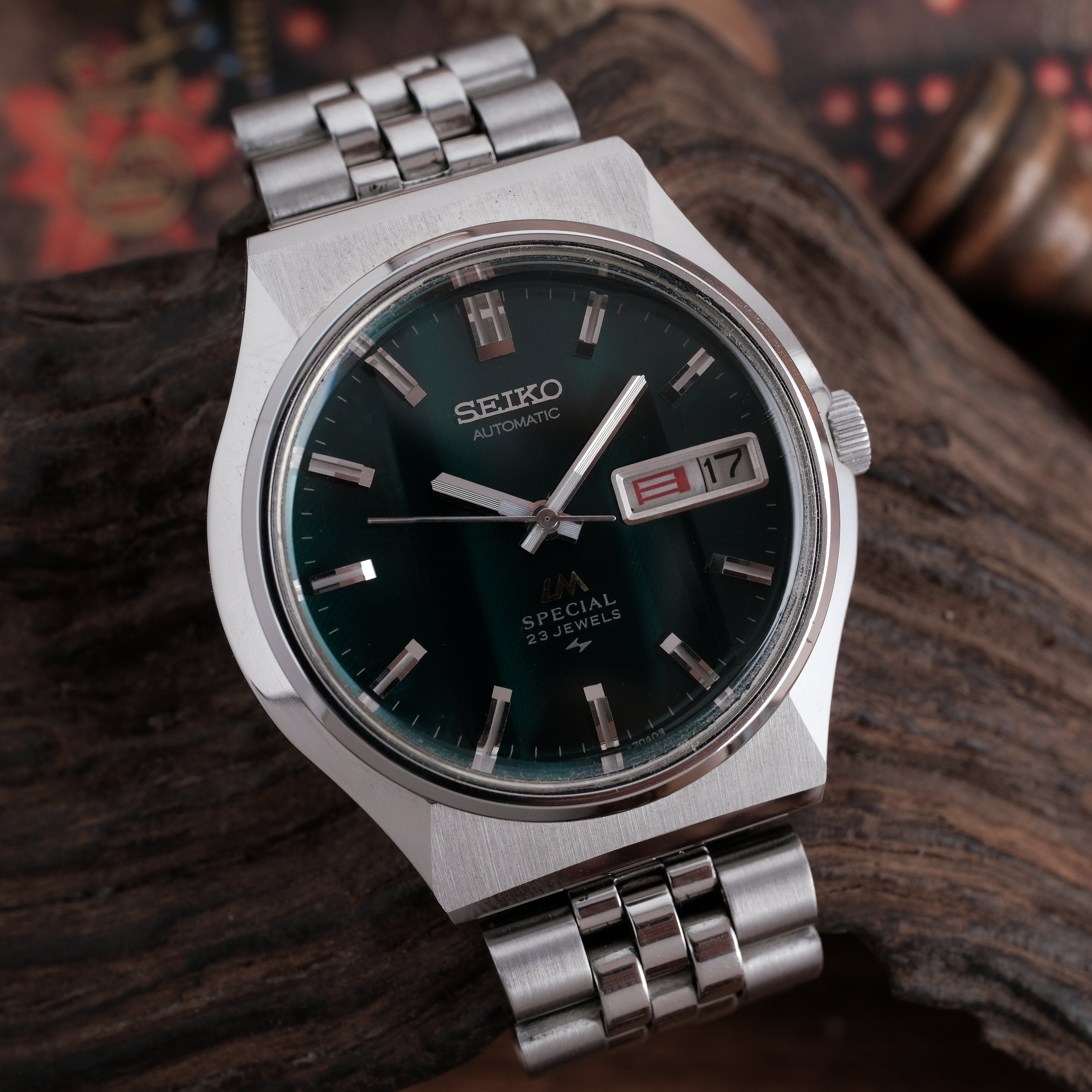
The Seiko 5216-7040 is a 36 mm steel LM Special whose value depends chiefly on its gradient dial, faceted crystal and sharp case geometry.
We auction more than 100 vintage watches a week.
Get first access: new Seiko 5216-7040 drops and alerts before auctions end.
Browse 22 live Seiko auctionsThe Seiko 5216-7040 is a compact steel automatic from 1974-1975, built around the 23-jewel caliber 5216A and a 36 mm case. Its character comes from the combination of a colored gradient dial and a factory faceted crystal, not from size or complication. Green examples can carry a vertical brushed texture, while brown dials produce a tiger-eye effect as the light moves.
LM Special and Lord Matic Special are both encountered with this reference. The applied dial emblem uses the shorter LM form, while contemporary descriptions often spell out Lord Matic Special. The watch to buy is the one with the cleaner dial, correct faceted crystal and crisp case brushing. Those three elements define the reference more clearly than a claimed service or polished shine.
Reference
5216-7040
Model names
LM Special; Lord Matic Special
Known production years
1974-1975
Case diameter
36 mm excluding the crown
| Case material | Stainless steel |
| Movement | Automatic caliber 5216A |
| Jewel count | 23 jewels |
| Known dial finishes | Green gradient with vertical texture; brown gradient with tiger-eye effect |
| Crystal | Faceted crystal |
| Observed day display | English and Japanese Kanji |
| Observed bracelet | Signed bracelet |
What it was built for
The 5216-7040 belongs to Seiko's 1974-1975 production and pairs a stainless-steel case with the automatic caliber 5216A. The movement has 23 jewels and was positioned above a basic everyday automatic, while the applied indices and colored gradient dial give the watch a sharper, more formal face. Some examples also have an English and Japanese Kanji day wheel, a practical detail that reinforces its domestic Seiko character.
This is not a large sports watch reduced for vintage taste. Its 36 mm case, measured without the crown, was the intended proportion, and the faceted crystal supplies much of the visual architecture. The crystal breaks reflections into angular bands across the green or brown dial, making the watch change more dramatically in motion than its restrained case diameter suggests.
The model landscape
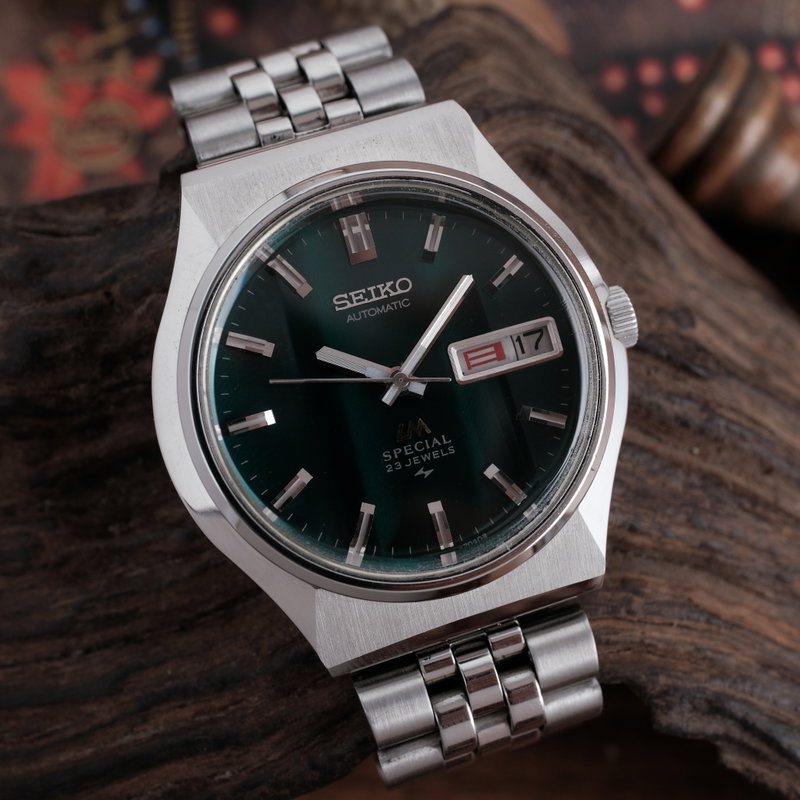
Green and brown are the two dial executions established for the 5216-7040. Green can show a vertical gradient or brushed texture with applied faceted indices, while brown produces a tiger-eye effect and may use silver-tone furniture. The stronger purchase is determined by an undisturbed dial surface and coherent hands and indices. A clean brown example outranks a damaged green one, and the reverse is equally true.
Value concentrates in the dial, the faceted crystal and the surviving case geometry. A correct signed bracelet adds appeal, especially when its end-link fit remains tidy, but it should not outweigh a refinished dial. The defensible premium goes to crisp printed text, intact applied Seiko and LM emblems, visible factory brushing and chamfers that have not been rounded away. Service history remains a separate question and should be supported by documentation.
What goes wrong
A refinished dial is the costliest fault because the gradient surface, applied furniture and printed text are the identity of the 5216-7040. Uneven color, lost texture or printing that does not sit cleanly with the applied emblems should be treated as evidence, not patina. A plain replacement crystal is also a material loss: it may protect the dial, but it removes the angular reflections that make this reference immediately recognisable.
Over-polishing softens the chamfers, erases the contrast between brushed and polished surfaces and can leave the lugs visually mushy. Original signed bracelets can develop stretch or poor end-link fit, while hands may show oxidation that the dial does not. Caliber 5216A performance must be assessed separately from appearance. Without a dated service receipt, the service history is unknown, and a good timegrapher reading does not establish what work was completed.
What to check before you buy
- Dial and applied emblems: The dial should combine a green or brown gradient finish with applied indices, an applied Seiko signature and an applied LM emblem. Flat color, lost vertical texture or poorly positioned printing can indicate a redial.
- Faceted crystal: The correct crystal has visible facets that divide reflections across the gradient dial. A plain replacement may be functional, but it changes the defining appearance and should not be described as equivalent to the factory-style crystal.
- Case geometry: The 36 mm stainless-steel case should retain readable brushing and crisp chamfers where those surfaces meet. Rounded transitions and soft lugs indicate polishing, even when the case remains bright and free of deep marks.
- Movement identity: The movement should be the automatic Seiko caliber 5216A with 23 jewels. Correct caliber markings support the reference, but they do not rule out a married case and movement or establish when the watch was serviced.
- Hands and dial furniture: Baton hands should remain visually coherent with the applied faceted indices and colored dial. Mismatched finishes, corrosion confined to replacement-looking hands or furniture that sits poorly can signal later parts or a franken assembly.
Other 5216-7040 examples we auctioned
More Seiko references
Related pages
Frequently asked questions
Ready to hunt for your own?
More than 100 vintage watches go under the hammer every week.