Vintage Omega Genève Dynamic: Bullseye Dials, Calibers and Buying Advice
The vintage Omega Genève Dynamic to buy is a steel bullseye-dial example with coherent reference, caliber and case geometry, ahead of a cleaner-looking redial.
Live now
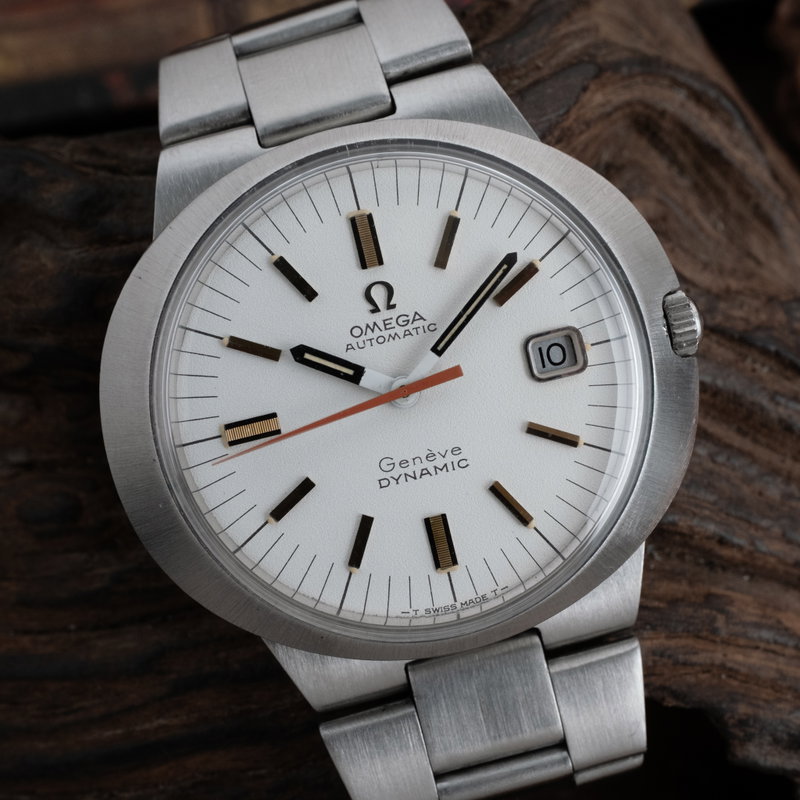
The Omega Genève Dynamic made conventional round watches look immediately older. From 1968 to 1971, its elliptical case and two-tone bullseye dial turned wrist fit into visible design rather than hiding ergonomics beneath familiar lugs.
A used Omega Genève Dynamic is not one fixed specification. Steel and gold-plated cases, manual and automatic movements, and 40 mm and 41 mm versions all occur among watches handled. The first decision is the dial: an honest bullseye with spotting or outer-track wear is preferable to a cleaner redial, because refinishing removes the part that carries most of this model's identity and premium.
Known production years
1968-1971
Known case sizes
40 mm and 41 mm, excluding the crown where specified
Case form
Elliptical, wrist-contoured design
Known case materials
Stainless steel; gold-plated top with stainless steel caseback
| Known dial styles | Two-tone bullseye in silver and charcoal, blue and silver, or grey and black |
| 166.039 movement | Automatic Omega caliber 565, 24 jewels |
| 166.079 movement | Automatic Omega caliber 752 |
| 135.033 movement | Manual-winding Omega caliber 284, 17 jewels |
| Known references | 165.039, ST 535.015, 135.033, 166.079, 166.039 |
What it was built for
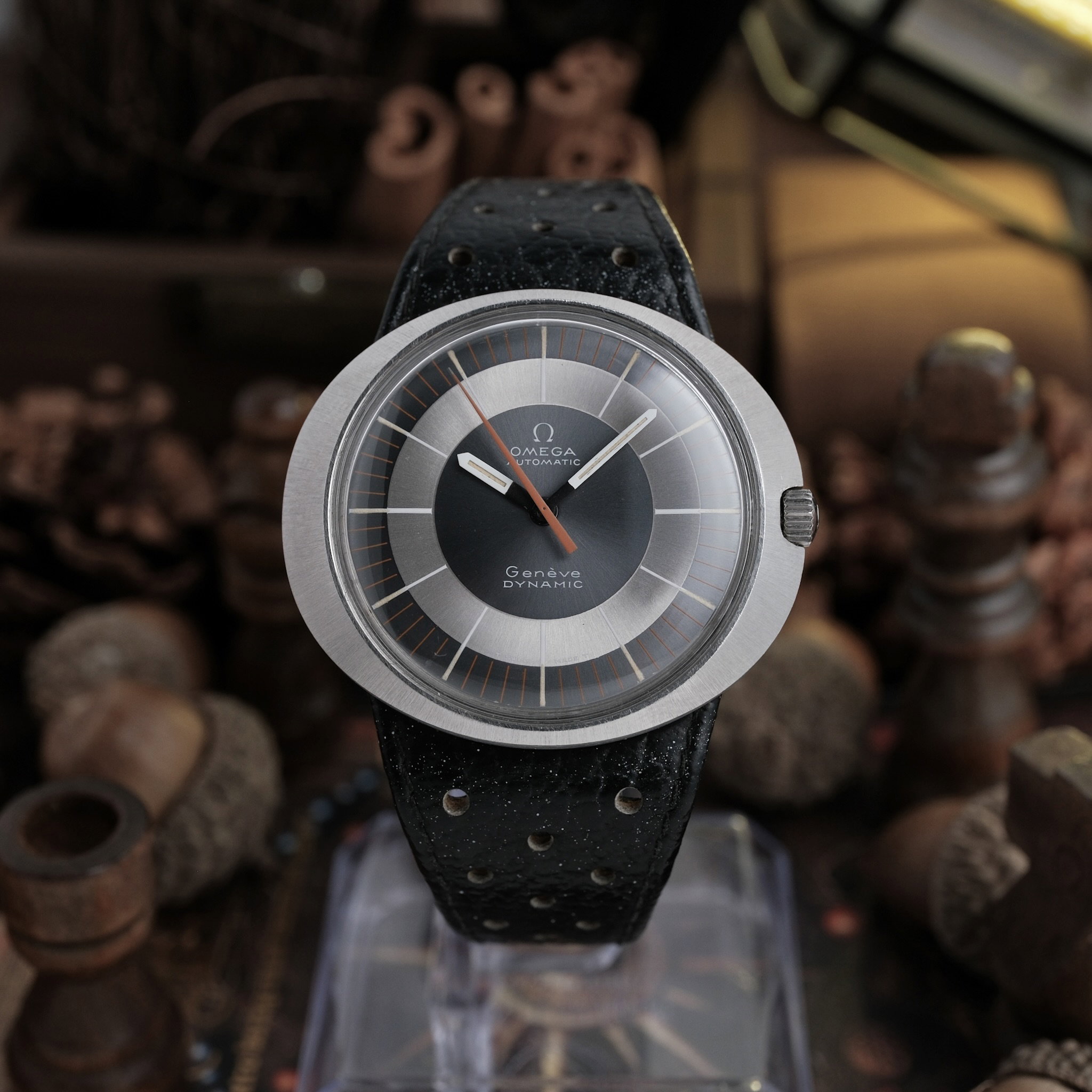
The Genève Dynamic was built around an elliptical case intended to follow the wrist, not around the usual round case and projecting lugs. A 1968 steel example at 40 mm combines that shape with a silver and charcoal bullseye dial and orange accents, while another from the same year uses blue and silver. The case and dial work as one graphic object.
That design also explains the integrated look of examples fitted to a stainless steel bracelet. The bracelet is not a decorative afterthought on the manual-wind 135.033 - it continues the case's low, broad geometry across the wrist. A replacement strap may be wearable, but it changes the visual idea more than it would on a conventional lugged watch.
Where the value sits
The premium sits first in the bullseye dial, then in case coherence and movement correctness. Silver and charcoal, blue and silver, and grey and black configurations are known, with orange accents adding contrast. Spotting, moisture damage and wear along the outer minute track reduce the spread, but a redial costs more than those flaws combined because the original concentric layout cannot be recovered by servicing.
Steel is the safer buy against a gold-plated top at comparable dial quality. Plating can wear through around exposed edges and no mechanical service replaces it, while the stainless steel caseback creates another junction to inspect for mismatched wear. Reference 166.079 exists in both stainless steel and gold-plated-top form among handled watches, so case material alone does not settle authenticity.
Movement choice matters less than coherence. The automatic 166.039 has caliber 565 with 24 jewels, the automatic 166.079 has caliber 752, and the manual 135.033 has caliber 284 with 17 jewels. Buy the correct pairing rather than paying extra merely for automatic winding.
Where to start
Start with a stainless steel example carrying a legible two-tone bullseye dial and a reference-caliber pairing that can be checked. Between an evenly spotted original dial and a cleaner refinished dial, take the spotted one. Between a softened case and one retaining a clear elliptical outline, take the stronger geometry even if the surface has honest scratches.
Size should follow the version rather than an abstract preference. The 40 mm cases already wear broad because the ellipse spreads across the wrist, while the 41 mm 166.079 adds still more visual width. Neither behaves like a conventional round watch of the same stated diameter, and the integrated aesthetic makes bracelet fit and wear part of the buying decision.
Service history is unknown unless supported by dated paperwork, and timegrapher performance alone does not establish what work was done. For a used Omega Genève Dynamic, prioritize the dial, case contour and correct movement before claims about servicing. The steel automatic is the easiest starting point against a plated case or a manual example with an incorrect movement.
Dating this watch
| Serial range / caliber | Year | Note |
|---|---|---|
| 1000000 | 1902 | approximate, ±1-3 years |
| 2000000 | 1908 | approximate, ±1-3 years |
| 3000000 | 1912 | approximate, ±1-3 years |
| 4000000 | 1916 | approximate, ±1-3 years |
| 5000000 | 1923 | approximate, ±1-3 years |
| 6000000 | 1925 | approximate, ±1-3 years |
| 7000000 | 1929 | approximate, ±1-3 years |
| 8000000 | 1935 | approximate, ±1-3 years |
| 9000000 | 1939 | approximate, ±1-3 years |
| 10000000 | 1944 | approximate, ±1-3 years |
| 11000000 | 1947 | approximate, ±1-3 years |
| 12000000 | 1950 | approximate, ±1-3 years |
| 13000000 | 1952 | approximate, ±1-3 years |
| 14000000 | 1954 | approximate, ±1-3 years |
| 15000000 | 1956 | approximate, ±1-3 years |
| 16000000 | 1958 | approximate, ±1-3 years |
| 17000000 | 1960 | approximate, ±1-3 years |
| 18000000 | 1961 | approximate, ±1-3 years |
| 19000000 | 1962 | approximate, ±1-3 years |
| 20000000 | 1963 | approximate, ±1-3 years |
| 21000000 | 1964 | approximate, ±1-3 years |
| 22000000 | 1965 | approximate, ±1-3 years |
| 24000000 | 1966 | approximate, ±1-3 years |
| 25000000 | 1967 | approximate, ±1-3 years |
| 26000000 | 1968 | approximate, ±1-3 years |
| 28000000 | 1969 | approximate, ±1-3 years |
| 31000000 | 1970 | approximate, ±1-3 years |
| 32000000 | 1971 | approximate, ±1-3 years |
| 33000000 | 1972 | approximate, ±1-3 years |
| 35000000 | 1973 | approximate, ±1-3 years |
| 37000000 | 1974 | approximate, ±1-3 years |
| 39000000 | 1975 | approximate, ±1-3 years |
| 40000000 | 1976 | approximate, ±1-3 years |
| 41000000 | 1977 | approximate, ±1-3 years |
| 42000000 | 1978 | approximate, ±1-3 years |
| 43000000 | 1979 | approximate, ±1-3 years |
| 44000000 | 1980 | approximate, ±1-3 years |
| 45000000 | 1982 | approximate, ±1-3 years |
| 46000000 | 1984 | approximate, ±1-3 years |
| 47000000 | 1985 | approximate, ±1-3 years |
| 48000000 | 1986 | approximate, ±1-3 years |
| 49000000 | 1988 | approximate, ±1-3 years |
| 50000000 | 1990 | approximate, ±1-3 years |
| 53000000 | 1993 | approximate, ±1-3 years |
| 54000000 | 1995 | approximate, ±1-3 years |
| 56000000 | 1996 | approximate, ±1-3 years |
| 58000000 | 1998 | approximate, ±1-3 years |
| 60000000 | 2000 | approximate, ±1-3 years |
Dating data comes from our decoder tables; treat years as approximate.
What to check before you buy
- Reference and caliber pairing: Match 166.039 to automatic caliber 565, 166.079 to automatic caliber 752, and 135.033 to manual caliber 284. A conflicting combination may indicate a franken or a married case and movement.
- Bullseye dial construction: Known dials use concentric two-tone fields, including silver and charcoal, blue and silver, or grey and black. Uneven boundaries, newly printed text over an aged surface, or inconsistent minute-track wear support a redial diagnosis.
- Dial markings and furniture: A grey and black example has applied indices, an orange sweep seconds hand and T SWISS MADE T at six. These details confirm a known configuration, but they must agree with the rest of the dial rather than serve as proof alone.
- Elliptical case geometry: The case should retain a deliberate elliptical outline that spreads across the wrist. Heavy polishing softens that contour and rounds the transitions, damage that matters more on the Dynamic because the case shape defines the model.
- Case material coherence: Both stainless steel and a gold-plated top with stainless steel caseback are known for 166.079. Inspect plating loss at exposed edges and compare wear across top and back, since sharply different wear can point to replaced or mismatched parts.
- Hands, lume and redial risk: Orange accents and aged lume occur on known bullseye examples, including pumpkin-colored plots. Fresh-looking lume against a spotted dial, mismatched hand aging, or crisp print laid over surface damage requires caution rather than an originality claim.
Recent Omega results
15 Omega watches auctioned
Omega · Geneve Dynamic
Omega · Genève Dynamic
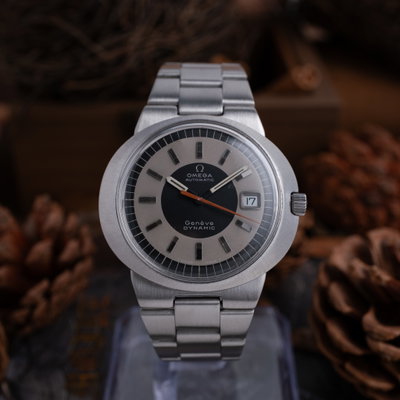
Omega · Genève Dynamic
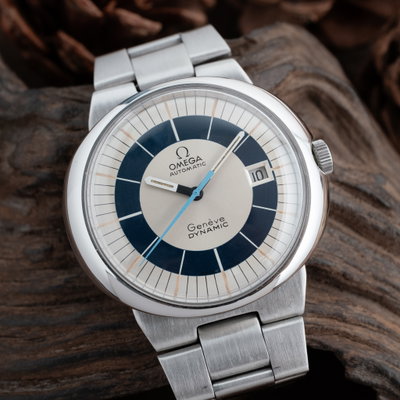
Omega · Genève Dynamic
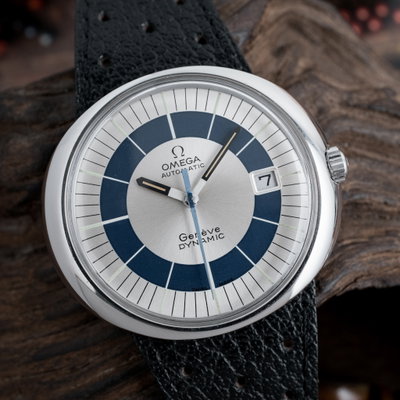
Omega · Genève Dynamic
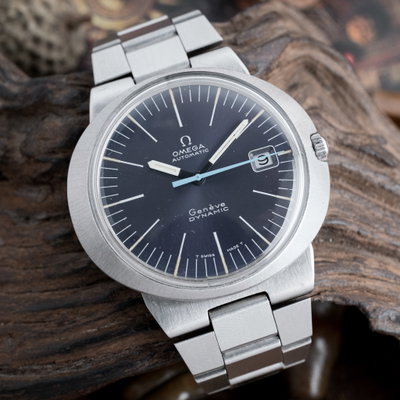
Omega · Genève Dynamic
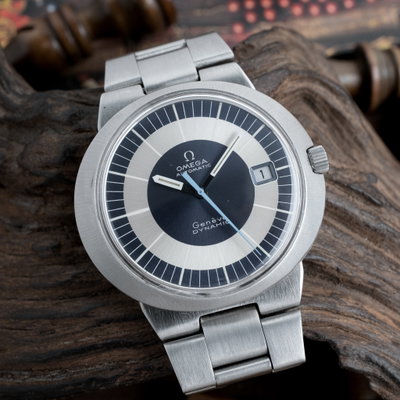
Omega · Genève Dynamic
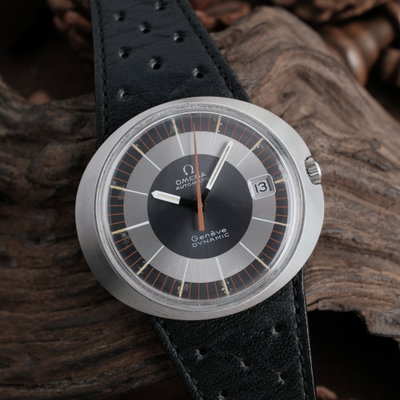
Omega · Genève Dynamic · 166.039 · 1968
We auction more than 100 vintage watches a week.
Get first access: new Omega watch drops and alerts before auctions end.
More Omega references
Related pages
Frequently asked questions
Ready to hunt for your own?
More than 100 vintage watches go under the hammer every week.