Seiko Advan 7019-7220: What to Know Before Buying
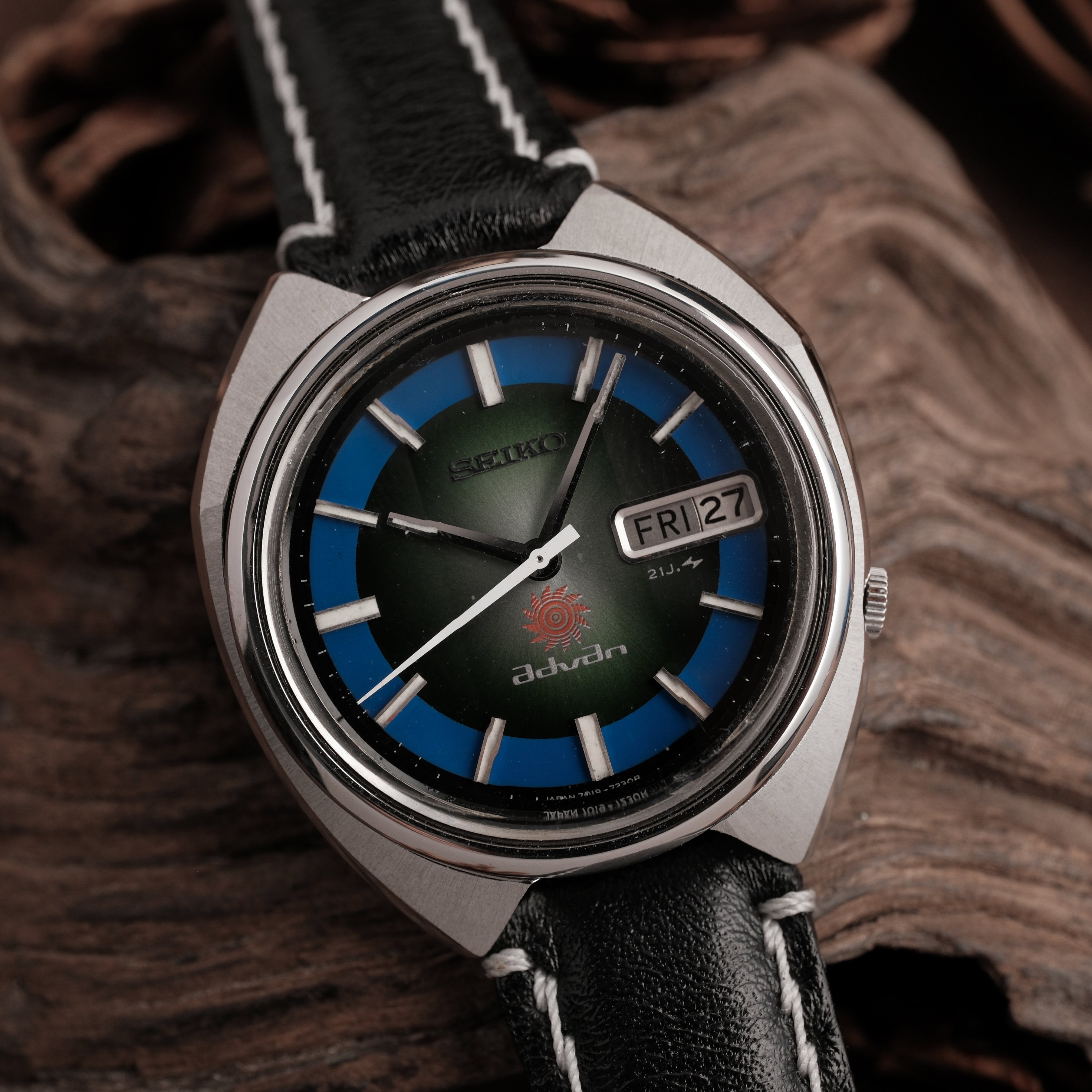
The Seiko Advan 7019-7220 is a 1972-1973 automatic defined by a faceted crystal, angular steel case and unusually bold dial treatments.
We auction more than 100 vintage watches a week.
Get first access: new Seiko 7019-7220 drops and alerts before auctions end.
Browse 27 live Seiko auctionsThe Seiko Advan 7019-7220 makes sense as a complete 1970s object: angular stainless steel, a faceted crystal and dials built around strong colour contrast. Produced across 1972 and 1973, it belongs to the experimental side of Seiko rather than the restrained side. The version to want is the one whose dial, crystal and case geometry still agree visually, because each element does substantial work.
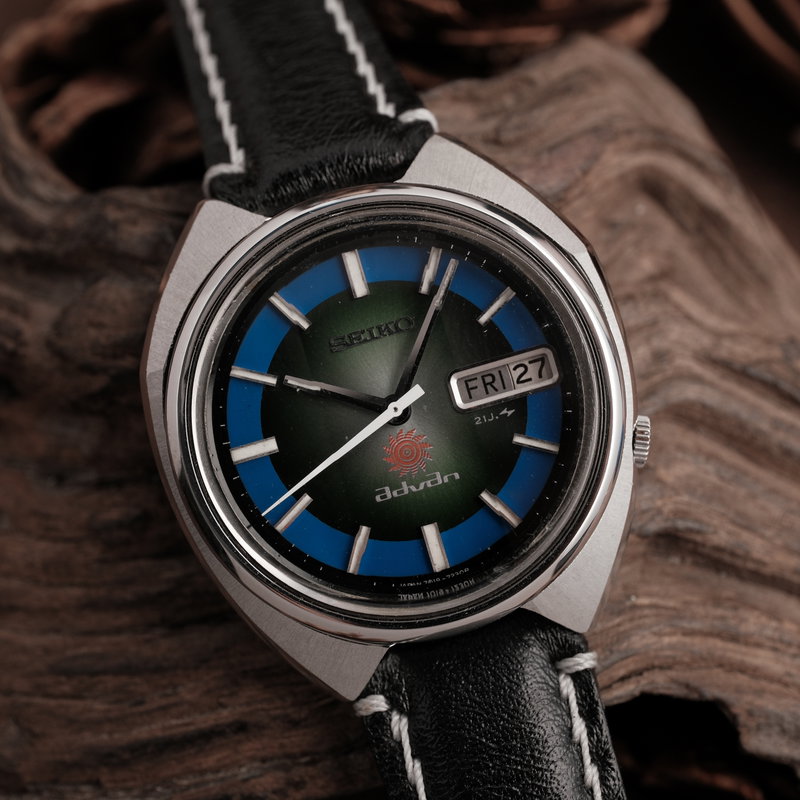
Dial choice changes the character more than the shared reference suggests. The 7019-7220 occurs with a silver sunburst centre and segmented blue minute track, a two-tone blue bullseye, and a green sunburst centre against a matte blue outer ring. All use the automatic caliber 7019A and a day-date display at 3 o'clock. A refinished dial costs more than ordinary case wear because colour transitions and applied furniture are central to this Advan's identity.
Model
Advan
Reference
7019-7220
Production years
1972-1973
Movement
Automatic Seiko caliber 7019A
| Case material | Stainless steel |
| Handled case sizes | 37 mm or 38 mm, excluding the crown |
| Calendar | Day-date display at 3 o'clock |
| Crystal | Faceted crystal |
| Known dial treatments | Two-tone blue bullseye; silver sunburst with segmented blue minute track; green sunburst with matte blue outer ring |
What it was built for
The Advan was aimed at a younger, style-conscious buyer, and the 7019-7220 expresses that brief through colour, geometry and changing reflections. Its faceted crystal breaks the dial into different planes as the wrist moves, while the angular stainless-steel case continues the same idea outside the dial. This is not a neutral dress watch. It works best when you want a vintage Seiko whose period character remains visible from across a table.
Caliber 7019A gives the reference automatic winding and a day-date display, so the design still performs as an everyday calendar watch. The practical layout prevents the blue, green or silver dial treatments from becoming decorative exercises. Legibility depends on the survival of the applied indices and hands against those contrasting surfaces. A damaged crystal can interfere more here than on a plain watch because its facets are part of the intended display.
On the wrist
Handled examples measure either 37 mm or 38 mm excluding the crown, a variation worth confirming on the individual watch rather than smoothing into one specification. In either measurement, the case has enough width for the bullseye and segmented-track dials to remain visually open. The geometry makes it read larger than a restrained round watch of similar diameter. Its stainless-steel construction also keeps the overall effect grounded rather than costume-like.
The green-and-blue version is the strongest choice when colour is the priority, while the silver-and-blue dial gives the day-date layout more visual separation. The two-tone blue bullseye sits between them and puts more emphasis on concentric form. None is mechanically superior because each uses caliber 7019A. Between a vivid dial in a softened case and a damaged dial in a sharper case, take the vivid dial unless the polishing has erased the case architecture.
What goes wrong
The worst fault is a redial, because recreating the sharp boundary between sunburst and matte sections rarely preserves the intended surfaces. Faceted crystals can become chipped or heavily scratched, obscuring the dial and changing the reflections that define the reference. Polishing can soften the angular case lines, especially around the lugs. Replaced crowns and mismatched hands also need to be disclosed, although a period-correct replacement is not the same thing as an original component.
Movement condition cannot be inferred from a bright dial. One handled caliber 7019A was running between -54 and -60 seconds per day, which proves that a running watch can still require mechanical attention. The service history is unknown unless documentation accompanies the individual example, and without it there is no basis for guessing what has been replaced. Buy the dial and case first, then budget for the movement on evidence rather than optimism.
What to check before you buy
- Dial construction: Known 7019-7220 dials use sharply separated treatments: blue bullseye, silver sunburst with a segmented blue track, or green sunburst against matte blue. Blurred boundaries or flat, newly applied colour indicate a likely redial.
- Calendar and movement: The dial should carry a day-date aperture at 3 o'clock, and the movement should be caliber 7019A. A different caliber or incompatible calendar layout points to a married or franken assembly rather than a coherent 7019-7220.
- Crystal and case geometry: The faceted crystal and angular stainless-steel case should work as one geometric design. Heavy polishing softens the lug lines, while a plain replacement crystal removes the shifting reflections characteristic of this reference.
- Hands and applied furniture: The hands should remain visually compatible with the faceted applied indices and the specific dial treatment. Genuine Seiko parts are not enough by themselves - mismatched furniture can make the watch franken even when every component is period-correct.
Other 7019-7220 examples we auctioned
7 Seiko 7019-7220 auctioned
More Seiko references
Related pages
Frequently asked questions
Ready to hunt for your own?
More than 100 vintage watches go under the hammer every week.