Seiko 5 Actus 7019-7060 Reference Guide
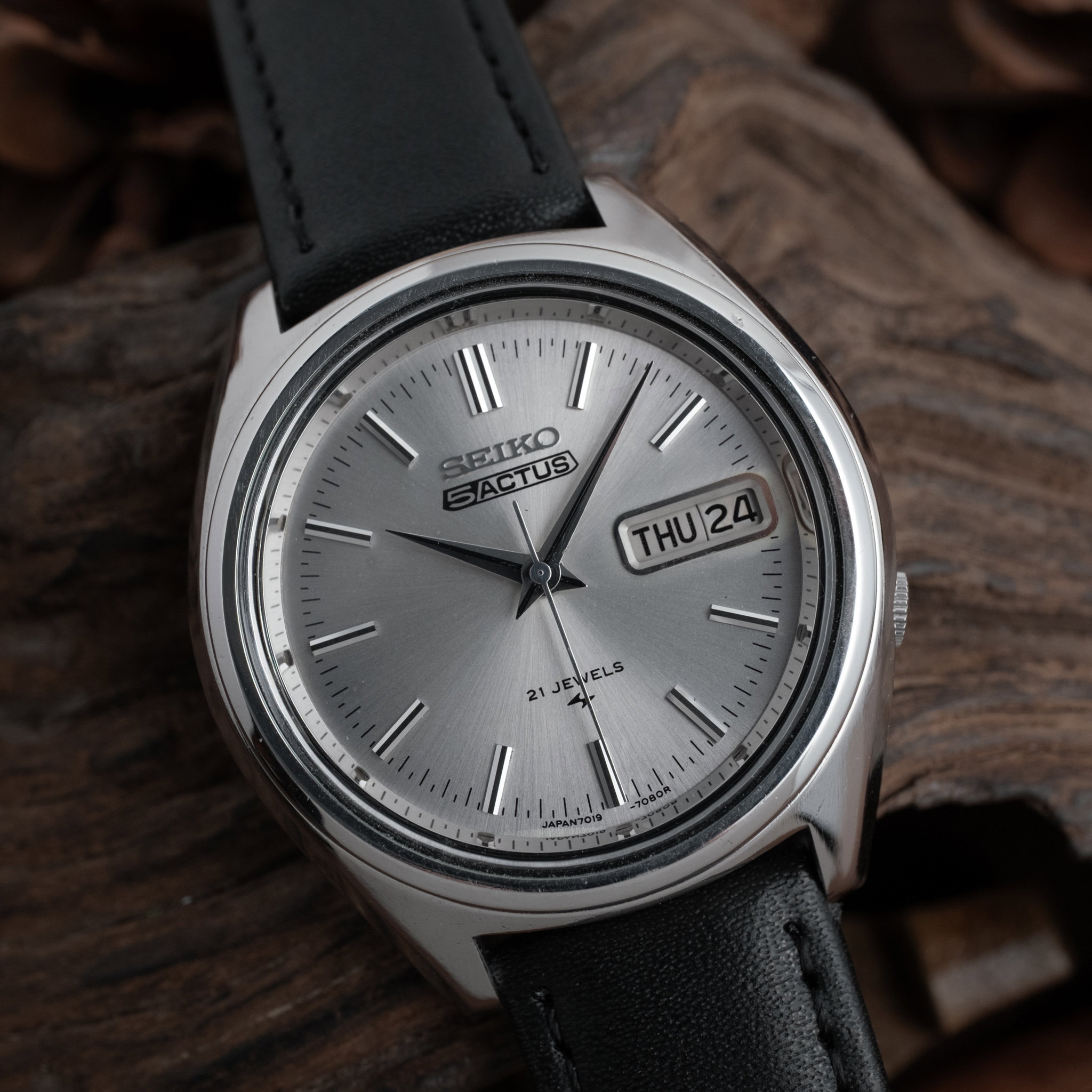
The Seiko 5 Actus 7019-7060 is a 1971-1976 automatic whose best buy is a steel example with a clean silver sunburst dial and coherent parts.
We auction more than 100 vintage watches a week.
Get first access: new Seiko 7019-7060 drops and alerts before auctions end.
Browse 17 live Seiko auctionsThe Seiko 5 Actus 7019-7060 puts its period plainly on the wrist: an angular tonneau-style case, a recessed crown at four o'clock and a silver sunburst dial. Examples handled from 1971 through 1976 establish it as a compact automatic from Seiko's 1970s Japanese range, rather than a modern watch reduced to vintage dimensions.
The version to want is stainless steel with a clean dial and a signed bracelet that fits the case correctly. Gold-plated examples can look sharper from across a room, but wear-through at the case edges cannot be reversed by servicing. Across measured examples, cases run from 36 mm to 38 mm excluding the crown, so the watch has more wrist presence than the recessed crown suggests.
Reference
7019-7060
Model
5 Actus
Known production years
1971-1976
Movement
Automatic Seiko caliber 7019
| Jewel count | 21 jewels |
| Measured case sizes | 36 mm, 37 mm and 38 mm excluding the crown |
| Case materials | Stainless steel, or gold-plated with a stainless steel caseback |
| Dial | Silver sunburst with applied indices |
| Crown position | Recessed at four o'clock |
The model landscape
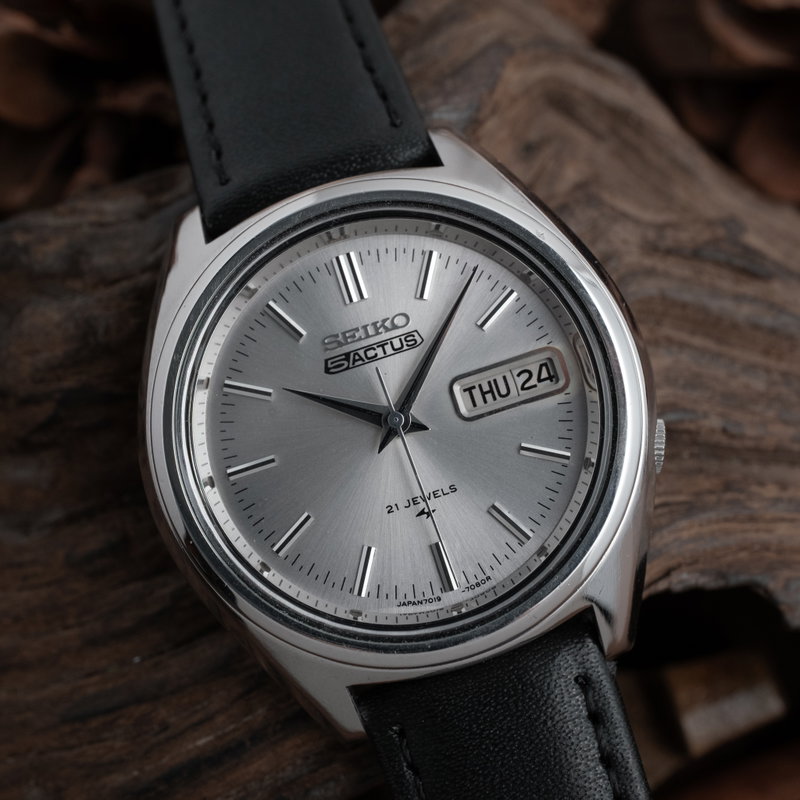
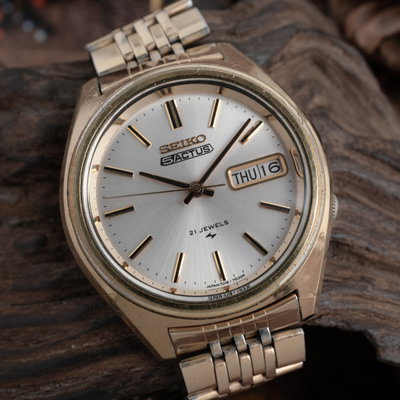
Reference 7019-7060 occurs in stainless steel and in a gold-plated case with a stainless steel caseback. Both use the automatic caliber 7019, while the dial and hand combination matters when judging whether the parts belong together. Steel examples handled with silver sunburst dials use applied indices and polished dauphine hands; a gold-plated example pairs gold-tone furniture with baton hands carrying black central stripes.
Measured cases span 36 mm to 38 mm excluding the crown. That variation is large enough to matter on the wrist, but it should not be used alone to reject a watch because individual measurements can differ with case geometry and technique. The tonneau-style outline spreads visually across the wrist, while the crown at four o'clock stays out of the way.
Where the value sits
The silver sunburst dial carries more value than a polished case or an undocumented service claim. Clean printing, intact applied furniture and a surface without moisture staining preserve the character of reference 7019-7060; a redial costs more than case wear because the lost factory finish cannot be recovered. A genuine service dial would still be a replacement and should be described as such, not confused with a refinished dial.
A signed Actus bracelet adds value when its fit at the case is correct and its links are not badly stretched. Period-correct does not prove original to the watch, so the bracelet should support the case rather than excuse a weak dial. Between a polished steel example with a clean factory-finished dial and a brighter watch with refinished printing, take the clean dial.
What goes wrong
Plating wear is the first concern on the gold-tone version, especially along exposed case edges and around the lugs. Steel cases instead lose definition when repeated polishing softens the angular tonneau profile. Bracelets develop stretch, crystals collect scratches, and replacement crowns can disrupt the recessed four o'clock fit even when the watch still winds and sets normally.
Dial damage matters most. Moisture spotting, staining, corrosion on the hands and refinished printing all reduce confidence, while mismatched hand styles can indicate a franken assembled from parts that did not leave the factory together. The caliber 7019 may run, but its service history is unknown without dated documentation, and timekeeping alone does not establish recent work.
What to check before you buy
- Dial and furniture: A silver sunburst dial with applied indices and a raised Seiko logo matches handled 7019-7060 examples. Uneven printing, moisture staining or a flat repainted surface points to damage or a redial rather than honest ageing.
- Hands and case version: Steel examples handled use polished dauphine hands, while the gold-plated example uses gold-tone baton hands with black central stripes. Crossing those combinations is a specific warning for a franken, though parts alone cannot prove originality.
- Crown and case geometry: The crown is recessed at four o'clock within an angular tonneau-style case. A protruding replacement crown, softened case outline or heavy polishing around the recess changes the geometry expected on reference 7019-7060.
- Caseback and plating: The gold-plated version handled has a stainless steel caseback, while steel examples use stainless steel cases. Inspect the junction for plating loss and confirm that the case construction is coherent rather than assembled from mismatched parts.
- Movement: The correct movement identified in handled examples is the automatic caliber 7019 with 21 jewels. Its presence supports the watch, but does not by itself exclude a married case and movement or establish service history.
- Bracelet fit: Signed Actus bracelets occur on handled examples. The signature, end fit and level of stretch should agree with the case, but even a period-correct bracelet is not proof that it originally shipped with that individual watch.
Other 7019-7060 examples we auctioned
5 Seiko 7019-7060 auctioned

More Seiko references
Related pages
Frequently asked questions
Ready to hunt for your own?
More than 100 vintage watches go under the hammer every week.