Vintage Seiko Lord Matic: Versions, Wear and Buying Priorities
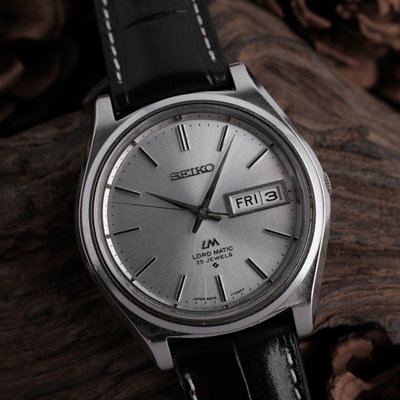
The strongest vintage Seiko Lord Matic pairs an intact textured dial with crisp case geometry and a caliber consistent with its production window.
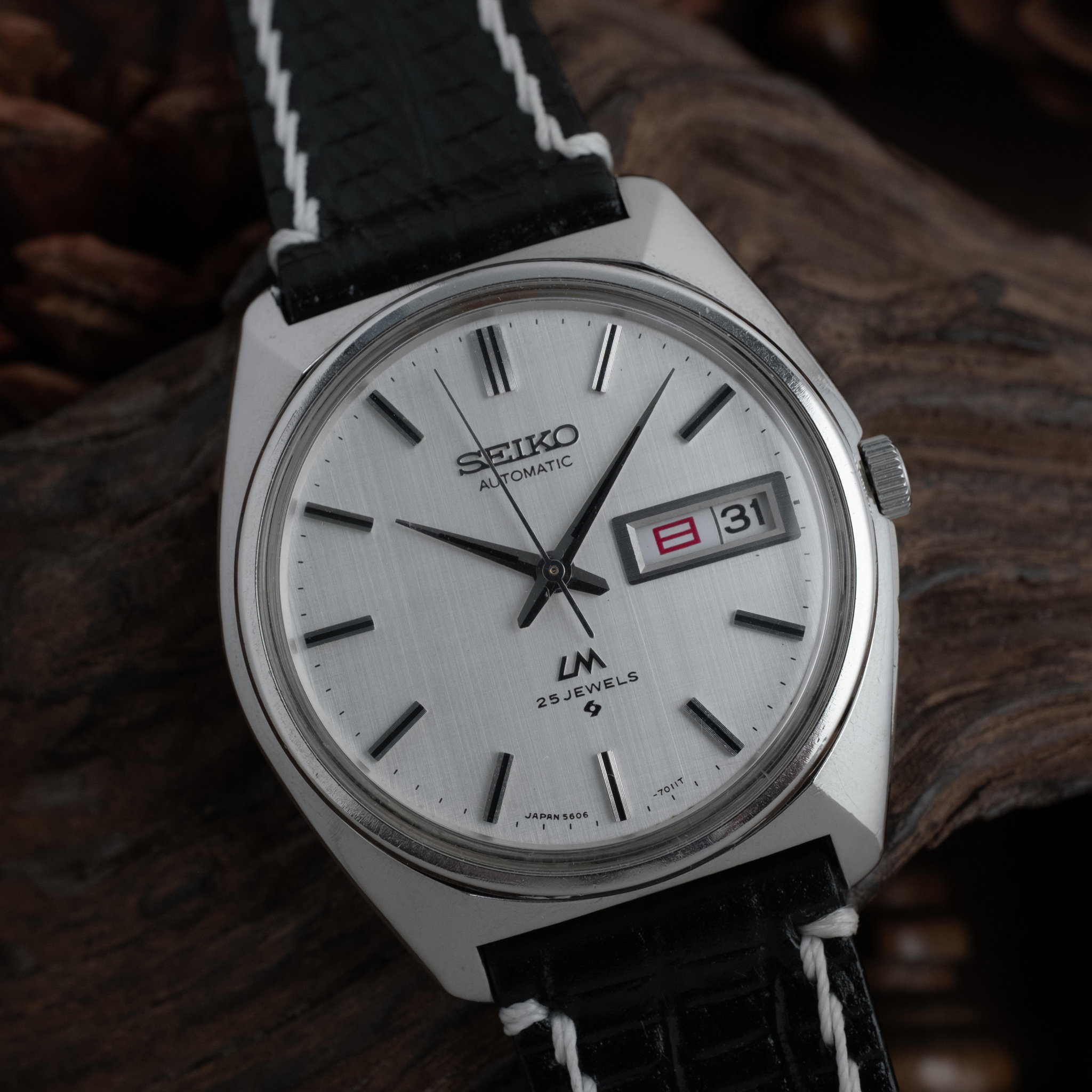
The vintage Seiko Lord Matic makes most sense as a late-1960s and 1970s automatic watch with unusually varied case and dial treatments. Examples handled from 1968 through 1979 include restrained silver dials, blue sunburst finishes, charcoal gradients, tonneau cases and sharply faceted crystals.
The safest target is not one reference at any cost. A clean dial and well-defined case outrank a more dramatic configuration with refinished printing, rounded edges or a badly damaged crystal. Among used Seiko Lord Matic watches, that distinction determines whether the design still works as intended.
Handled production years
1968-1979
Documented calibers
5605, 5606 and 5606A
Documented jewel counts
23 or 25 jewels
Documented case sizes
36 mm or 37 mm, excluding crown
| Documented case material | Stainless steel |
| Documented dial treatments | Vertically brushed silver, deep blue sunburst, gradient blue and gradient charcoal |
| Documented case and crystal forms | Tonneau-shaped monocoque case and faceted crystal configurations |
The model landscape
The Lord Matic changed substantially across references. The 1968 5606-7050 combines a 36 mm tonneau-shaped monocoque case with a vertically brushed silver dial, while the 1972 5606-7230 uses the same stated diameter with a deep blue sunburst dial and faceted crystal. The 5606-7010 reaches 37 mm and keeps the more restrained silver treatment.
Colour and architecture become more assertive in the 1973 5606-7290 and 1974 5606-8040. Both are 37 mm steel watches, but the former has a vertically brushed gradient blue dial and the latter a vertically brushed charcoal gradient dial with gold-tone accents. The 5606-8040 is also known with a signed bracelet, which makes bracelet completeness relevant rather than incidental.
Value sits first in the dial, then in case definition and the correct combination of parts. Gradient finishes, applied faceted indices and faceted crystals create more room for damage or unsuitable replacement than a plain silver configuration. Between a dramatic redial and an honest silver dial, take the honest dial.
On the wrist
Handled Lord Matic cases at 36 mm and 37 mm occupy a compact range, but shape changes the result. The tonneau form of the 5606-7050 spreads its visual mass differently from the more conventional 5606-7010, while a faceted crystal adds height and sharper reflections without increasing the listed diameter.
Dial finish also changes wrist presence. The deep blue sunburst 5606-7230 reacts broadly to light, whereas the vertically brushed gradient dials of the 5606-7290 and 5606-8040 pull the eye along the dial. For a quieter used Seiko Lord Matic, the silver 5606-7010 is the easier choice; for stronger 1970s character, the gradient references make the clearer case.
What goes wrong
The worst fault is a refinished dial, because it removes the surface treatment and printing that distinguish one Lord Matic configuration from another. Faceted crystals can be chipped or replaced with a shape that changes the whole profile. Over-polishing softens the case edges, and that loss is especially visible on tonneau forms and cases built around crisp planes.
Bracelet stretch and mismatched bracelets matter on examples such as the 5606-8040, which is known with a signed bracelet. A replacement crown or a married case and movement requires the same caution: period-correct does not establish that the parts left the factory together. The service history is unknown unless documentation accompanies the watch, so external preservation cannot prove mechanical condition.
Caliber markings provide a useful boundary rather than a complete verdict. The 5605 production window runs from 1968 to 1975, while the 5606 window runs from 1968 to 1976. A movement outside those supplied windows needs an explanation, but a date match alone does not rule out a franken watch.
Dating this watch
| Serial range / caliber | Year | Note |
|---|---|---|
| 5605 | 1968-1975 | caliber production window |
| 5606 | 1968-1976 | caliber production window |
Dating data comes from our decoder tables; treat years as approximate.
What to check before you buy
- Match the dial treatment to the reference: The 5606-7230 is documented with a deep blue sunburst dial, while the 5606-7290 uses a vertically brushed gradient blue finish. A flat repaint or changed texture points to a redial.
- Confirm the architectural parts: The 5606-7050 uses a tonneau-shaped monocoque case, and the 5606-8040 is documented with a faceted crystal. Rounded case planes or a plain crystal materially change those configurations.
- Assess caliber and date together: Caliber 5605 has a 1968-1975 production window and caliber 5606 a 1968-1976 window. Agreement supports the watch, but it does not by itself exclude a married or franken assembly.
- Check bracelet correctness and wear: The 5606-8040 is documented with a signed bracelet. Confirm the signature and fit, then assess stretch and replaced links separately because a Seiko-signed bracelet is not automatically the correct one.
Recent Seiko results
Seiko · Lord Matic · 5606-7000 · 1969
Seiko · Lord Matic · 5606-8110 · 1975
Seiko · Lord Matic · 5606-5010 · 1972
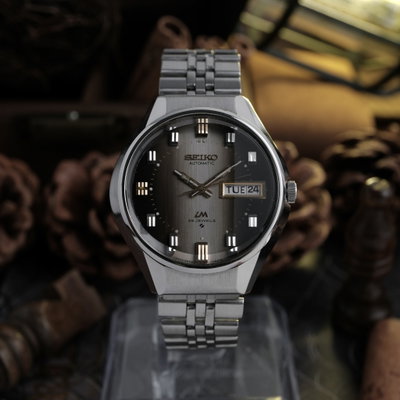
Seiko · Lord Matic · 5606-8040 · 1974
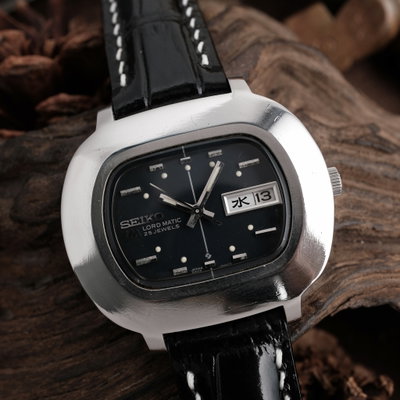
Seiko · Lord Matic · 5606-5010 · 1971
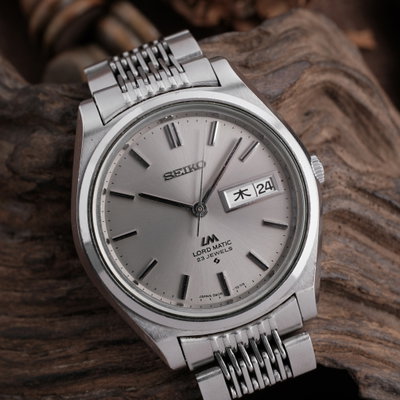
Seiko · Lord Matic · 5606-7070 · 1971
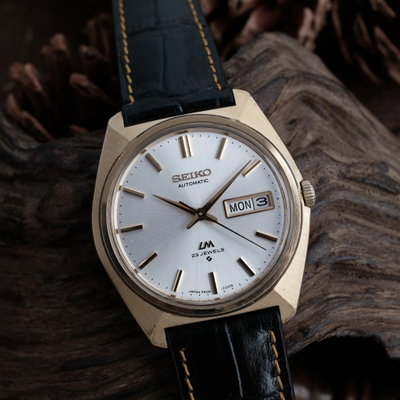
Seiko · Lord Matic · 5606-7000
Seiko · Lord Matic · 5606-7070 · 1968
More Seiko references
Related pages
Frequently asked questions
Ready to hunt for your own?
More than 100 vintage watches go under the hammer every week.