Vintage Seiko Seikomatic-P: 34 mm or 38 mm, and What to Check
The Seikomatic-P is a late-1960s automatic Seiko whose strongest buying case combines a clean silver sunburst dial, a coherent 5106A movement and the right case size for you.
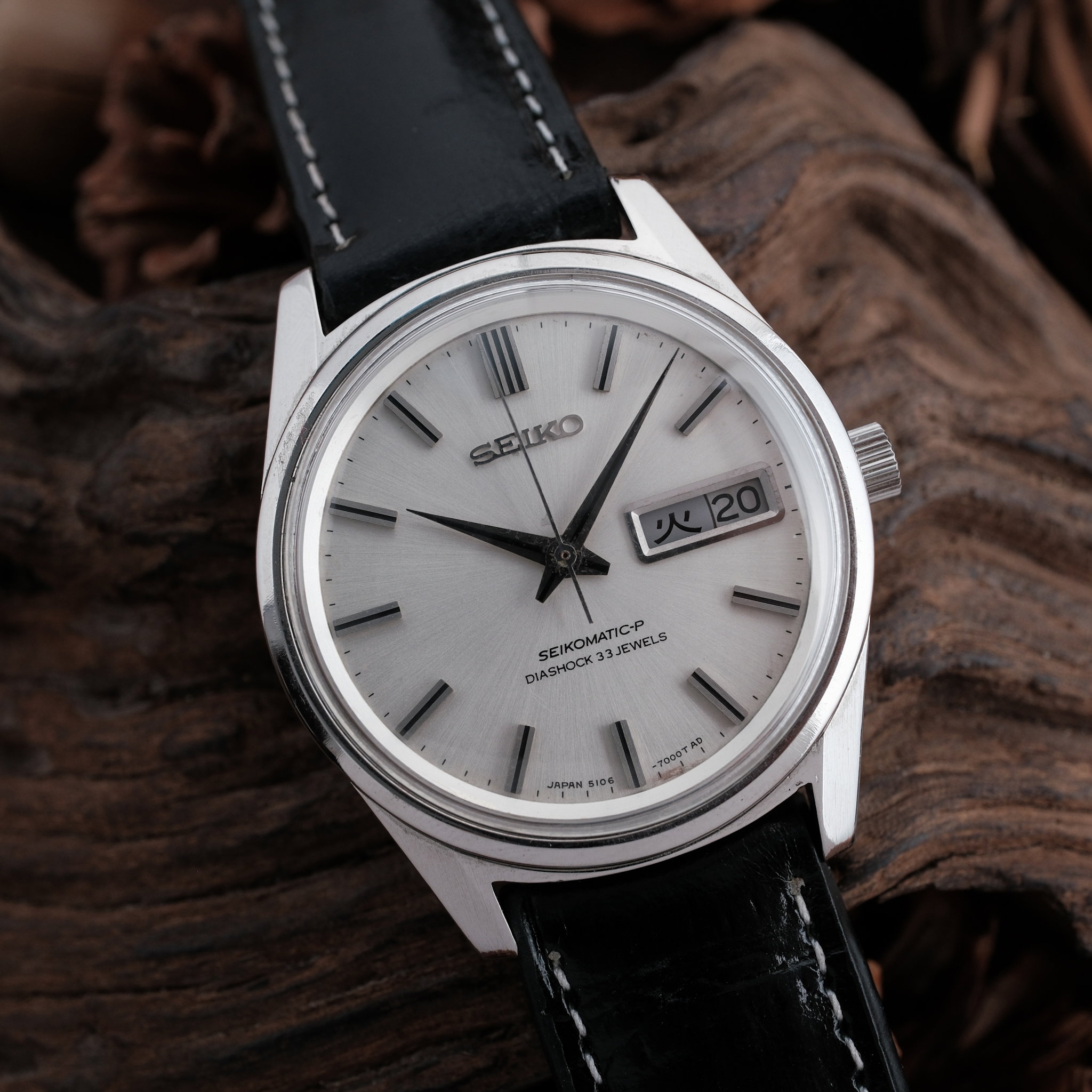
The Seikomatic-P makes its strongest case through contrast: watches using the same automatic 5106A movement were sold in both 34 mm and 38 mm stainless-steel cases. That four-millimetre spread changes the character completely, so a used Seiko Seikomatic-P should be chosen by case proportion before small cosmetic differences.
Production examples handled here run from 1967 to 1969, with silver sunburst dials, applied faceted markers and day-date displays defining the known look. The larger 5106-8020 gives the design more wrist presence, while the compact 5106-7000 concentrates the same visual language into a more restrained case. Buy the size you will wear, then pay for the cleanest credible dial and sharpest case available within that format.
Known production years
1967-1969
Movement
Automatic caliber 5106A
Jewel count
33 jewels
Documented case sizes
34 mm and 38 mm, excluding crown
| Case material | Stainless steel |
| Display | Day-date |
| Documented dial | Silver sunburst with applied faceted indices |
| Larger documented reference | 5106-8020 at 38 mm |
| Compact documented reference | 5106-7000 at 34 mm |
What it was built for
The Seikomatic-P joined a refined automatic movement to a practical day-date display during the late 1960s. Caliber 5106A and its 33-jewel specification put the mechanical emphasis above a basic time-only watch, while the silver sunburst dial, applied markers and faceted hands kept the display formal enough for office wear.
Case diameter determines how that brief translates on the wrist. At 34 mm, the 5106-7000 reads compact and dress-led; the 38 mm 5106-8020 has broader dial exposure and a more modern stance. Both measurements exclude the crown, so the difference is in the case itself rather than an inconsistent measuring method. Under a cuff, the smaller watch disappears more readily, while the larger version gives the sunburst finish more room to work.
Where the value sits
Value rests first in a convincing silver sunburst dial, because a redial cannot be corrected by servicing the 5106A. Applied faceted indices should remain coherent with the hands and printed signature, but minor edge patina is less damaging than refinished printing. A genuine service dial is a factory replacement rather than a redial, yet it still needs to be disclosed because it changes what the buyer is paying for.
Case condition creates the next meaningful spread. Rounded lug edges and softened transitions indicate polishing, while deeper wear cannot be removed without taking away more steel. The 5106-8020 also needs particular attention at its distinctive hexagonal crown: a replacement crown changes the visible profile even when it operates correctly. Presentation engravings can be period evidence, but they do not establish full provenance on their own.
Mechanical condition is the last large variable, not an excuse to ignore the exterior. One 1969 example ran roughly 43 to 48 seconds slow per day, proving that operation alone does not establish healthy timekeeping. Day-date action and crown operation must therefore be checked alongside rate. The service history is unknown unless paperwork accompanies the individual watch, and without documentation we prefer not to speculate beyond what the movement and timing test establish.
Dating and serials
Known Seikomatic-P examples span 1967 to 1969, which is the safest production range supported here. The separate caliber-production window for the 5106 runs from 1968 to 1971, but that window dates caliber production rather than decoding a complete watch. It should not be used to overrule a coherent case, dial and movement combination.
A dated presentation engraving can anchor an individual caseback to a moment, as with a December 1967 inscription, but it does not prove the movement and case have remained together. A married watch can contain genuine Seiko parts from separate watches, while a franken combines parts that never shipped together. Dating therefore works as a consistency test across the watch, not as a single conclusive number.
Dating this watch
| Serial range / caliber | Year | Note |
|---|---|---|
| 5106 | 1968-1971 | caliber production window |
Dating data comes from our decoder tables; treat years as approximate.
What to check before you buy
- Dial construction: The documented configuration uses a silver sunburst dial with applied faceted indices and printed Seiko text. Flat paint, weak sunburst brushing or crude printing indicates a redial rather than honest ageing.
- Hands and dial relationship: Known examples pair the applied faceted markers with faceted hands, including dauphine-form hands on a 5106-8020. Mismatched finishes or hands that sit awkwardly against the markers can indicate later assembly.
- Case and crown: The 1969 5106-8020 is documented with a hexagonal crown and a 38 mm steel case. Confirm that the crown profile suits that configuration and that polishing has not rounded the lug edges or softened the case transitions.
- Movement identity: The watch should contain automatic caliber 5106A, with documented examples specified at 33 jewels. A different caliber makes the watch incorrect for the model, while the correct caliber alone does not rule out a married case and movement.
- Day-date and timing: Test the day-date display, crown operation and rate together. An operational example was still roughly 43 to 48 seconds slow per day, so movement, calendar and timekeeping must agree before mechanical condition is judged.
Recent Seiko results
More Seiko references
Related pages
Frequently asked questions
Ready to hunt for your own?
More than 100 vintage watches go under the hammer every week.