Vintage Rado Ticino: References, Dials and Buying Priorities
Buy the vintage Rado Ticino for its dial, but favour a sharp 35 mm steel case and a documented reference-dial pairing over surface drama alone.
We auction more than 100 vintage watches a week.
Get first access: new Rado watch drops and alerts before auctions end.
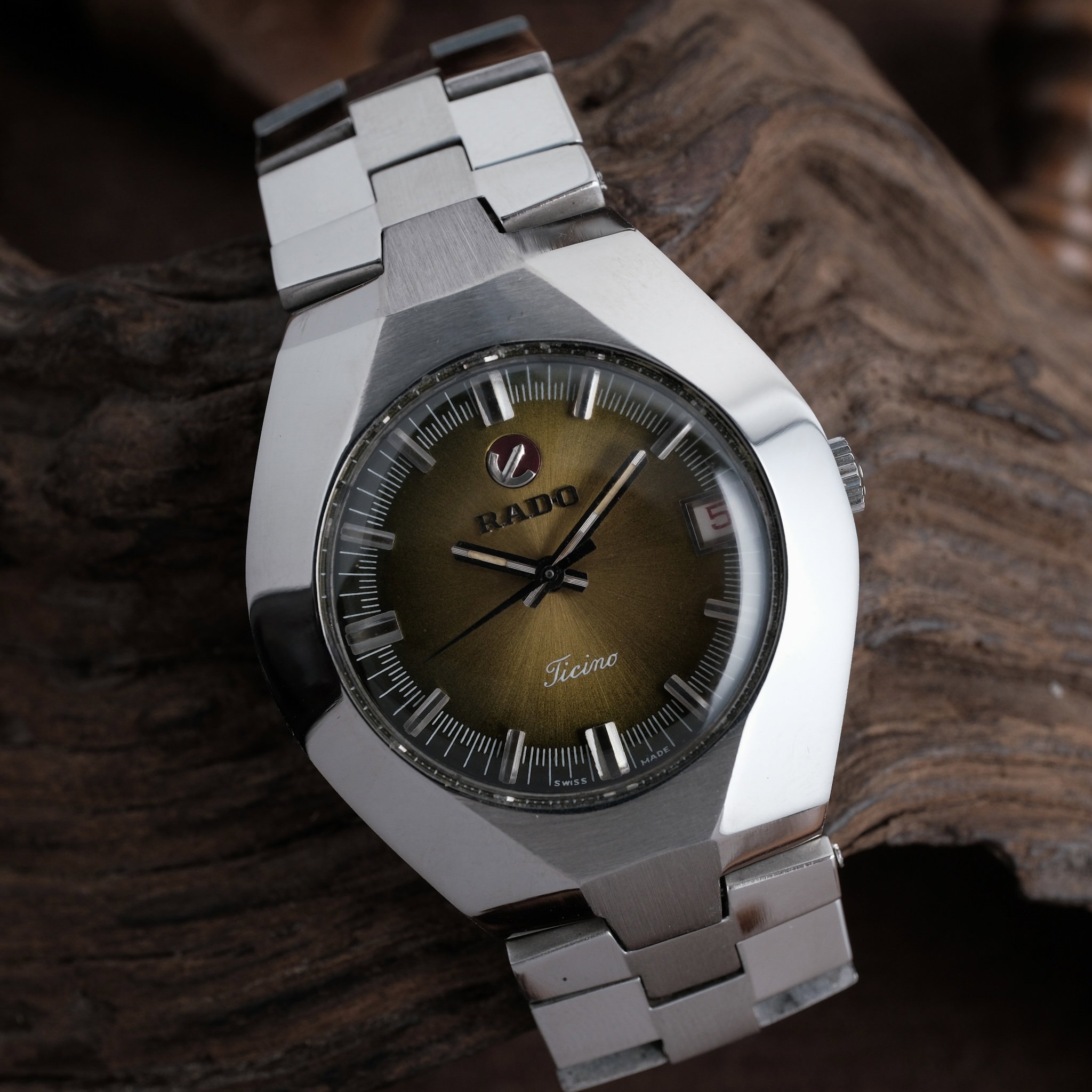
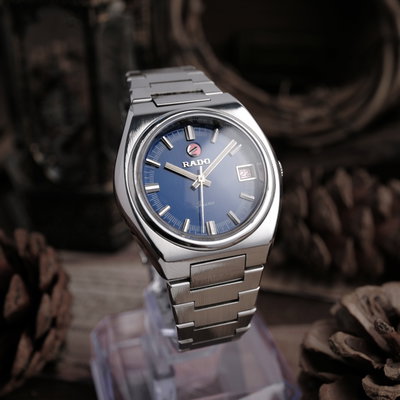
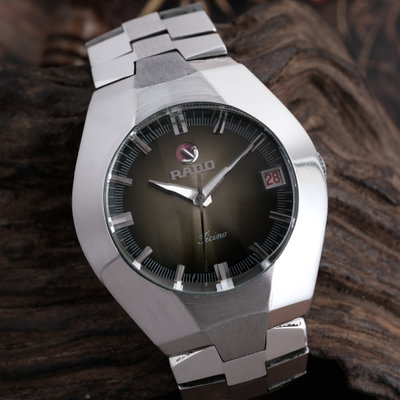
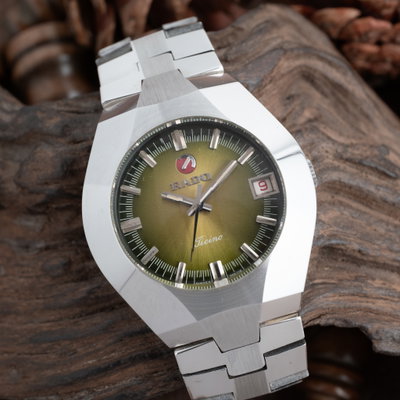
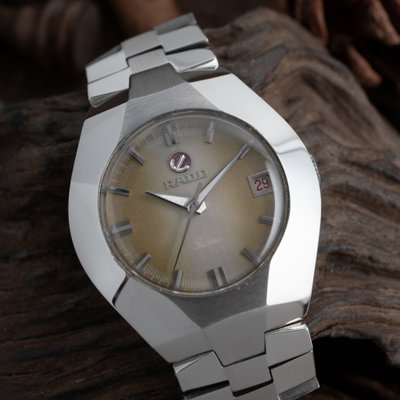
Browse 31 live Rado auctionsThe Ticino concentrates Rado's early 1970s design language into a compact steel automatic. Examples from 1973-1975 use 35 mm cases, while their dials range from golden-khaki sunburst and vertical linear finishes to blue waves and green gradients.
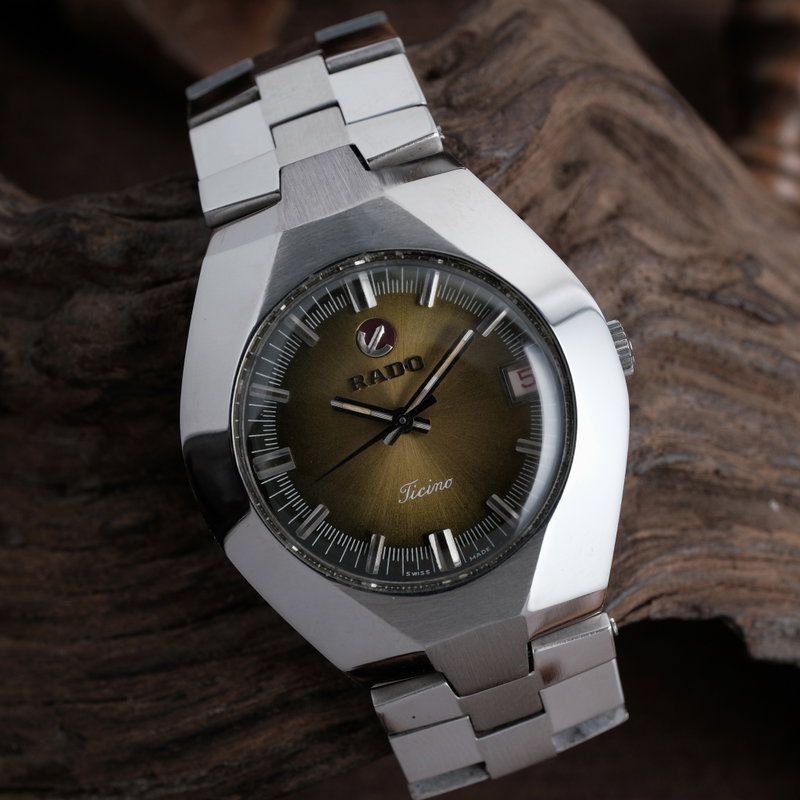
Reference 11050 is the clearest place to begin because it is documented with both sunburst and vertically textured dials, as well as the automatic ETA caliber 2824. That variation also creates the central buying risk: the reference alone cannot validate the dial. A convincing vintage Rado Ticino needs the case, movement, dial treatment and anchor emblem to form a period-coherent watch.
Known production window
1973-1975
Documented case size
35 mm excluding the crown
Documented case material
Stainless steel
Movement type
Automatic
| Named caliber | ETA caliber 2824 on references 11050 and 8228303A |
| Documented jewel count | 25 jewels on automatic examples of references 11050 and 8224246 |
| Dial executions | Golden-khaki sunburst, vertical linear texture, blue repeating waves, green gradient and golden-brown gradient |
| Documented emblem | Rotating Rado anchor on references 11050 and 8215942 |
| Documented date detail | Red date display on a sunburst reference 11050 |
What it was built for
The Ticino was conceived as a visually assertive automatic rather than a restrained round dress watch. Its 35 mm steel case uses angular or tonneau architecture, and applied faceted indices catch light against sunburst, linear, wave-textured or gradient surfaces.
The 1973-1975 production window places the Ticino firmly in the period when shaped cases and integrated-looking transitions carried more visual weight than diameter alone. A 35 mm tonneau case occupies the wrist differently from a round case of the same width, with the shoulders giving it a broader outline. It remains compact enough to pass under most cuffs without losing its period character.
Where the value sits
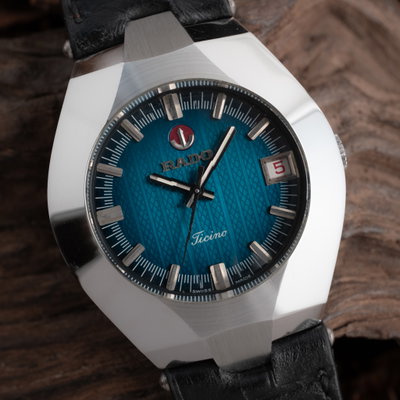
The dial carries the premium. A clean blue wave-textured 8228303A, green gradient 8224246 or golden-khaki 11050 is worth prioritising over a more polished case with a compromised surface. Gradient dials need particular discipline because spotting can interrupt the transition, while aggressive cleaning can flatten sunburst grain or disturb printed text.
Case definition comes next. Sharp lines preserve the intended tonneau geometry, whereas repeated polishing softens the transitions and can turn the case into a rounded shape the Ticino never had. No production total is established here, so claims that one dial colour is rare need a stated denominator before they deserve a premium.
Movement labels matter, but they do not outrank the visible parts. The ETA caliber 2824 is documented in references 11050 and 8228303A, while 25-jewel automatic descriptions also occur on 11050 and 8224246. A correct caliber cannot compensate for a redial, a franken dial-reference pairing or case lines polished away beyond recovery.
Where to start
Start with reference 11050 against the less documented variants because its ETA caliber 2824, 35 mm steel case and multiple dial executions allow meaningful comparison. Between a sharp example with an evenly aged dial and a brighter watch with softened case lines, take the sharp case. Between original spotting and a redial, the spotted original dial is usually the more defensible object, provided the damage is plainly located and priced accordingly.
Reference 8228303A is the stronger alternative when the blue repeating wave texture remains intact and the applied furniture sits cleanly. Reference 8224246 suits a buyer who wants the green gradient effect, but the centre-to-edge transition must remain continuous rather than retouched. The service history of any individual watch is unknown without supporting documentation, and the evidence does not justify guessing beyond the movement and condition visible in the watch itself.
What to check before you buy
- Reference and dial pairing: Reference 8228303A is documented with a vivid blue repeating wave texture, while 8224246 is documented with a green gradient. A different pairing is not automatically false, but it needs evidence rather than assumption.
- Reference 11050 dial execution: Reference 11050 exists with both golden-khaki sunburst and vertical linear dials. Confirm the finish is internally consistent, because a flattened texture, disturbed printing or uneven colour can disclose a redial.
- Movement configuration: ETA caliber 2824 is documented in references 11050 and 8228303A, and a 25-jewel automatic is documented for 8224246. A different movement requires explanation, but the available evidence does not establish every valid Ticino caliber.
- Case geometry: Handled Ticino examples use 35 mm stainless steel cases with sharp angular or tonneau lines. Soft transitions and rounded shoulders indicate polishing, which permanently reduces the case architecture that defines the model.
- Anchor and date details: A rotating Rado anchor is documented on references 11050 and 8215942, while a red date display is documented on a sunburst 11050. These details should agree with the dial rather than serve as isolated proof of authenticity.
Recent Rado results
24 Rado watches auctioned
Rado · Ticino · 11050
Rado · Ticino · 8228303A
Rado · Ticino · K370145
Rado · Ticino
Rado · Ticino · 8212850
Rado · Ticino · 8227907A
Rado · Ticino · 8216761
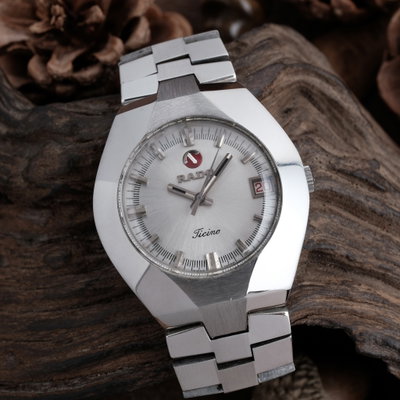
Rado · Ticino · 11050
More Rado references
Related pages
Frequently asked questions
Ready to hunt for your own?
More than 100 vintage watches go under the hammer every week.