Vintage Rado Manhattan - what separates the convincing examples
Buy the vintage Rado Manhattan for its square steel case and day-date dial, but favour a clean brushed dial, sound crystal and correctly fitted bracelet.
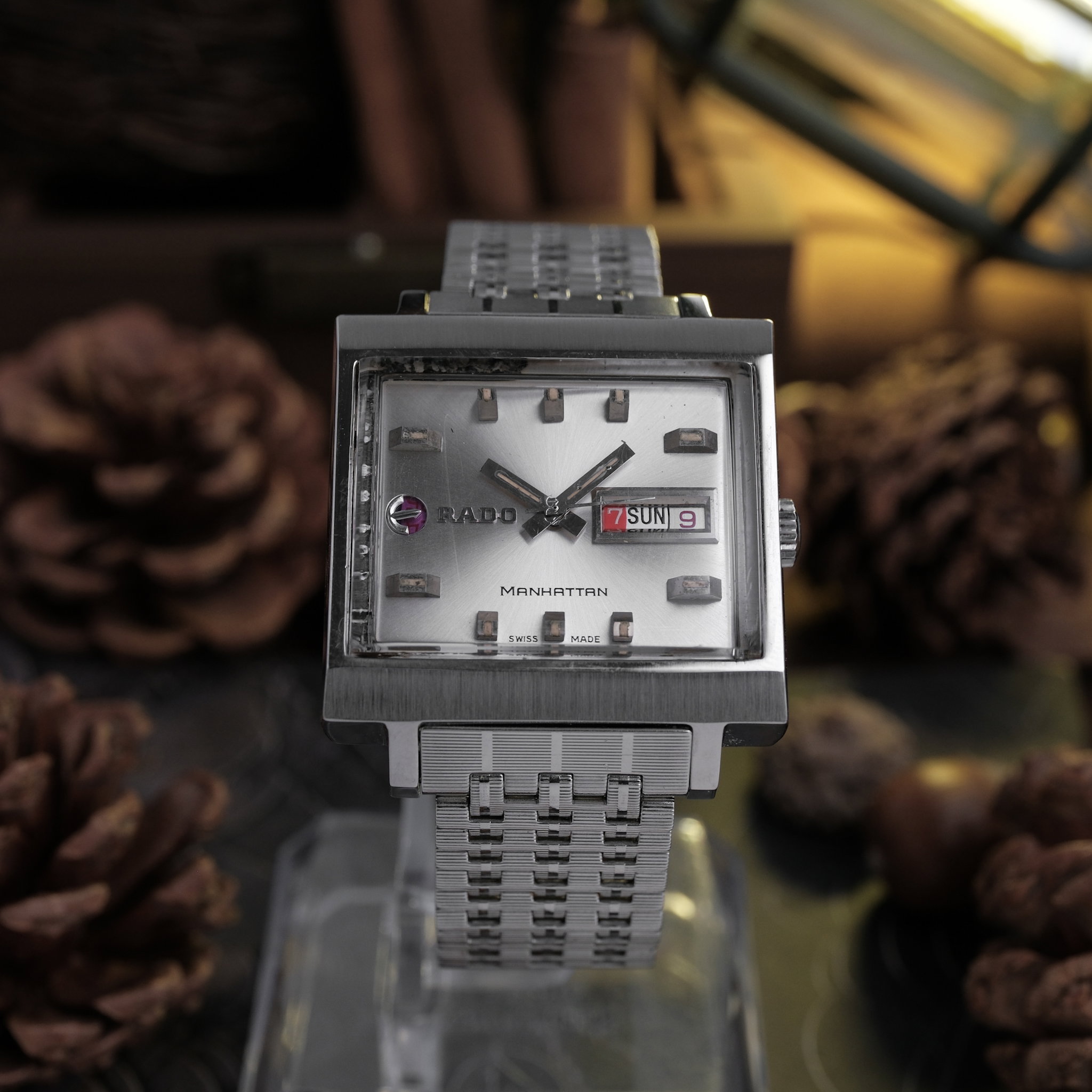
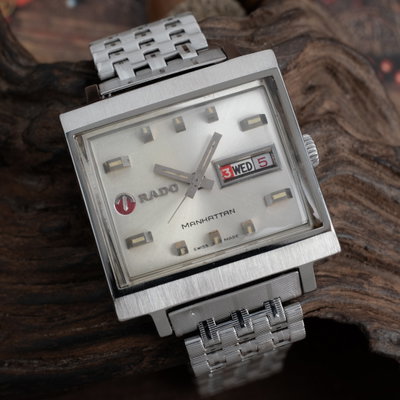
The Rado Manhattan makes its case through proportion: a broad square steel body, a faceted acrylic crystal and a day-date dial with chunky applied indices. The examples handled from 1969 establish the period, while surviving watches also carry the unmistakable visual language associated with the 1970s.
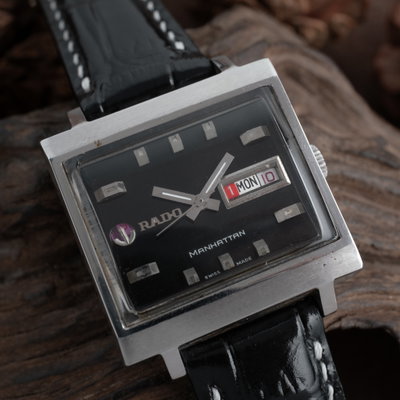
The strongest vintage Rado Manhattan is not automatically the largest. A clean vertically brushed or sunburst dial, a crystal that preserves the case geometry and a properly fitted multi-link bracelet matter more than the difference between 34 mm and 36 mm. Black dials bring stronger contrast, but oxidation on the hands can undo that advantage.
Known production year
1969-1969
Case material
Stainless steel
Known case widths
34 mm and 36 mm, excluding the crown
Movement types handled
Mechanical and automatic
| Display | Day and date at 3 o'clock |
| Dial finishes handled | Vertically brushed silver-tone, silver sunburst and black |
| Crystal | Faceted acrylic |
| Bracelet | Signed multi-link bracelet on handled examples |
What it was built for
The Manhattan was built as a mechanical day-date watch with far more visual mass than a conventional round dress model. Its square stainless-steel case pushes the dial toward the corners, while applied block indices and baton hands keep the display legible beneath the faceted acrylic crystal. The day and date sit together at 3 o'clock, making the complication part of the composition rather than an interruption.
This is a watch for collectors who want late-1960s design without losing everyday information. The rotating Rado anchor gives the dial movement, while silver finishes range from vertical brushing to sunburst treatment. Those surfaces react differently to damage: brushing exposes spotting quickly, and sunburst finishing loses its radial structure when refinished.
Where the value sits
Dial condition creates the widest spread. Even silver-tone examples vary from clean vertical brushing to distributed spotting, perimeter dirt and debris, while black dials can remain legible despite badly oxidised hands. A redial costs more than case wear because the factory surface, applied indices and printed day-date layout are the identity of the watch. A genuine service dial is different from a redial, but neither should be priced as the dial that left the factory with that watch.
The original multi-link bracelet adds more than convenience because its width and articulation continue the square case across the wrist. A signed anchor crown is another useful component, although crowns and crystals are consumable parts and must not support a blanket claim of originality. Between a clean 34 mm example on the correct bracelet and a damaged 36 mm watch, take the smaller one.
Where to start
Start with a steel Manhattan whose dial finish remains coherent from centre to perimeter. At 34 mm, the case still reads broad because its square outline occupies more wrist than a round watch of the same stated width. The 36 mm version has greater presence, but the extra size does not compensate for dirt beneath the crystal, hand corrosion or a softened case.
Lead with the worst fault when comparing used Rado Manhattan watches. Spotting across the dial cannot be serviced away, oxidation and pitting on the hands remain visible at normal distance, and a cracked or heavily marked faceted acrylic crystal blunts the architecture. Bracelet stretch and poor end-link fit also matter because the bracelet should leave the case cleanly rather than sagging at the first links. Service history is unknown unless supported by documentation.
What to check before you buy
- Dial construction: The handled Manhattan dials use applied chunky block indices, baton hands, a rotating Rado anchor and a day-date aperture at 3 o'clock. Flat replacement furniture or a different aperture position requires explanation.
- Surface finish: Silver dials retain either vertical brushing or a sunburst pattern. A uniformly painted surface, missing directional grain or printing laid over damaged metal points toward a redial rather than honest ageing.
- Case and crystal geometry: The stainless-steel case is square and works with a faceted acrylic crystal. Softened edges indicate polishing, while a domed generic crystal changes the profile and should not be treated as period-correct without evidence.
- Hands and ageing: Baton hands with central dark stripes occur on handled silver-dial examples. Oxidation, pitting and dark lume are damage, not patina, and sharply new hands against an aged dial can indicate a later replacement.
- Bracelet and crown: Handled examples include a signed multi-link bracelet and an anchor-signed crown. Both can be replaced consumable components, so signatures support the assessment only when fit, wear and construction agree with the watch.
Recent Rado results
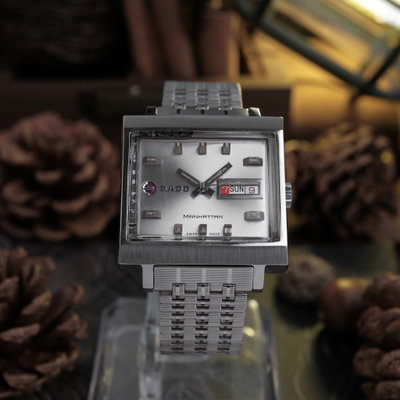
Rado · Manhattan · 11815

Rado · Manhattan · 11815-1
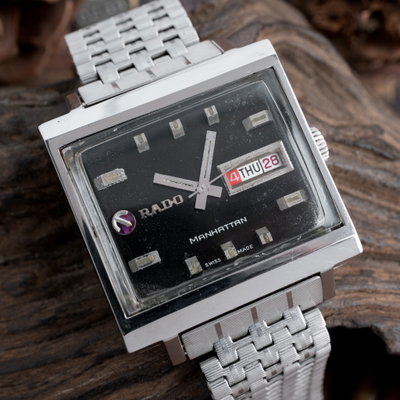
Rado · Manhattan · 3781902
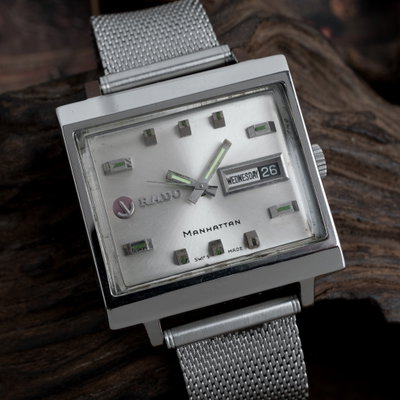
Rado · Manhattan · 11815
Rado · Manhattan
Rado · Manhattan · 8/7/26
More Rado references
Related pages
Frequently asked questions
Ready to hunt for your own?
More than 100 vintage watches go under the hammer every week.