Vintage Rado Daymaster - the curved-day calendar watch
The vintage Rado Daymaster to buy has an honest silver sunburst dial, a coherent day-date layout and the least compromised case.
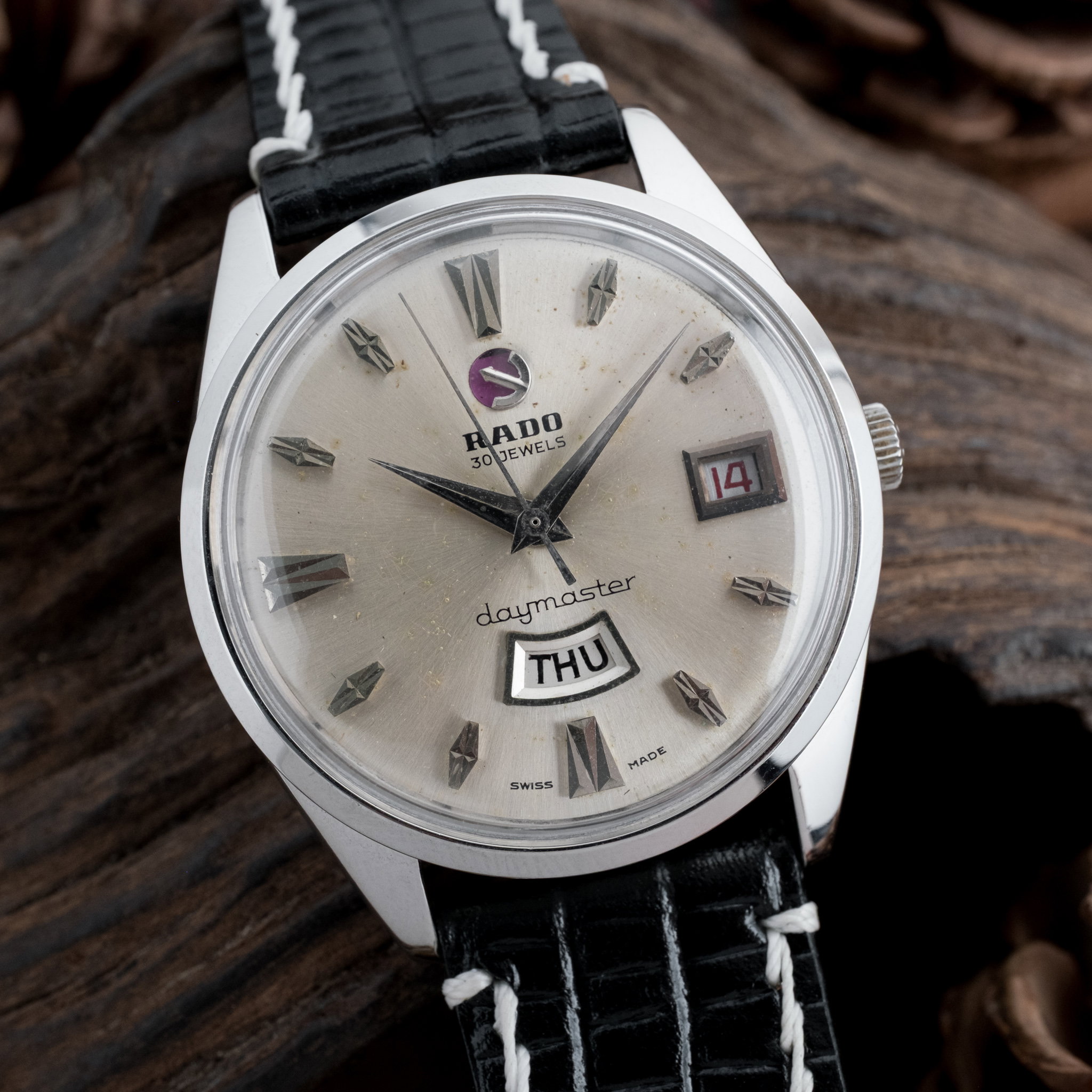
The Daymaster makes sense from across the room: a curved day display sweeps above six, the date sits at three and Rado's rotating anchor marks twelve. Examples handled from 1965 to 1969 combine that unusual calendar with silver sunburst dials and applied faceted indices. The layout, not the name on the dial, is the reason to own one.
Steel examples measure 35 mm, while a gold-tone Daymaster is known at 36 mm with a stainless steel caseback. That single millimetre changes the dial's apparent spread, but the condition of the sunburst finish matters more. Noticeable spotting, oxidised hands and worn plating cannot be treated as harmless patina when they interrupt the watch's defining surfaces.
Known production span
1965-1969
Known case sizes
35 mm stainless steel; 36 mm gold-tone
Movement type
Automatic
Known caliber
AS 1806 on one handled example
| Known jewel count | 30 jewels |
| Calendar layout | Curved day display at 6; date at 3 |
| Dial finish | Silver sunburst |
| Case materials | Stainless steel; gold-tone with stainless steel caseback |
| Known references | 18020, 11754/1, 11753, 11754, 343942, 11778/1 |
What it was built for
The Daymaster was built around calendar legibility rather than a conventional day aperture. Its curved English day display occupies the lower dial above six, separated from the date at three, while applied faceted indices keep the silver sunburst field readable. That arrangement gives the watch its identity and also makes a mismatched or refinished dial easier to spot.
The known 1965-1969 examples use automatic movements, with one steel watch specifically carrying the 30-jewel AS 1806. The broader movement picture is not complete enough to assign that caliber to every Daymaster. A movement signed or specified differently is not automatically wrong, but its compatibility with the dial, calendar layout and case must be established rather than assumed.
Where the value sits
The dial carries the premium. Light spotting visible only under magnification is easier to accept than broad spotting across the entire sunburst surface, and oxidation on dauphine hands should be priced as damage when it breaks their finish. A redial costs more than a scratched crystal because the curved day aperture, printed text and sunburst treatment define the Daymaster.
Case material creates the next divide. Stainless steel avoids plating loss, while the gold-tone version can wear through at the lugs and case edges, damage no routine service reverses. Over-polishing softens lug lines on either case, and a replaced crown or crystal matters less than a dial whose printing or calendar openings no longer agree with known examples.
Where to start
Start with a 35 mm stainless steel Daymaster when dial quality is equal. It removes plating wear from the decision and keeps the compact proportions associated with the steel examples handled, while the 36 mm gold-tone case offers more visual spread and warmer furniture. Between a clean steel dial and a spotted gold-tone dial, take the steel watch.
Reference 11753 is the clearest route to the gold-tone configuration, with a stainless steel caseback and gold-tone dauphine hands. Reference 18020 provides a steel alternative at 35 mm. Other known references require case-by-case comparison because the available evidence does not establish a complete mapping of case material, size and movement for each one.
What to check before you buy
- Dial and calendar layout: A correct known layout places the curved English day display above six and the date at three on a silver sunburst dial. Uneven aperture edges, incompatible printing or a flat repainted finish are redial or franken warnings.
- Hands, indices and anchor: Known examples use dauphine hands, applied faceted indices and Rado's rotating anchor at twelve. Oxidation can be genuine damage, but inconsistent colours or mismatched ageing can indicate replaced hands or assembled dial furniture.
- Case and caseback pairing: Reference 11753 is known in a 36 mm gold-tone case with a stainless steel caseback, while reference 18020 is known in 35 mm stainless steel. A different pairing is not condemned automatically, but it needs evidence before being accepted.
- Movement claim: The AS 1806 is confirmed on one handled steel Daymaster with 30 jewels, not across the whole model. A caliber mismatch, improvised movement ring or calendar that does not align cleanly can indicate a married or franken watch.
Recent Rado results
More Rado references
Related pages
Frequently asked questions
Ready to hunt for your own?
More than 100 vintage watches go under the hammer every week.