Seiko Lord Matic 5606-7191: the versions and faults that matter
The Seiko Lord Matic 5606-7191 is a compact automatic day-date best bought for dial condition, coherent parts and a case that retains its geometry.
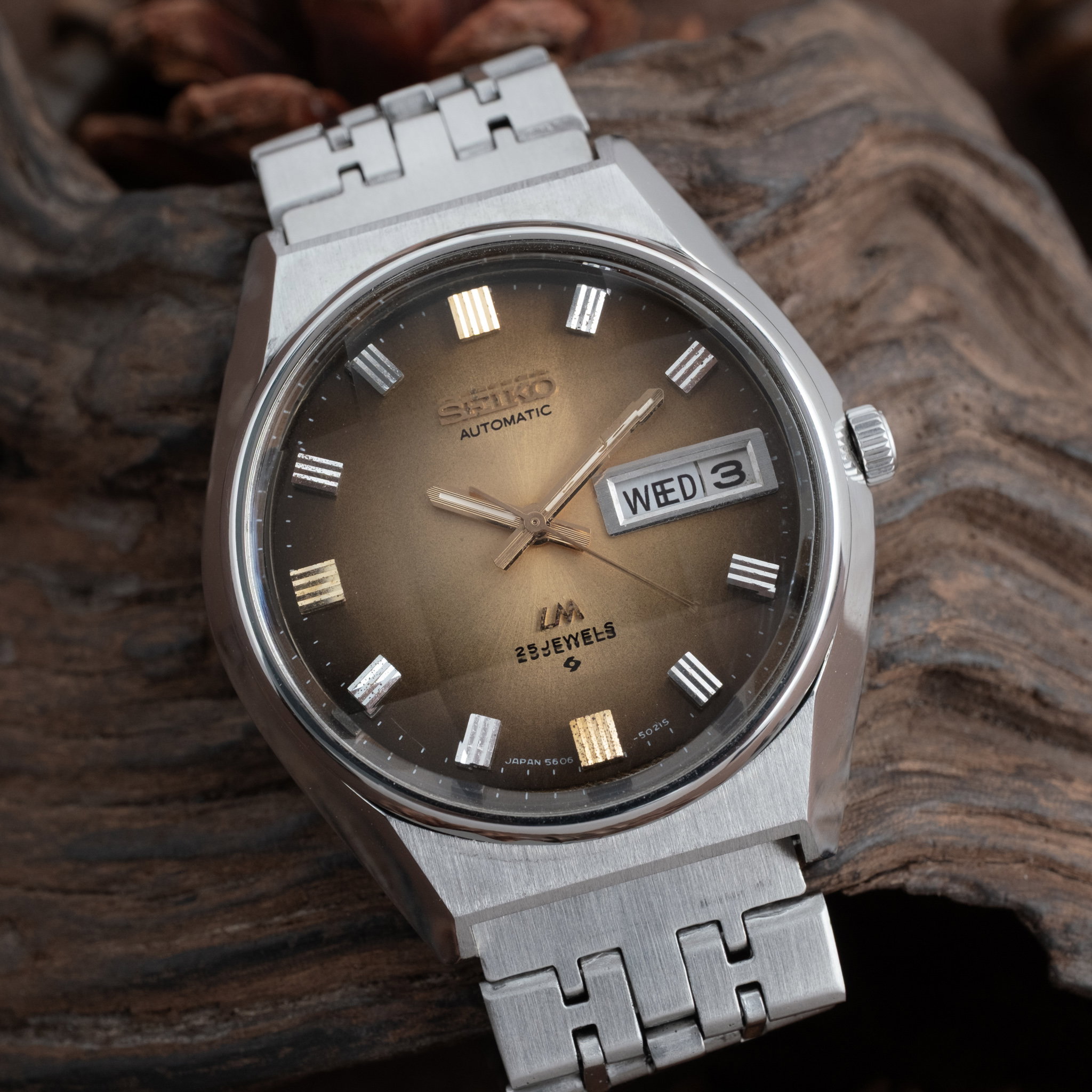
The Lord Matic 5606-7191 puts an automatic day-date movement into a compact stainless-steel case with distinctly early 1970s dial treatments. Known examples date from 1972 to 1973, while the caliber 5606 production window is broader and must not be mistaken for the production span of this reference.
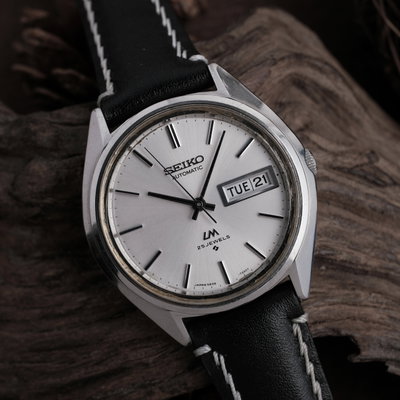
The safest buy is the watch with the cleanest honest dial and a case that still carries defined edges, not the most unusual colour at any cost. Silver sunburst, gradient brown and silver linen dials are known, with the linen version using black Roman numerals. A refinished dial costs more in lost appeal than moderate case wear, while an intact signed bracelet can strengthen an otherwise coherent example.
Model
Lord Matic
Reference
5606-7191
Known production years
1972-1973
Case material
Stainless steel
| Known case sizes | 36 mm or 37 mm, excluding the crown |
| Movement | Automatic caliber 5606A |
| Known jewel counts | 23 or 25 jewels |
| Known dial variants | Silver sunburst, gradient brown, or silver linen with black Roman numerals |
| Calendar | Day-date, with English and Kanji wheels known |
| Known bracelet | Signed Seiko LM beads-of-rice bracelet |
The model landscape
The 5606-7191 is not tied to one dial treatment. Silver sunburst examples use applied faceted indices, while the gradient brown version uses applied markers against a darker edge. The silver linen dial changes the character more decisively through its textured surface, printed black Roman numerals and black hands.
Day-date displays with English and Kanji wheels occur across the reference. Movement markings also require attention: handled watches contain the automatic 5606A with either 23 or 25 jewels, so jewel count alone does not settle authenticity. Between a vivid dial with damage and a quieter silver dial with an undisturbed surface, take the silver dial.
On the wrist
Known cases measure 36 or 37 mm excluding the crown, a variation that matters less than the broad dial opening and angular case shape. The day-date aperture at three o'clock gives the watch more visual weight than a simple dress watch, while applied furniture on the sunburst versions catches light sharply.
The compact diameter suits a cuff and keeps the Lord Matic close to its period proportions. A faceted crystal is known on the gradient brown configuration and adds stronger reflections than the flatter visual effect of the linen dial. Bracelet fit also changes the impression: a signed beads-of-rice bracelet makes the Roman-numeral version read more formally, but stretch must be judged separately from the watch head.
What goes wrong
Dial damage is the costliest visible fault. Edge wear and discoloration can gather along the outer minute track even when the centre remains presentable, while moisture spotting or a redial removes the sharp contrast that defines the sunburst and linen finishes. A service dial would be a genuine factory replacement, not a redial, but neither should be described as the original dial without evidence.
Case polishing softens the angular geometry first, leaving rounded transitions where defined edges should remain. Bracelet stretch, oxidised hands and replaced crowns are separate faults, and a clean dial does not cancel them. A watch assembled from correct-looking parts that never shipped together is franken; a period-correct component is not proof that it has remained with this watch since 1972 or 1973.
The 5606A must be assessed as a mechanical movement, not accepted because the rotor turns and the watch runs. Rate readings from individual watches cannot establish service history, and no receipt means the service history is unknown. Calendar operation should be treated cautiously until tested, because the day-date display is central to this reference rather than an incidental complication.
Dating this watch
| Serial range / caliber | Year | Note |
|---|---|---|
| 5606 | 1968-1976 | caliber production window |
Dating data comes from our decoder tables; treat years as approximate.
What to check before you buy
- Dial and hand configuration: Silver sunburst dials are known with applied faceted indices and hands carrying dark central stripes. Gradient brown examples use applied markers and baton hands with white inserts, while linen dials use black Roman numerals and black hands.
- Movement markings: The movement should be an automatic 5606A. Both 23-jewel and 25-jewel examples are known, so the caliber designation and overall parts coherence matter more than using jewel count as a single pass-or-fail test.
- Case size and material: Known 5606-7191 cases are stainless steel and measure 36 or 37 mm excluding the crown. Defined case edges support an honest assessment, while rounded transitions indicate polishing rather than a different factory shape.
- Day-date assembly: English and Kanji day wheels are known with a framed aperture at three o'clock. A correct-looking wheel is only one part of the judgement, since a period-correct replacement does not prove that the assembly is original to the watch.
- Redial and franken signs: Printing must suit the specific dial treatment: applied furniture on sunburst and gradient dials, or printed black Roman numerals on the silver linen dial. Mixed details from these configurations can indicate a refinished dial or a franken assembly.
Other 5606-7191 examples we auctioned
More Seiko references
Related pages
Frequently asked questions
Ready to hunt for your own?
More than 100 vintage watches go under the hammer every week.