Vintage Seiko Marvel - variants, wear and the right one to buy
Buy the vintage Seiko Marvel for its factory dial and coherent manual-wind movement, accepting compact sizing before paying extra for case shine.
We auction more than 100 vintage watches a week.
Get first access: new Seiko watch drops and alerts before auctions end.
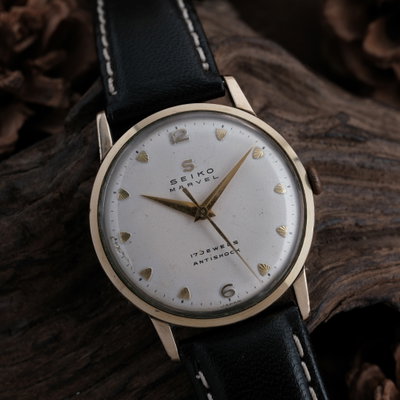
Browse 32 live Seiko auctionsThe Marvel marks Seiko's move to a fully in-house designed movement and belongs to the brand's 1957-1964 production landscape. It is a compact, manual-wind dress watch rather than a later sports model: slim hands, applied furniture and restrained silver dials do the work. The Marvel shown here makes most sense as a mid-century daily watch for careful wear. No water-resistance specification is established by the watches handled.
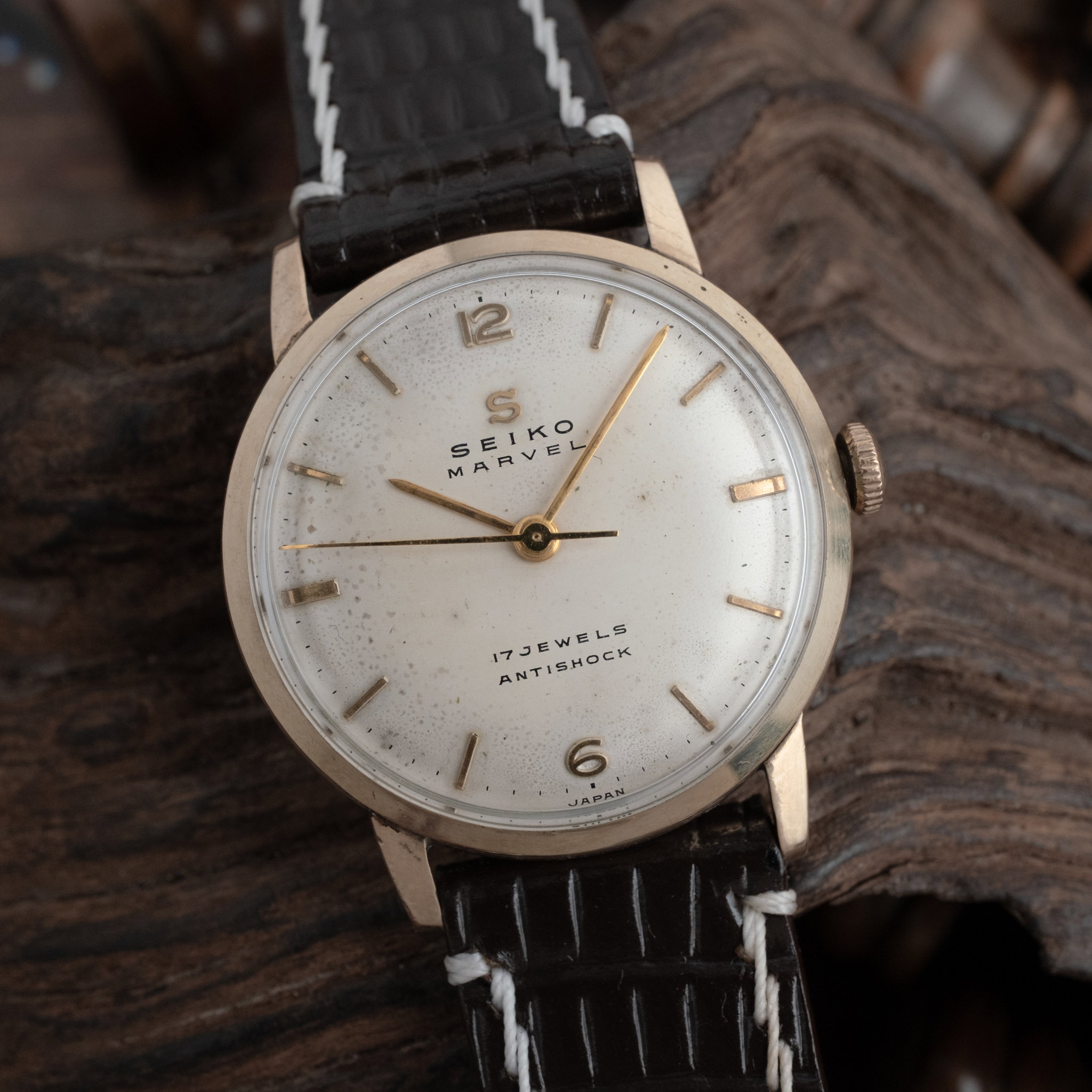
Case size and dial state decide the purchase. Known examples run from 32 to 34 mm excluding the crown, so even the largest wears compact by current standards. The strongest choice is a 33 or 34 mm example with a clean factory dial, intact gold surface and coherent Seikosha movement. A refinished dial costs more in lost appeal than modest hand oxidation or honest edge wear.
Known production years
1957-1964
Winding
Manual wind
Movement configurations
Seikosha movements documented with 17 jewels and 19 jewels
Handled case sizes
32 mm, 33 mm and 34 mm, excluding the crown
| Case constructions | 14K gold-filled front with stainless steel back, or 20-micron gold-plated case with steel back |
| Known dial treatments | Silver sunburst, frosted stardust and aged silver-tone |
| Known references | 14033 M, J14044, 14044, H0514701, J14065, 14025, 14034 M, J13010 and 14022 |
| Known hand style | Gold-tone dauphine hands |
The model landscape
The Marvel is not one fixed configuration. The J13010 combines a compact gold-filled case front with an applied S logo, while the 14025 pairs a gold-plated case with a frosted stardust dial and a higher jewel-count movement. Silver sunburst dials, applied faceted indices and Arabic numerals also occur, so one familiar dial layout cannot authenticate the whole model.
Value sits first in the dial, then in case integrity and movement coherence. An applied S-logo dial deserves a premium only when its printing, furniture and ageing agree; the logo cannot rescue a redial. A 14K gold-filled front also survives wear differently from a 20-micron plated front. Between a bright plated case with worn-through lug edges and an evenly aged gold-filled example, take the latter.
On the wrist
At 32 to 34 mm excluding the crown, the Marvel wears as a compact mid-century dress watch. The 34 mm case gives applied indices and dauphine hands more room, while the smaller versions make the gold-tone cases feel more formal. Silver sunburst dials change visibly with light; frosted stardust surfaces read softer and can disguise light spotting from a distance.
Manual winding makes the Marvel an involved daily watch rather than a set-and-forget choice. Legibility is strongest when the hands retain clear contrast against the silver dial, because oxidation on gold-tone dauphine hands can flatten that separation. Water resistance is unknown, and no surviving case construction should be treated as proof of present sealing.
What goes wrong
The worst fault is a refinished dial. It removes the factory surface that separates a silver sunburst dial from a frosted stardust one, and newly printed text cannot recover that loss. Genuine service dials are different from redials, but the evidence here does not establish a service-dial specification for the Marvel, so that label should not be used without documentation.
Gold plating wears through first at exposed edges, gold-filled fronts can show wear, and polishing softens the lugs. Dauphine hands develop oxidation, while dial spotting can become concentrated discoloration, as seen between 7 and 9 o'clock on one early example. The service history is unknown unless paperwork establishes it. Buy the cleanest coherent dial and case, rather than a shinier used Seiko Marvel with an unexplained movement or mismatched furniture.
What to check before you buy
- Dial print and surface: A Marvel dial may be silver sunburst, frosted stardust or aged silver-tone. Printing must sit naturally on that surface; sharp new text over spotting or lost texture points to a redial.
- Applied dial furniture: The J13010 is known with an applied gold-tone S logo, while other Marvel configurations differ. The logo, indices and dial ageing should agree, and the S logo alone does not authenticate the watch.
- Hands: Gold-tone dauphine hands occur on handled examples and may show oxidation or spotting. Their colour and ageing should make sense beside the applied indices; conspicuously fresh hands can indicate a later replacement.
- Case and caseback: Known gold-filled and plated Marvel cases use stainless steel backs. Wear at the lug edges should agree with the stated construction; heavy polishing rounds the lugs and can blur the transition between surfaces.
- Crown: The available evidence does not establish one original crown profile for every Marvel configuration. A signed or unsigned crown is therefore inconclusive by itself and should not carry an authenticity claim.
- Movement markings: Handled examples use manual-wind Seikosha movements with 17 or 19 jewels. The jewel count should match the bridge marking and description; mismatched movement claims raise the possibility of a franken or married watch.
- Redial and franken signs: A correct reference, dial or movement is not enough on its own. Mixed ageing between printing, applied furniture, hands and case can expose a redial or parts assembled from watches that never shipped together.
Recent Seiko results
11 Seiko watches auctioned
More Seiko references
Related pages
Frequently asked questions
Ready to hunt for your own?
More than 100 vintage watches go under the hammer every week.