Vintage Seiko LM Special: Versions, Wear and Buying Checks
Buy a vintage Seiko LM Special for its dial and faceted case, choosing 34 mm for compact wear or 36 mm for stronger wrist presence.
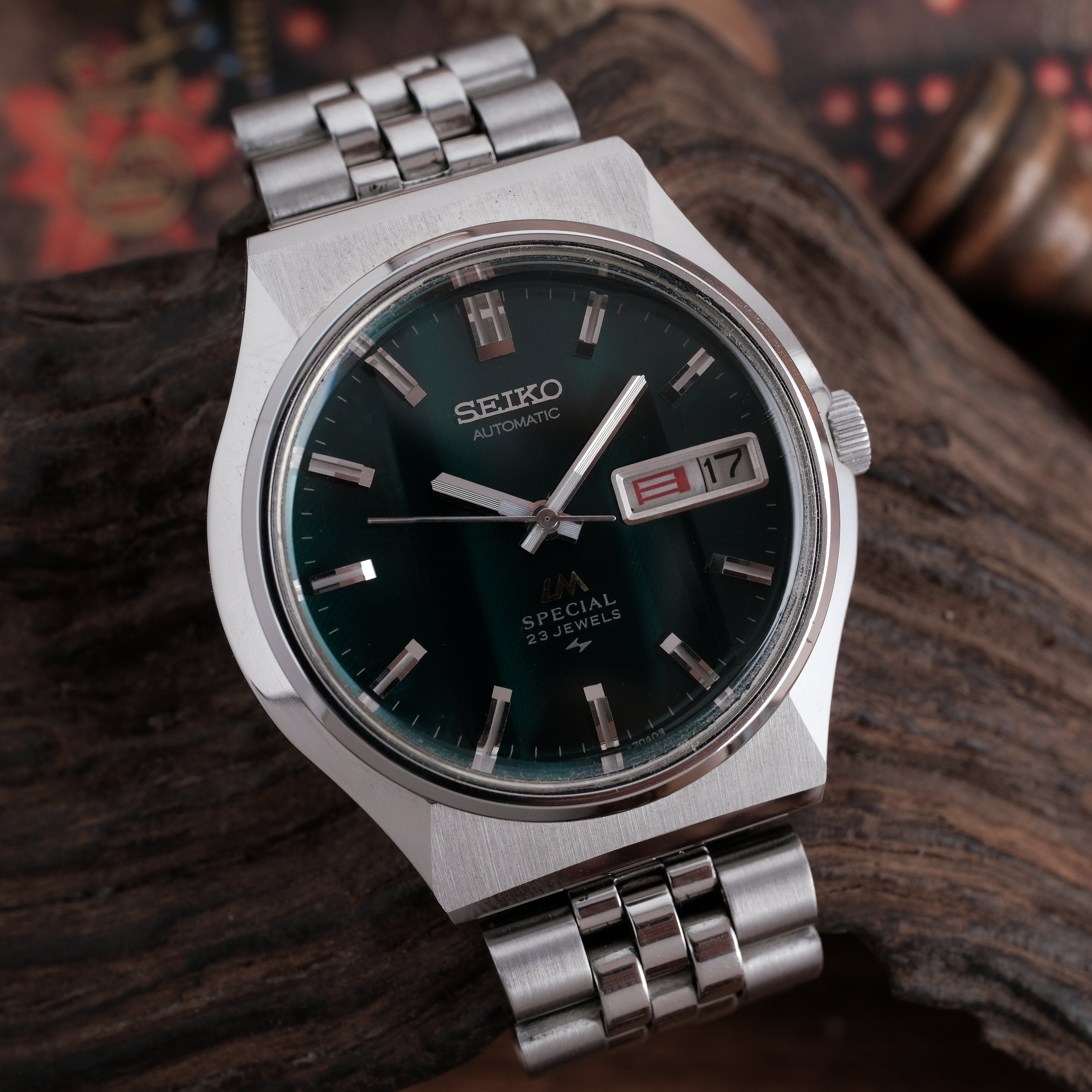
The Seiko LM Special concentrates the experimental side of the 1970s into a compact automatic watch. Its known production span runs from 1970 to 1977, while handled examples pair angular steel cases and faceted crystals with brown striped, green gradient or blue sunburst dials. A used Seiko LM Special makes most sense when that complete visual scheme survives together, rather than when one bright component distracts from mismatched parts.
The first decision is between the compact 34 mm format and the broader 36 mm case, both measured without the crown. The second is the dial, because refinishing a striped, gradient or sunburst surface removes the exact finish that separates these watches from ordinary 1970s automatics. Between a sharp 34 mm example with an honest dial and a softened 36 mm watch with a redial, take the smaller watch.
Known production years
1970-1977
Known case sizes
34 mm and 36 mm, excluding the crown
Case material
Stainless steel
Documented movement
Seiko caliber 5216A automatic
| Documented jewel counts | 23 and 25 jewels, depending on configuration |
| Calendar configuration | Day-date, including English and Kanji on 5216-6040 |
| Known dial finishes | Brown vertical stripe, green gradient and blue sunburst |
| Crystal form | Faceted crystal |
The model landscape
The LM Special is a family of distinct references rather than one fixed design. Reference 5216-6040 combines a 36 mm steel case with a brown vertically striped dial, an English and Kanji day-date display and caliber 5216A. Reference 5216-7040 keeps the 36 mm format but changes the character with a green gradient dial. These two versions put dial texture and colour ahead of restraint.
Reference 5216-6020 reduces the steel case to 34 mm and uses a blue sunburst dial, applied faceted indices and baton hands with central white stripes. Its caliber 5216A example carries 25 jewels, while handled examples of the two 36 mm references carry 23, so jewel count must be judged against the exact configuration rather than treated as a universal LM Special rule. The market premium belongs with a coherent dial, crystal and case, not an isolated specification.
On the wrist
At 34 mm, reference 5216-6020 wears as a compact 1970s watch, with the blue sunburst dial supplying more visual width than the measurement suggests. The applied indices and white-striped baton hands keep the display legible, while the faceted crystal adds reflections across the dial. Choose this version against a 36 mm example when a smaller case and a signed bracelet matter more than maximum wrist presence.
The 36 mm references 5216-6040 and 5216-7040 occupy more space without abandoning the LM Special's angular proportions. The brown vertical stripes on the former change as the wrist moves, while the green gradient of the latter concentrates colour toward the dial. The crystal is part of that effect, so a rounded replacement or heavily polished surface changes how either version reads before the movement becomes relevant.
What goes wrong
A redial is the costliest fault because the brown stripes, green gradient and blue sunburst finishes are difficult to reproduce convincingly. Faceted crystals can lose their geometry through polishing or replacement, cases can acquire soft edges from repeated refinishing, and signed bracelets can develop stretch. None of those faults should be hidden behind the word patina: even ageing is patina, while rounded facets, loose links and altered dial paint are damage or replacement.
Franken LM Specials require particular care because the family spans numerous references and more than one case size. A genuine 5216A movement does not prove that a dial, case and day wheel shipped together, and period-correct parts are not necessarily original to that watch. The service history is unknown unless paperwork establishes it, so current rate figures alone do not prove the condition of the movement.
Start with the dial, then require the faceted crystal and angular case to support the same reference-specific design. The 34 mm 5216-6020 is the clearest choice against a softened larger watch when compact proportions suit you. If stronger wrist presence is the priority, choose a 36 mm 5216-6040 or 5216-7040 with intact dial finish rather than paying a premium for fresh polish.
What to check before you buy
- Reference-specific dial: Reference 5216-6040 is known with a brown vertically striped dial, 5216-7040 with a green gradient dial and 5216-6020 with a blue sunburst dial. A flat refinish removes the defining surface treatment.
- Hands and hour markers: The 5216-6020 uses applied faceted indices and baton hands with central white stripes. Mismatched hand shapes, missing inserts or furniture that conflicts with the dial configuration are franken warnings.
- Faceted crystal and case: The crystal should retain a clearly faceted profile that works with the angular steel case. Rounded crystal surfaces, soft case edges or uneven transitions indicate polishing, replacement or both.
- Movement and jewel count: Known examples of 5216-6020, 5216-6040 and 5216-7040 use caliber 5216A, but both 23 and 25 jewel configurations occur. Match the movement to the exact reference instead of rejecting either count automatically.
- Day-date configuration: The 5216-6040 is known with an English and Kanji day wheel beside the date. A different wheel may be a service replacement or part of a franken assembly, and the watch itself cannot establish when it was changed.
Recent Seiko results
More Seiko references
Related pages
Frequently asked questions
Ready to hunt for your own?
More than 100 vintage watches go under the hammer every week.