Rado Mannheim 702: What to Know Before You Buy
The Rado Mannheim 702 is a 36 mm steel automatic whose dial originality, case definition and movement consistency determine the right buy.
We auction more than 100 vintage watches a week.
Get first access: new Rado 702 drops and alerts before auctions end.
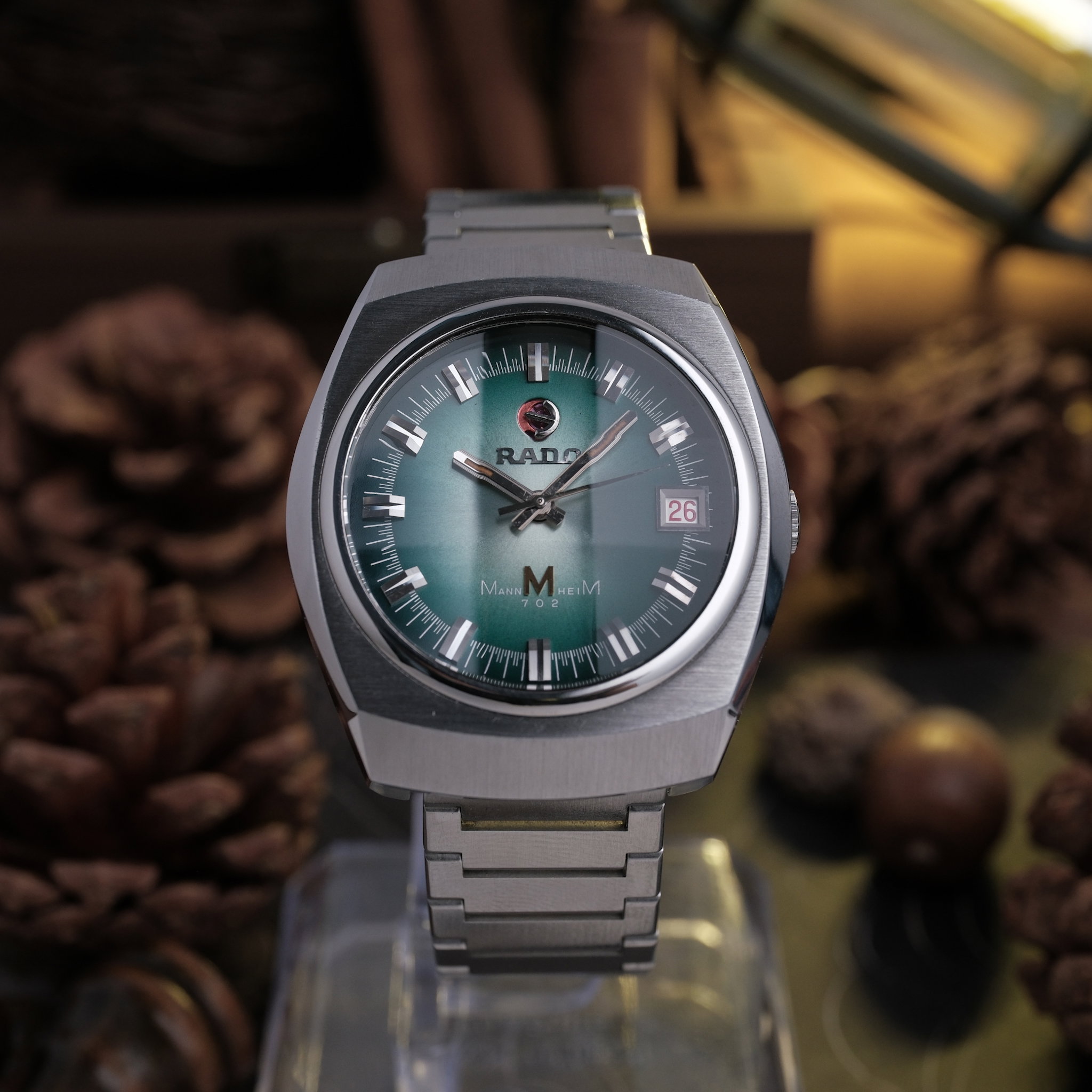
Browse 23 live Rado auctionsThe Rado Mannheim 702 compresses 1970s design into a 36 mm stainless-steel case, with a rotating anchor, an unusual split model signature and red date numerals.
The version to want has a clean, coherent dial and clearly defined case lines. Silver sunburst, blue vertically brushed, green fumé and heavily aged dark dials are known, while automatic calibers 2783, 2793 and 2824 have all been handled in reference 702.
Reference
702
Model
Mannheim
Period
1970s
Case diameter
36 mm excluding the crown
| Case material | Stainless steel |
| Movement type | Automatic |
| Known calibers | 2783, 2793 and 2824 |
| Jewel count | 25 jewels |
| Known dial finishes | Silver sunburst, blue vertically brushed, green fumé and aged dark |
| Date display | Red date numerals |
The model landscape
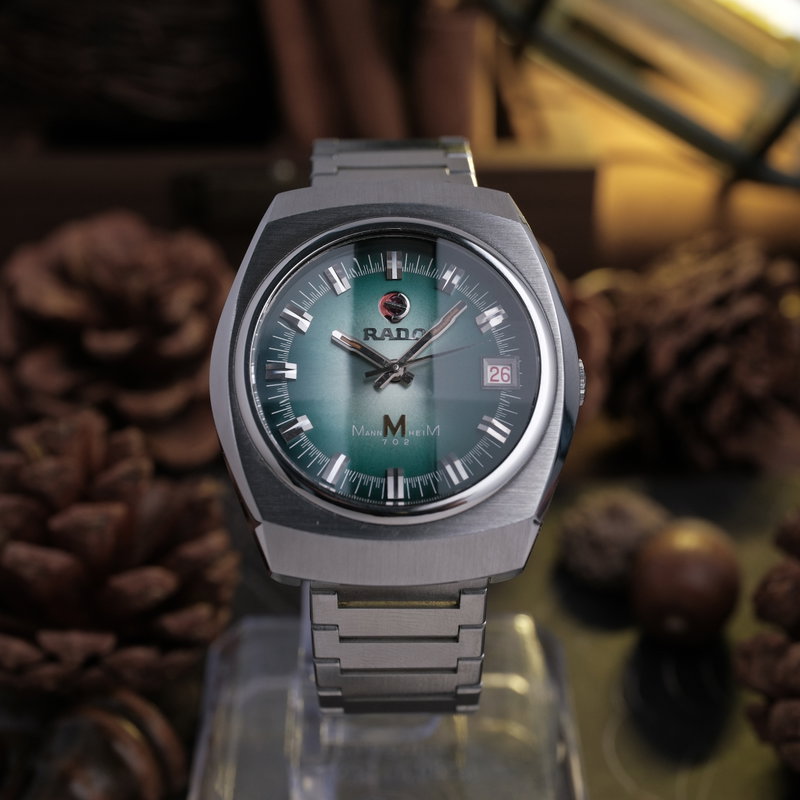
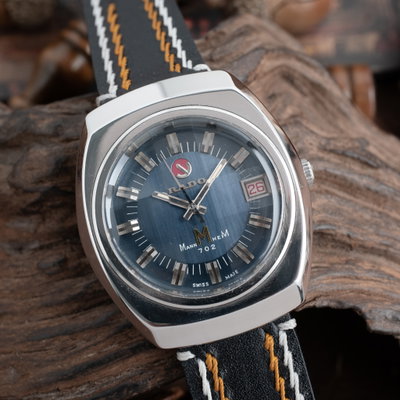
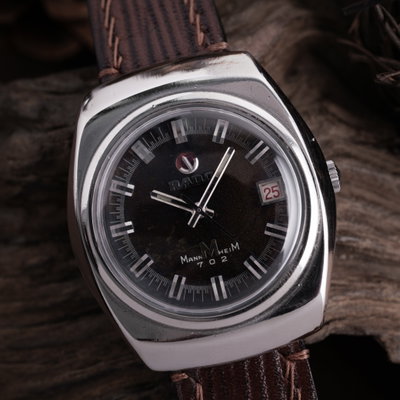
The silver sunburst Mannheim 702 is the safest entry point because its faceted markers, rotating anchor and surface condition are comparatively easy to read. The blue vertically brushed version brings stronger contrast through gold-tone dial furniture, while the green fumé dial makes the clearest period statement. A dark dial with dense golden-bronze speckling can be compelling, but call it damage or even ageing according to what is actually present - not tropical, which describes a black dial faded brown.
Movement labels alone do not settle authenticity. Reference 702 examples have contained automatic calibers 2783, 2793 and 2824, all with 25 jewels, so rejecting a watch merely because it differs from another Mannheim is unsafe. The movement still has to agree with the dial, case and date execution; without supporting documentation, the exact factory history of any individual combination remains unknown.
On the wrist
At 36 mm excluding the crown, the Mannheim 702 wears compactly across the wrist without looking delicate. The cushion or tonneau-shaped steel case puts more metal around the dial than a round case of the same diameter, while the broad dial opening preserves legibility. It suits a cuff better than its assertive typography suggests, although thickness is not established by the watches handled and should not be guessed.
The vertically brushed blue and green fumé dials react more strongly to changing light than the silver sunburst version. Red date numerals add a small but unmistakable accent at three o'clock, and the applied gold-tone M interrupts the printed MANNHEIM signature. An integrated-style steel bracelet strengthens the period shape, but its fit and stretch matter more than whether it merely looks contemporary.
What goes wrong
A refinished dial is the costliest mistake because the Mannheim's value rests heavily on its unusual typography, finish and applied furniture. Heavy spotting, moisture staining or an evenly speckled surface must be described literally; attractive ageing does not make damage disappear. A genuine service dial is different from a redial, but neither should be sold as the untouched dial without evidence.
Over-polishing softens the broad case edges and turns defined corners mushy. Bracelets can develop stretch, replacement crowns may break the visual fit, and mixed movement or dial parts can create a franken watch even when every component is genuine Rado or ETA. On examples we have photographed, clean dial surfaces and strong case lines have made a more persuasive watch than cosmetic brightness.
Mechanical condition also needs plain language. One green fumé example ran around 50 to 55 seconds fast per day, while a blue example ran around 25 to 29 seconds fast per day; operational is not the same as recently serviced. Service history is unknown unless receipts establish it, and no prediction about future accuracy follows from a single timegrapher reading.
What to check before you buy
- Dial typography and furniture: The dial should carry the Mannheim treatment with printed MANN and HEIM separated by an applied gold-tone M, together with the rotating Rado anchor. Uneven replacement printing or incompatible furniture points to a redial or mixed assembly.
- Dial finish and date execution: Known finishes include silver sunburst, blue vertical brushing, green fumé and an aged dark surface. Red date numerals are consistent across handled examples, but colour alone proves nothing if the finish or typography has been refinished.
- Case geometry: The 36 mm stainless-steel case should retain readable geometric edges and defined transitions. Rounded corners and mushy surfaces indicate polishing, while mismatched bracelet end links can expose an unsuitable replacement.
- Movement consistency: Automatic calibers 2783, 2793 and 2824 are known in reference 702, each with 25 jewels. Confirm that the movement, date mechanism and dial belong together rather than treating one acceptable caliber stamp as proof of the entire watch.
- Franken and service-part tells: A genuine Rado crown, dial or movement is not enough if those parts never shipped together. Service dials must be identified as factory replacements, while redials show non-factory printing; without documentation, do not claim either as original.
Other 702 examples we auctioned
8 Rado 702 auctioned

More Rado references
Related pages
Frequently asked questions
Ready to hunt for your own?
More than 100 vintage watches go under the hammer every week.