Rado Montana 633.3041.4: what to know before buying
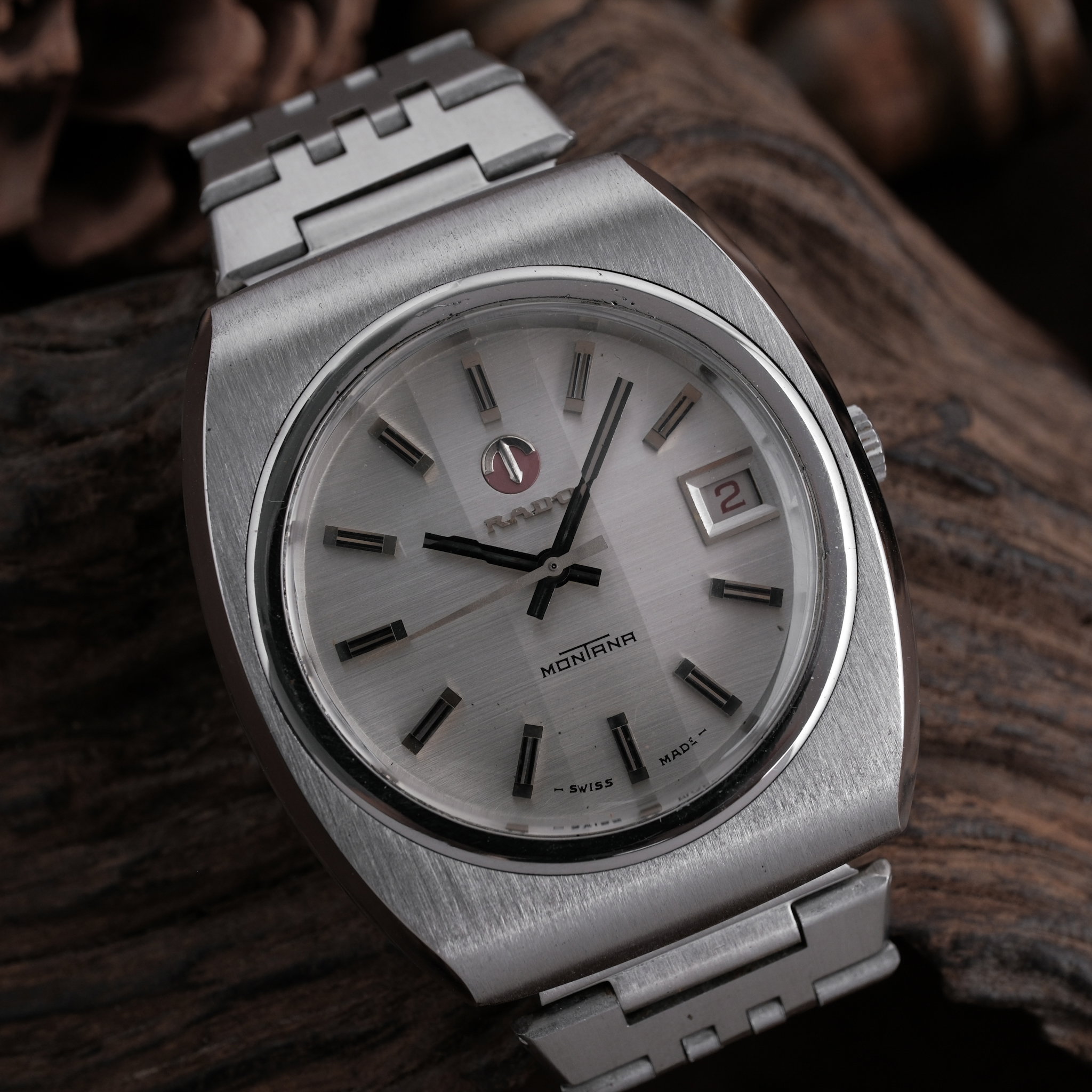
The Rado Montana 633.3041.4 is a 1970s automatic whose value rests on an honest dial, sharp cushion case and correct period bracelet.
We auction more than 100 vintage watches a week.
Get first access: new Rado 633.3041.4 drops and alerts before auctions end.
Browse 23 live Rado auctionsThe shape gives it more wrist presence than its diameter suggests, while the red date keeps either known dial treatment from becoming austere.
The decision is between vertically brushed silver and grey-to-brown fumé. Silver puts the black printing, applied indices and black baton hands into sharp relief; fumé adds more visual depth but gives you another surface whose evenness must be judged carefully. Buy the stronger dial before the stronger timegrapher reading, because mechanical performance can change after service while a damaged or refinished dial remains the watch's defining fault.
Brand
Rado
Model
Montana
Reference
633.3041.4
Production period
1970s
| Case size | 36 mm excluding the crown |
| Case material | Stainless steel |
| Movement | Automatic caliber 2824 |
| Jewel count | 25 jewels |
| Dial options | Vertically brushed silver or grey-to-brown fumé |
| Date display | Red date numerals at three o'clock |
The model landscape
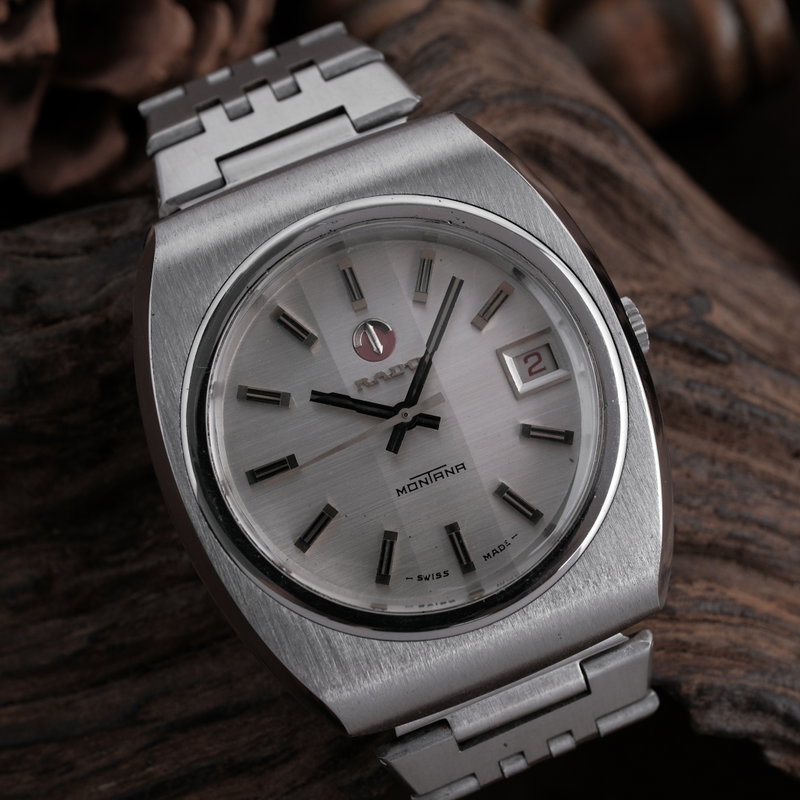
Reference 633.3041.4 is known with two materially different dial treatments. The vertically brushed silver dial uses crisp black printing, applied indices with black inserts and an applied Rado anchor, while the fumé version moves from grey to brown beneath applied faceted indices. Both use red date numerals at three o'clock. The silver version is the safer choice when clarity matters; the fumé version earns its premium only when the gradient remains even and free from spotting.
Bracelet configuration changes the object almost as much as the dial. A signed mesh bracelet gives the cushion case a continuous 1970s profile, while the integrated bracelet seen with the silver dial makes the geometry more architectural. A replacement bracelet may still be wearable, but it removes part of what makes this reference specific. Between a clean dial on a replacement bracelet and a refinished dial on a signed bracelet, take the clean dial.
On the wrist
At 36 mm excluding the crown, the Montana wears broader than a conventional round watch of the same stated diameter. The cushion case carries visual weight into the corners, and the close bracelet connection extends that shape around the wrist. It suits a cuff better than the geometry suggests, although no thickness measurement is established here and claims about clearance beyond the visible case profile would be speculation.
Legibility depends on the dial. The silver treatment gives the black baton hands and printing the strongest contrast, while the fumé dial trades some immediate clarity for a layered grey-to-brown surface. Applied indices create depth on both. The red date is not a discreet detail, so this is the wrong reference if you want a monochrome 1970s watch.
What goes wrong
Dial damage costs most. On silver examples, loss of the vertical brushing or heavy printing points toward a redial; on fumé examples, patchy colour, spotting or an abrupt gradient can overwhelm the intended effect. A service dial is different from a redial, but the available evidence does not establish a factory replacement specification for 633.3041.4, so the distinction should not be claimed without documentation.
Case polishing is the next permanent loss. The cushion geometry should retain defined transitions rather than soft, mushy edges, and bracelet fit should not leave an unexplained visual break at the case. Hands also matter: known examples use black baton hands, with black central stripes on the fumé configuration, plus a silver sweep seconds hand. Mixed furniture can indicate a franken assembled from parts that did not ship together.
Caliber 2824 is automatic and has 25 jewels, but a timegrapher result is only a snapshot. The handled watches have shown meaningfully different daily rates, so current performance cannot establish service history or authenticity by itself. The service history is unknown unless supported by records, and without documentation no claim should go beyond the movement, dial and case evidence visible in the watch.
What to check before you buy
- Dial layout and surface: A silver dial should retain vertical brushing, crisp black printing, applied indices with black inserts and an applied Rado anchor. A fumé dial should move evenly from grey to brown beneath applied faceted indices.
- Hands and date furniture: Known configurations use black baton hands, with a black central stripe on the fumé version, plus a silver sweep seconds hand. Red date numerals at three o'clock are common to both established dial treatments.
- Case and bracelet relationship: The 36 mm stainless steel cushion case should retain defined geometric transitions. Signed mesh and integrated bracelet configurations are established, while a generic bracelet or awkward case gap lowers confidence in the assembled watch.
- Movement identity: The movement should be an automatic caliber 2824 with 25 jewels. A plausible movement alone does not authenticate the watch, because a correct caliber can still sit inside a married or franken assembly.
Other 633.3041.4 examples we auctioned
5 Rado 633.3041.4 auctioned

More Rado references
Related pages
Frequently asked questions
Ready to hunt for your own?
More than 100 vintage watches go under the hammer every week.