Vintage Rado McKinley: What to Know Before Buying
Buy the vintage Rado McKinley for its clean silver dial, defined cushion case and red date, with condition taking priority over reference number.
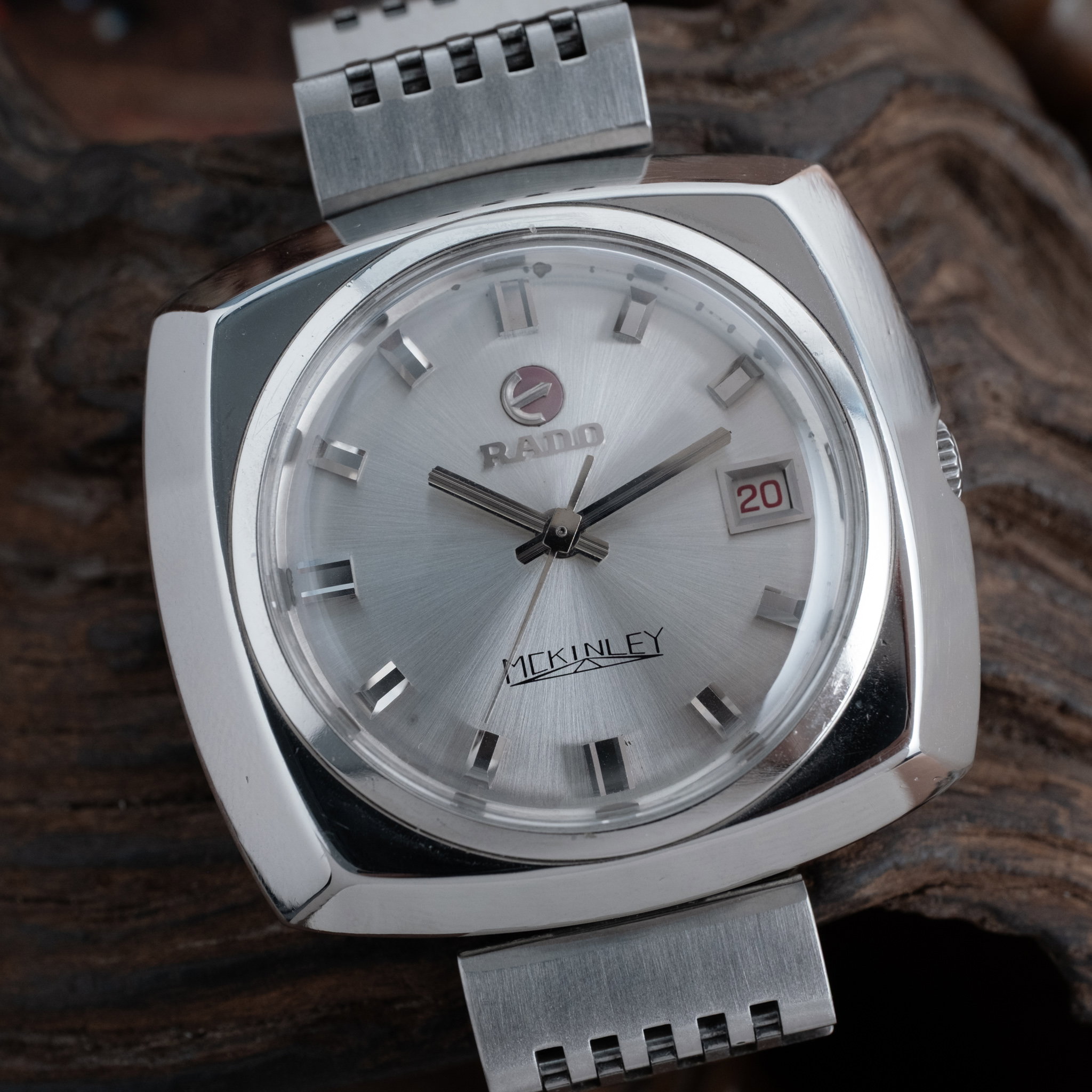
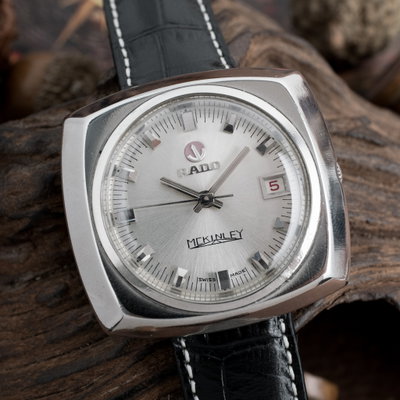
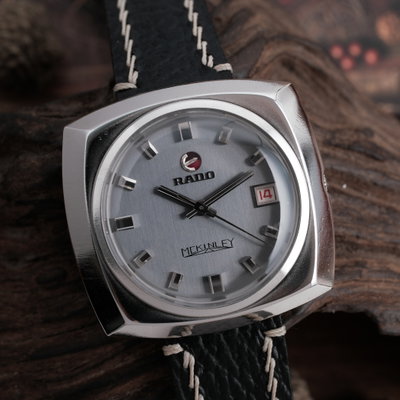
The vintage Rado McKinley is a 1970s automatic built around a 40 mm stainless-steel cushion case, not a conventional round dress watch. Its silver sunburst or brushed dial, applied faceted indices, anchor logo and red date at three o'clock remain readable inside the broad case. Reference 244349 and reference 246434 show the two dial textures, while reference 241199 adds a matching block-link bracelet.
The version to buy has the cleanest dial and the least softened case, not merely a preferred reference number. Across the McKinleys we have handled, reference 244965, reference 244700 and reference 244349 share the same basic silver-dial formula despite their different numbers. Between a sharp case with light hand oxidation and a polished case with a refinished dial, take the first watch. A redial removes more value than either of those other faults.
Model
Rado McKinley
Production period
1970s
Case size
40 mm excluding the crown
Case material
Stainless steel
| Case form | Cushion |
| Movement | Automatic, with 25 jewels stated on some handled examples |
| Dial finishes | Silver sunburst or silver brushed |
| Date display | Red numerals at three o'clock |
| Bracelet configuration | Matching block-link bracelet recorded on reference 241199 |
What it was built for
The McKinley belongs to the bold case design of the 1970s. Its 40 mm cushion case spreads across the wrist, while faceted hour markers and black-striped baton hands keep the silver dial legible. The red date at three o'clock is functional contrast rather than decoration alone.
The movement is automatic, and some handled examples are marked with 25 jewels. That jewel count should not be projected onto every McKinley without checking the individual movement, because other examples establish only that they are automatic. Reference 244700 has also been recorded with gilt movement finishing, but the evidence does not support treating that finish as universal. The service history of most surviving examples is unknown.
Where the value sits
The dial carries the widest value spread. A clean silver sunburst or brushed surface with intact printing, applied faceted indices and a red date commands a premium over a redial, even when the latter sits in a sharper case. Sunburst and brushed finishes are both supported by handled McKinleys, so texture alone does not establish a hierarchy. Reference number alone does not either, because the known examples do not establish a defensible rarity order.
A matching block-link bracelet adds value because it completes the broad 1970s profile seen on reference 241199. Its condition still matters: stretch, damaged links or poor end-link fit can erase much of that premium. On a strap, the McKinley remains coherent, but the head looks broader and more isolated. Buy the bracelet when it fits properly, but never trade a clean dial and defined case edges merely to obtain it.
What goes wrong
The worst fault is a refinished dial, followed by a case polished until the cushion geometry turns soft. Hand oxidation is visible on some examples and matters less when it is light and the black central stripes remain intact. Bracelet stretch can make a complete watch feel loose, while heavy case wear can blur the broad transitions that give the McKinley its shape.
Movement performance varies enough to require an individual reading. One handled McKinley ran substantially fast, while another recorded a much smaller daily deviation, so the word automatic says nothing about present health. A running watch may still have unknown service history. Without dated service documentation, the movement should be judged by its measured rate and operating behaviour, not by assurances that cannot be checked.
What to check before you buy
- Dial configuration: Supported McKinley dials are silver sunburst or brushed, with applied faceted indices and black printed text. Uneven fresh paint, buried index feet or printing inconsistent with the dial surface points to a redial.
- Hands and date: Handled examples use baton hands with black central stripes and a red date at three o'clock. Light oxidation can be honest wear, but a different hand shape or mismatched finish can indicate replacement parts or a franken configuration.
- Case geometry: The known steel examples use a 40 mm cushion case measured without the crown. Rounded transitions and soft edges indicate polishing; that does not make the watch false, but it permanently reduces the definition and value of the case.
- Movement claims: The model is supported with automatic movements, and 25 jewels is recorded on some examples rather than all of them. Treat a claimed jewel count or gilt finish as watch-specific and confirm that the movement matches the stated configuration.
Recent Rado results
More Rado references
Related pages
Frequently asked questions
Ready to hunt for your own?
More than 100 vintage watches go under the hammer every week.