Vintage Rado Matterhorn: What to Buy and What to Avoid
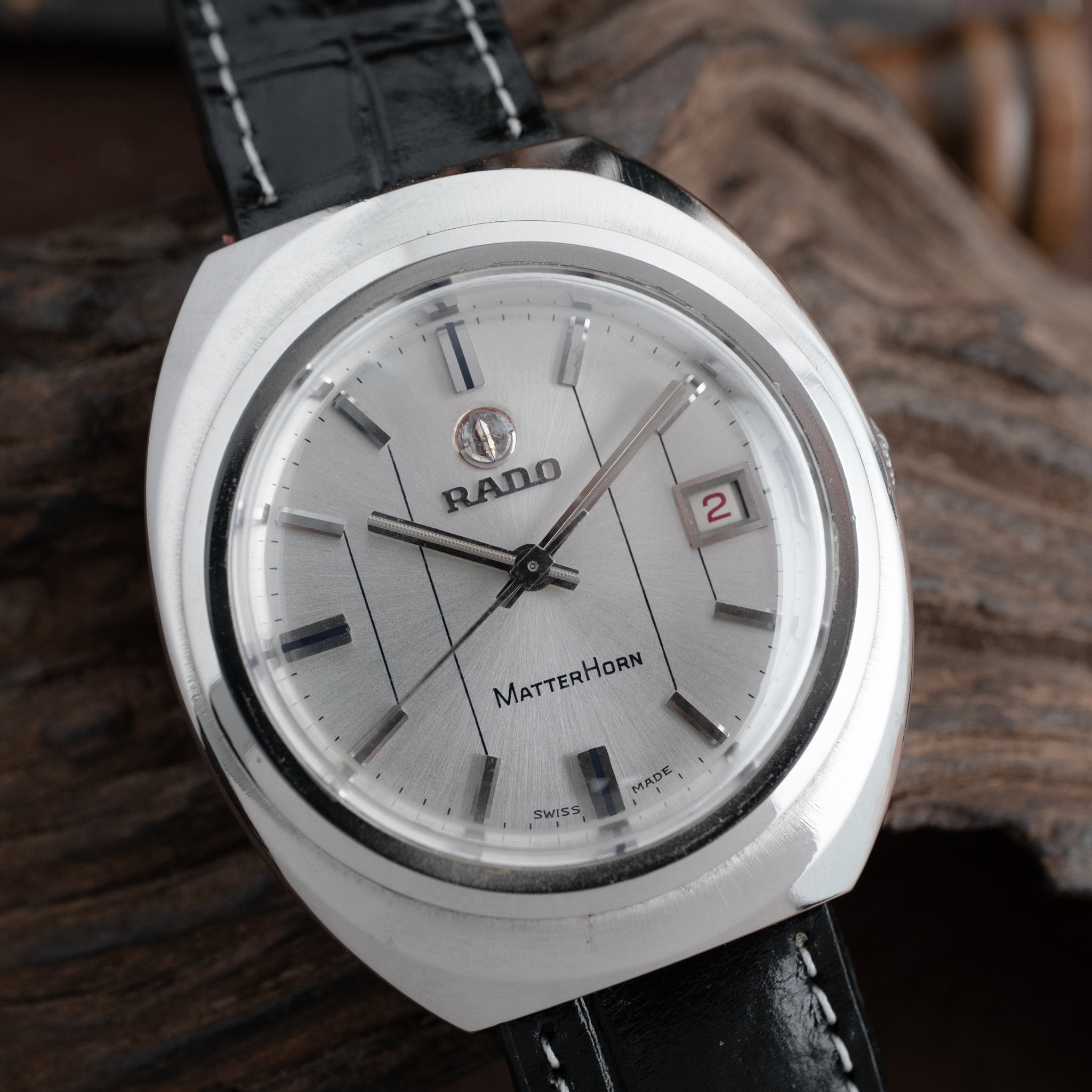
The vintage Rado Matterhorn to buy pairs a clean striped dial with sharp cushion-case lines and a well-fitting steel bracelet.
We auction more than 100 vintage watches a week.
Get first access: new Rado watch drops and alerts before auctions end.
Browse 10 live Rado auctionsThe Rado Matterhorn turns a 1970s automatic watch into a piece of wrist architecture. Its broad cushion case, vertical dial treatment and rotating anchor make sense together, and the examples shown here confirm that the model belongs on its steel bracelet rather than a generic strap.
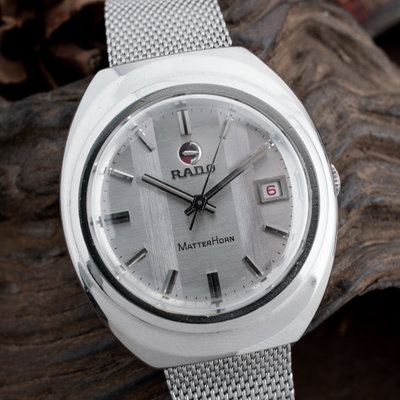
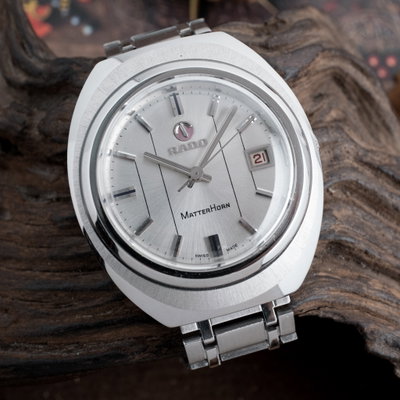
Buy the dial first. A clean striped or frosted surface matters more than superficial case shine, while sharp case lines and a close bracelet fit establish whether the rest of the watch still carries the design properly. The strongest vintage Rado Matterhorn is therefore not the brightest example, but the one with the least compromised geometry and dial work.
Production period evidenced
1970s
Case material
Stainless steel
Case sizes handled
37 mm and 38 mm, excluding the crown
Movement type
Automatic
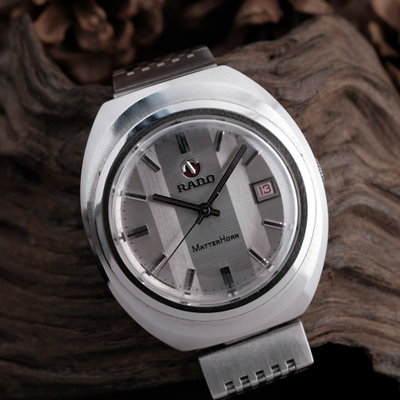
| Named caliber | AS 1859 on reference 70005755 |
| Jewel count | 25 jewels |
| Dial treatments | Two-tone vertical brushed silver, silver frosted with vertical printing, and silver-tone vertical stripes |
| Case form | Cushion case |
| Distinctive dial element | Rotating anchor logo |
| Bracelet format | Steel integrated-style bracelet |
The model landscape
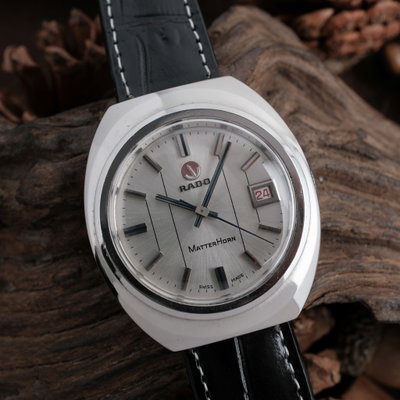
The Matterhorn is not confined to one dial treatment. Reference 70005755 combines a two-tone, vertically brushed silver dial with applied indices, while reference 11918 uses a silver frosted surface with vertical linear printing. Reference 70007936 returns to alternating silver-tone vertical stripes. Those differences change the watch more than the reference number alone suggests.
Case diameter also varies within the examples handled. The 37 mm reference 11918 reads slightly tighter, while the 38 mm references 70005755 and 70007936 give the cushion case more visual spread. Against a compromised 38 mm watch, take the sharper 37 mm example with the cleaner dial. The missing millimetre matters less than softened case lines or damaged furniture.
On the wrist
At 37 mm or 38 mm excluding the crown, the Matterhorn wears larger than a conventional round watch of the same diameter because the cushion case carries visual mass into its corners. The vertical dial treatment pulls the eye lengthwise, while the applied indices and rotating anchor break up a broad silver surface. It suits a wrist that can carry 1970s geometry without needing an oversized modern case.
The steel bracelet is part of that geometry. A correct-looking fit continues the case into the bracelet, whereas a generic strap exposes the broad case edges and changes the proportions. Bracelet condition deserves equal attention: excess stretch and loose fitment weaken the integrated-style effect even when the watch head remains sound.
What goes wrong
The worst fault is a refinished dial. Recreating alternating brushed stripes, frosted texture or fine vertical printing without flattening the design is difficult, and a redial costs more in credibility than ordinary case wear. Oxidised applied indices, spotting and wear around the dial edge are separate faults. They can be accepted when clearly bounded, but they should not be renamed patina.
Over-polishing softens the Matterhorn's cushion-case lines and removes the contrast between its planes. Bracelets develop stretch, replacement bracelets can fit poorly, and crowns may be changed during service. Movement history is often unknown; without receipts, a running automatic movement does not establish when it was last serviced. On caliber AS 1859 examples, the caliber marking should agree with the watch rather than being treated as proof by itself.
Where to start
Start with a steel Matterhorn whose dial treatment remains coherent from centre to edge, then judge the case and bracelet as one assembly. Between reference 11918 and the striped references 70005755 or 70007936, the better purchase is the cleaner dial with sharper case lines, not whichever version looks brighter in photographs.
A complete bracelet merits a premium only when its fit supports the case and stretch remains controlled. Heavy oxidation on the applied hardware, edge wear on the dial or a mushy cushion case should widen the value gap. The practical choice is a 37 mm or 38 mm automatic example with honest surface wear, intact dial texture and no attempt to disguise missing geometry.
What to check before you buy
- Dial execution: The Matterhorn dial should retain a coherent vertical treatment, whether striped brushing or a frosted surface with linear printing. Flattened texture or printing that sits unnaturally over the finish is a redial warning.
- Case geometry: The stainless steel cushion case should show defined planes and clear outer lines. Rounded transitions and mushy corners indicate polishing, which permanently changes the broad architectural shape.
- Anchor and applied furniture: The rotating anchor and applied indices must sit cleanly within the dial layout. Oxidation can be genuine damage, but mismatched finish, awkward placement or disturbed dial texture around the fittings needs explanation.
- Movement match: Reference 70005755 has been handled with the 25-jewel automatic caliber AS 1859. That pairing is useful confirmation for this reference, but the caliber alone cannot prove that the case, dial and movement left the factory together.
- Bracelet fit: The steel bracelet should meet the cushion case closely enough to preserve the integrated-style profile. Wide gaps, mismatched finishing or excessive stretch point to replacement parts or prolonged wear and reduce value.
Recent Rado results
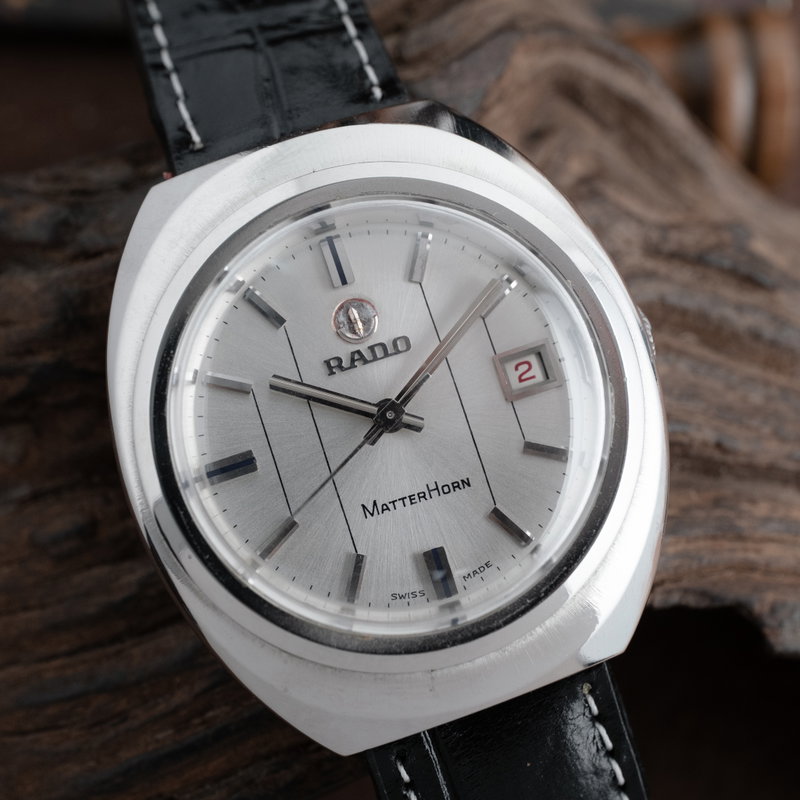
Rado · Matterhorn · 70017668
Rado · Matterhorn · 10005597
Rado · Matterhorn · 70001399
Rado · Matterhorn · 70015747
Rado · Matterhorn · 70005755
Rado · Matterhorn · 11918

Rado · Matterhorn · 11918
Rado · Matterhorn · 70011812
More Rado references
Related pages
Frequently asked questions
Ready to hunt for your own?
More than 100 vintage watches go under the hammer every week.