Rado Marco Polo: What to Know Before Buying
Buy the 36 mm steel Marco Polo with the cleanest factory dial and sharpest case; choose the vertical day-date version only when its calendar is complete and correct.
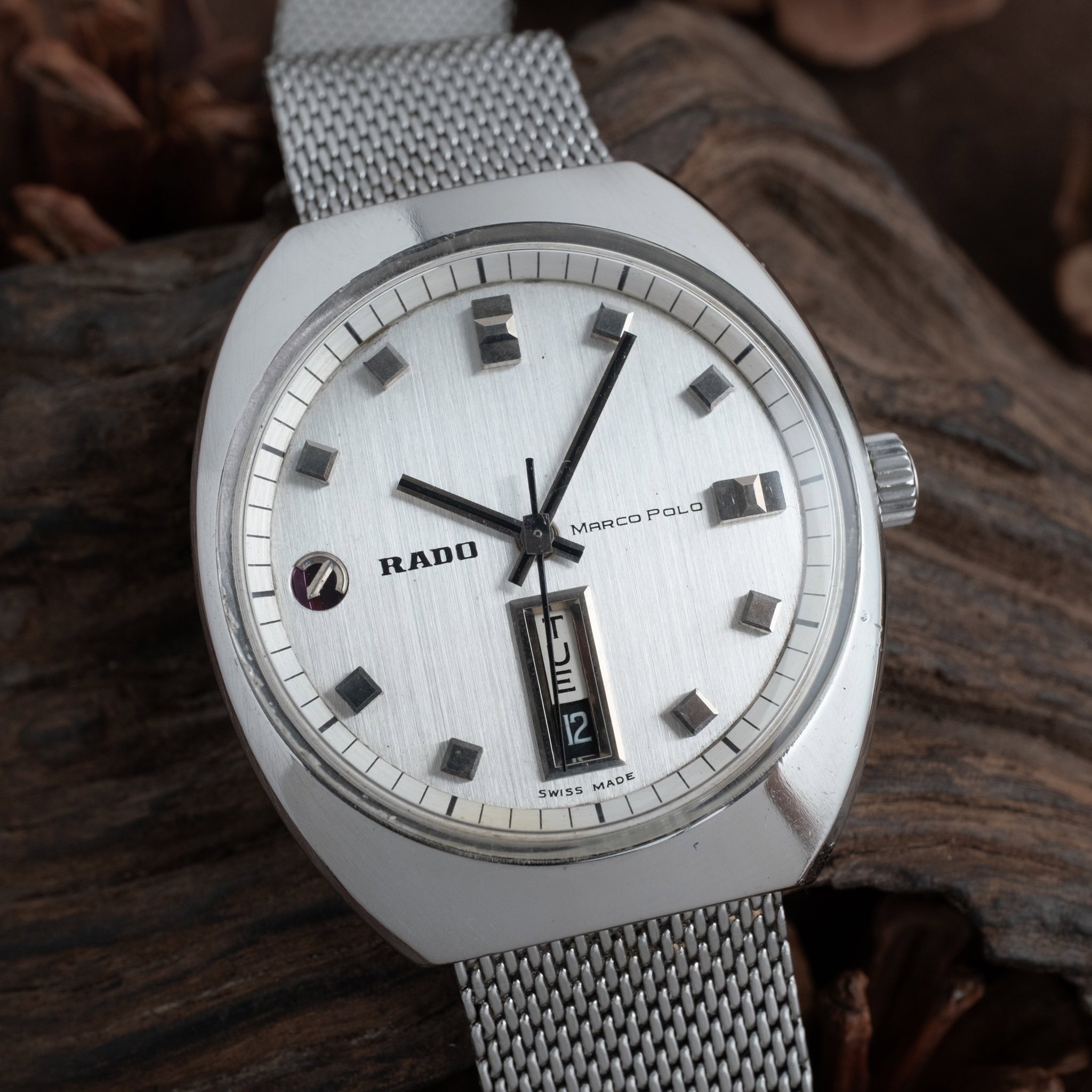
The Marco Polo turns Rado's 1970s design language into a compact automatic watch: a 36 mm cushion or tonneau case, a silver dial with applied faceted indices, and the freely rotating anchor. The versions differ enough to matter, especially where the calendar sits and whether the case is steel or gold-plated.
The strongest starting point is the steel Marco Polo with an intact factory dial and crisp case lines. The vertical day-date layout at six o'clock is the more unusual choice, while examples with a red date display and an anchor at nine offer the most asymmetrical face.
Known production range
1970-1974
Case size
36 mm excluding the crown
Case forms
Cushion and tonneau
Case materials
Stainless steel and gold-plated stainless steel
| Movement type | Automatic |
| Known calibers | 1906 and AS 1858 |
| Known jewel count | 25 jewels |
| Dial finishes | Silver sunburst and vertically brushed silver |
| Calendar configurations | Date, red date display, and vertical day-date at six o'clock |
The model landscape
Marco Polo production handled here runs from 1970 through 1974, with several distinct dial arrangements rather than one fixed design. Some watches use a conventional date, while others place a vertical day-date display at six o'clock. Another version combines a red date display with the rotating anchor at nine, creating a visibly different balance across the dial.
Steel is the safer case material because scratches and polishing can be judged directly. Gold-plated cases bring warmer contrast against the silver dial, but wear-through at the lug edges cannot be reversed by routine servicing. Between equal dials, the steel watch is the stronger purchase; between a sharp plated case and a heavily polished steel one, condition settles the choice.
On the wrist
At 36 mm excluding the crown, the Marco Polo wears larger than a round watch of the same stated diameter because its cushion or tonneau case carries visual width into the corners. Applied faceted indices and brushed or sunburst silver finishes keep the dial active in changing light, while the broad case gives it more presence than a conventional dress watch.
The automatic movement makes the Marco Polo practical for regular use, and the simple silver-dial versions remain easy to read. The vertical day-date display is visually denser at six, so it suits a buyer choosing the model for its period design rather than maximum dial symmetry. The case shape works under a cuff, but it does not disappear like a small round watch.
What goes wrong
Dial damage costs the most. A redial can erase the original brushed or sunburst finish, distort the applied-index relationship, or misplace the rotating anchor, while a genuine service dial remains a factory replacement rather than the dial fitted when the watch left Rado. Compare the printing and furniture as one composition before treating any isolated detail as proof.
Cases fail differently by material. Polishing softens the cushion-case corners and removes crisp transitions, while gold plating wears through first around exposed lug edges and case corners. Replacement crowns, incorrect calendar parts, tired automatic movements and mismatched hands can create a franken watch even when every component is genuine Rado. Invoices may establish past work; without them, the movement's present performance is the only defensible claim.
What to check before you buy
- Dial architecture: Match the silver sunburst or vertically brushed surface to the applied faceted indices, rotating anchor and calendar opening. A redial often loses the directional brushing or leaves furniture sitting inconsistently.
- Calendar configuration: A vertical day-date display belongs at six o'clock on the known caliber 1906 configuration. The AS 1858 example uses a red date display with the rotating anchor at nine, so mixed layouts require explanation.
- Case definition: The cushion or tonneau case should retain readable corners and transitions. Heavy polishing rounds those edges, while plated examples must also be checked for exposed base metal at the lugs and corners.
- Movement and parts consistency: Confirm that the automatic movement, dial calendar layout, hands and crown form a coherent version. Genuine but mismatched Rado components make a franken watch, and a case paired with another watch's movement is married.
Recent Rado results
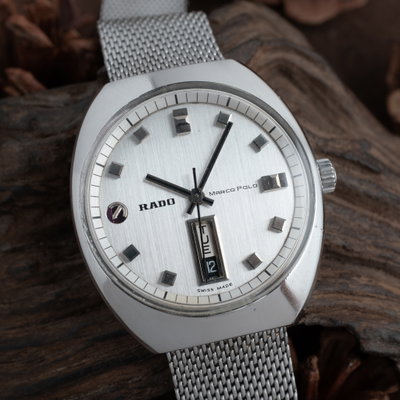
Rado · Marco Polo · 11838
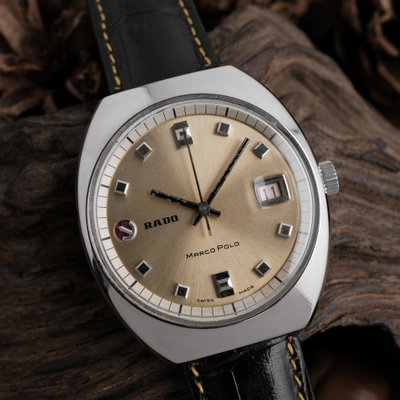
Rado · Marco Polo · 11836/1
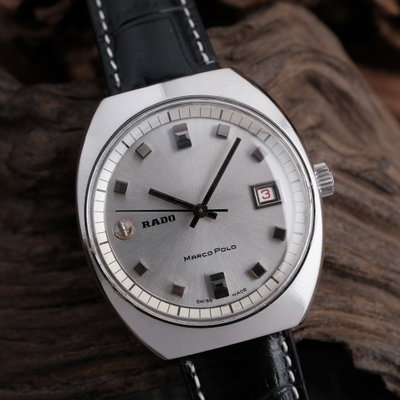
Rado · Marco Polo · 353633
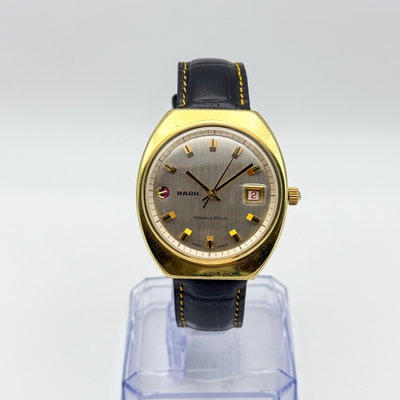
Rado · Marco Polo · 11837 · 1970
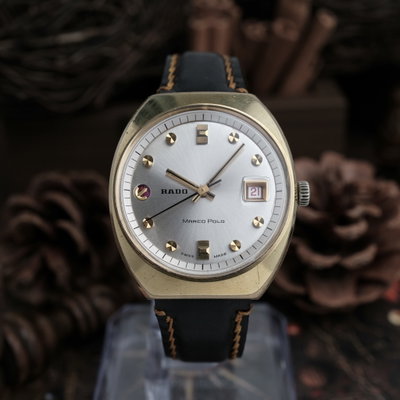
Rado · Marco Polo · 11817
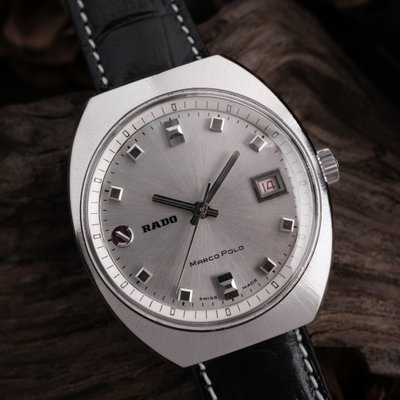
Rado · Marco Polo · 11336/1
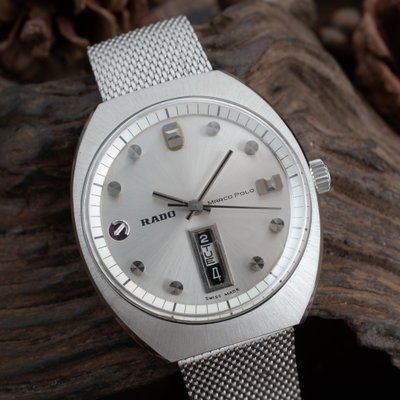
Rado · Marco Polo · 11838
More Rado references
Related pages
Frequently asked questions
Ready to hunt for your own?
More than 100 vintage watches go under the hammer every week.