Seiko Lord Matic 5606-8031: the 1975 silver-dial reference
Choose the Seiko 5606-8031 with the cleanest correct dial and sharpest steel case, then budget for service unless its history is documented.
We auction more than 100 vintage watches a week.
Get first access: new Seiko 5606-8031 drops and alerts before auctions end.
Browse 27 live Seiko auctionsThe Seiko Lord Matic 5606-8031 pairs a 36 mm stainless-steel case with the automatic caliber 5606 and a silver sunburst dial. The examples handled date to 1975, placing this reference firmly in Seiko's mid-1970s mechanical range rather than leaving its period open to guesswork.
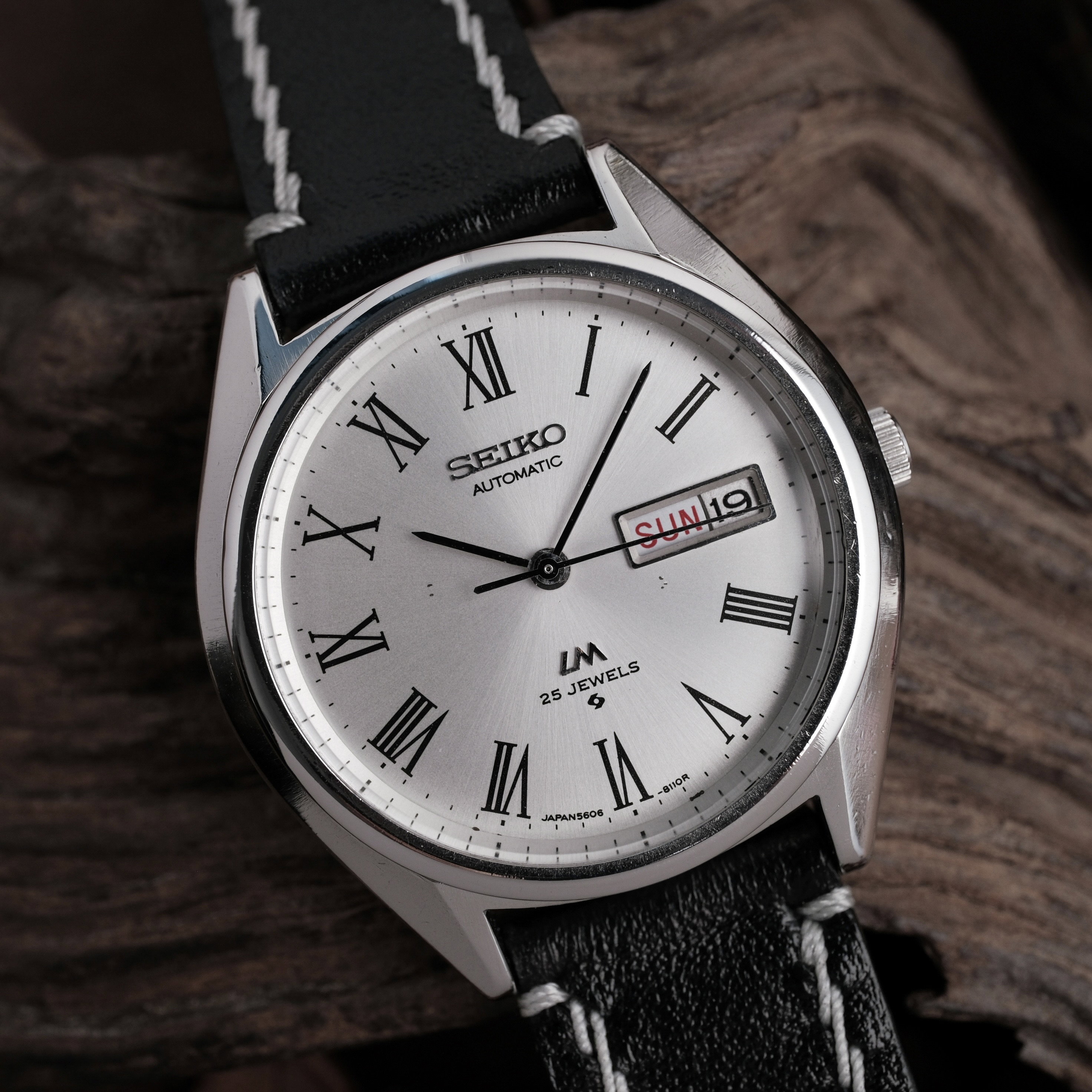
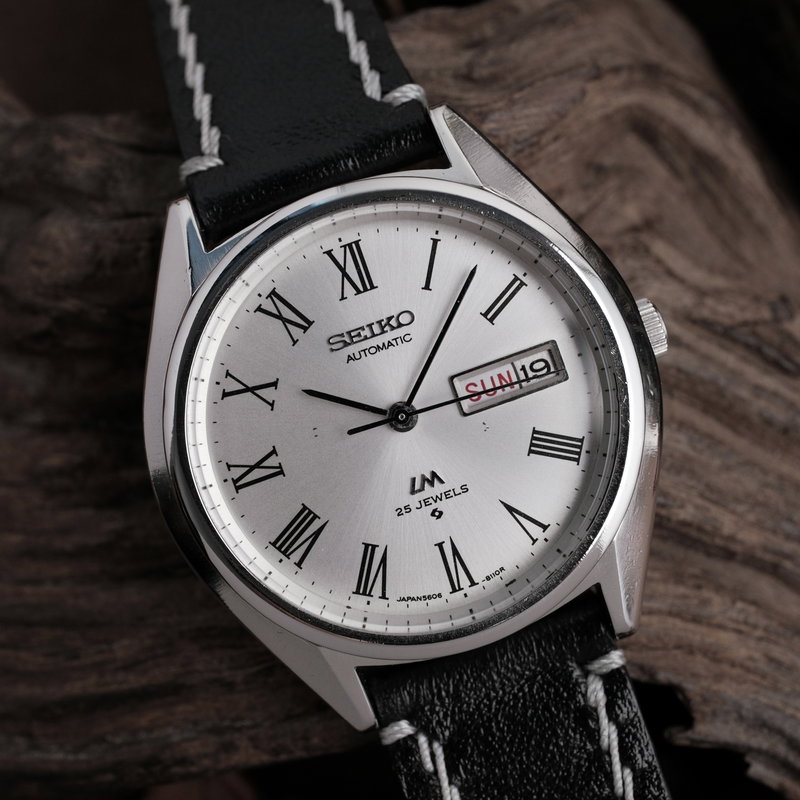
Two dial treatments matter when choosing one. Applied baton indices with black central stripes are correct, but so are printed black Roman numerals on the silver sunburst ground. That Roman dial should not be dismissed as a redial merely because it departs from the more familiar applied-index layout.
Brand
Seiko
Model
Lord Matic
Reference
5606-8031
Known year range
1975-1975
| Case diameter | 36 mm, excluding the crown |
| Case material | Stainless steel |
| Movement | Automatic caliber 5606 |
| Jewel count | 25 jewels |
| Dial variants | Silver sunburst with applied black-striped indices or printed black Roman numerals |
What it was built for
The Lord Matic sat below King Seiko and Grand Seiko in Seiko's hierarchy while retaining an automatic 5606 movement and a more deliberate case treatment than the standard range. Reference 5606-8031 was a steel dress watch for regular use, not a sports model, and no water-resistance claim is established by the available evidence.
Its 36 mm diameter keeps the silver dial broad without making the watch visually heavy. Applied-index versions gain contrast from black-striped markers and matching hands, while the printed Roman-numeral version reads dressier and less architectural. At this size, those dial differences change the watch more than the shared case dimensions suggest.
Where the value sits
The dial carries the largest condition premium. A clean silver sunburst surface with intact printing is worth protecting, because refinishing removes the original radial finish and replaces factory lettering with an approximation. Between a sharp Roman-numeral dial and a damaged applied-index dial, take the Roman version rather than buying the more familiar layout in worse condition.
Case geometry comes next. The better 5606-8031 cases retain clear transitions along the lugs and defined edges around the case body; repeated polishing leaves those lines soft and cannot be reversed. The relative scarcity of the Roman-numeral version is not established, so a premium based only on claimed rarity is unsupported.
Caliber 5606 belongs in the reference, but movement condition cannot be judged from the name alone. Running-rate readings describe performance at one moment and do not establish service history. Without invoices, treat the service history as unknown and keep the dial and case ahead of an unsupported mechanical claim.
Where to start
For the most characteristic 5606-8031, choose the silver sunburst dial with applied black-striped indices and matching striped hands. Choose the printed Roman-numeral dial instead when its surface and printing are cleaner. The reference supports both, so condition should settle the decision rather than familiarity.
A 36 mm case gives this used Seiko Lord Matic a restrained footprint and enough dial area for clear time reading. It suits a cuff more naturally than a larger sports watch, although no case-thickness figure is established here. The steel case also avoids the irreversible wear-through associated with plated cases.
Lead every condition assessment with the worst fault: a redial, rounded case edges from polishing, or oxidation across the hands and applied furniture. A mismatched movement can make the watch franken, while a case and movement taken from different watches make it married. Crystals and crowns are consumable parts, so period-correct replacements are not proof that every component left the factory together.
Dating this watch
| Serial range / caliber | Year | Note |
|---|---|---|
| 5606 | 1968-1976 | caliber production window |
Dating data comes from our decoder tables; treat years as approximate.
What to check before you buy
- Dial configuration: Reference 5606-8031 is known with a silver sunburst dial using either applied black-striped baton indices or printed black Roman numerals. The Roman layout is a valid variant, not automatic evidence of refinishing.
- Hands and applied furniture: On the applied-index version, the hands and hour markers carry matching black central stripes. Replaced hands with a conflicting treatment weaken the watch even when their shape looks broadly period-correct.
- Case geometry: The stainless-steel case measures 36 mm excluding the crown and should retain defined transitions at the lugs and case body. Soft, rounded edges diagnose polishing rather than normal surface wear.
- Movement identity: The reference belongs with Seiko's automatic caliber 5606, also described on handled examples as 5606A. A different caliber requires explanation and can indicate a franken or a married watch.
Other 5606-8031 examples we auctioned
More Seiko references
Related pages
Frequently asked questions
Ready to hunt for your own?
More than 100 vintage watches go under the hammer every week.