Seiko Sportsmatic 5 Deluxe: Versions, Wear and Buying Advice
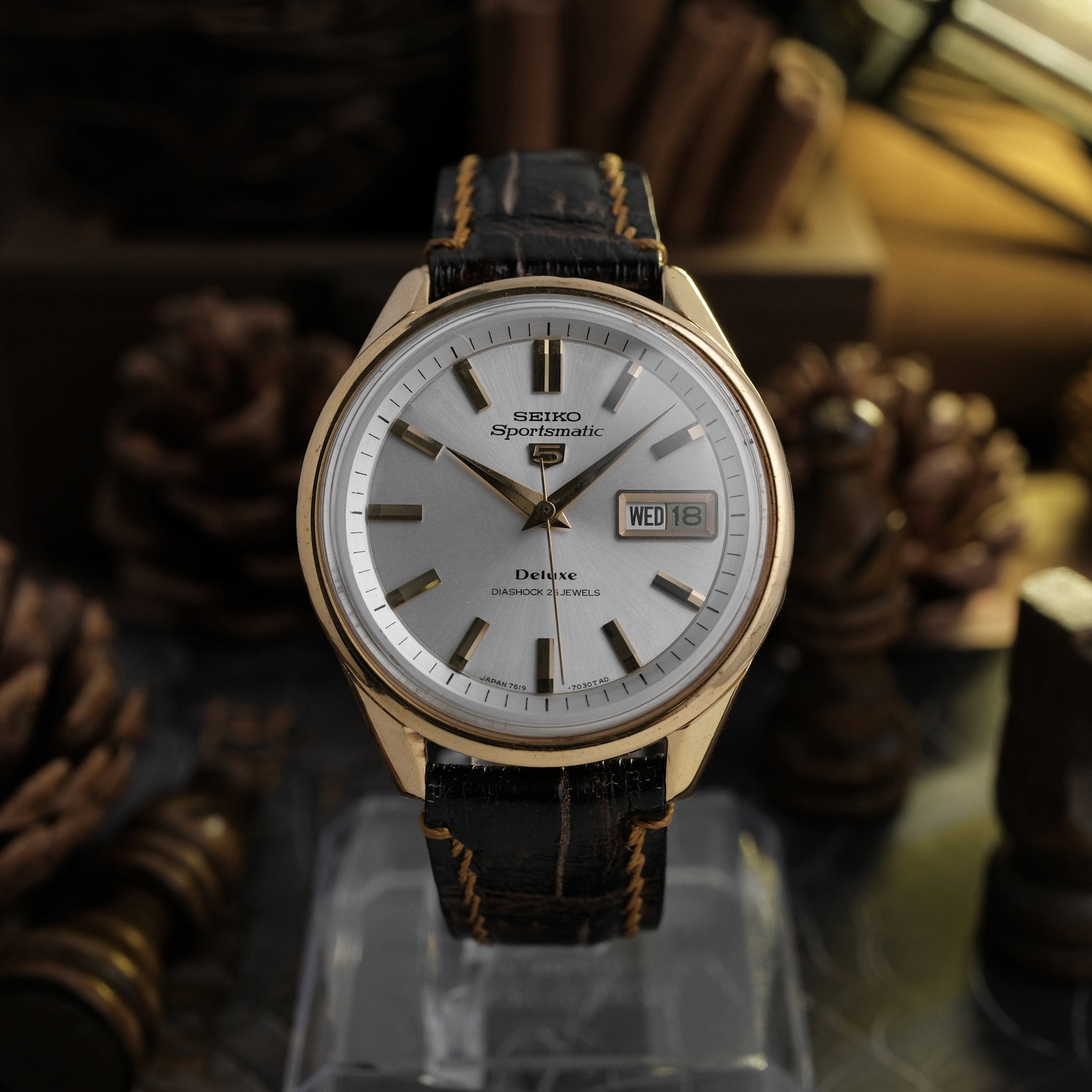
The Seiko Sportsmatic 5 Deluxe is a 1964-1967 automatic whose strongest buys pair a clean sunburst dial with sharp steel casework.
We auction more than 100 vintage watches a week.
Get first access: new Seiko watch drops and alerts before auctions end.
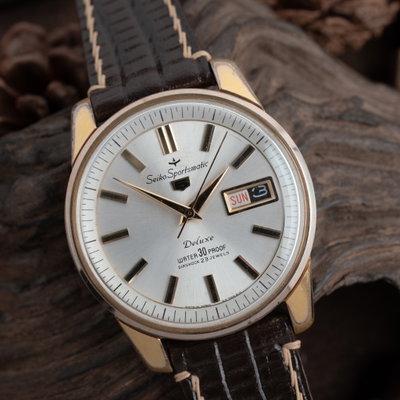
Browse 18 live Seiko auctionsThe Seiko Sportsmatic 5 Deluxe belongs to a narrow 1964-1967 period when an automatic day-date watch could still wear like a slim mid-century dress piece. Its recessed crown and separate date-setting pusher keep the case profile clean, while the silver sunburst dial and applied faceted indices give it more presence than a plain utility watch.
The decision is not simply steel against gold plate. The watches handled span 37 mm and 38 mm cases, automatic calibers 7606A and 7619A, and both 23-jewel and 25-jewel specifications. Buy the dial first, then the case: a clean sunburst surface is difficult to replace honestly, while worn gold plating exposes brassing that no routine service can reverse.
Known production years
1964-1967
Case sizes handled
37 mm and 38 mm, excluding crown
Movement types handled
Automatic calibers 7606A and 7619A
Jewel counts handled
23 jewels and 25 jewels
| Case materials handled | Stainless steel and gold-plated cases with stainless steel casebacks |
| Dial configuration | Silver sunburst dial with applied faceted indices and day-date display |
| Setting controls | Recessed or hidden crown with dedicated date-setting pusher |
The model landscape
The earlier side of the Sportsmatic 5 Deluxe includes 1964 watches with caliber 7606A and 23 jewels, including reference 427970. By 1966, references 7619-9000 and 7619-9010 used caliber 7619A with 25 jewels. That distinction is useful because a movement must agree with the exact case reference rather than merely look period-correct.
Steel is the safer version when case wear matters. Gold-plated examples can retain clean silver sunburst dials, yet brassing around exposed case surfaces permanently widens the condition gap. At equal dial quality, take the steel watch with sharp facets over a brighter plated case with wear-through.
On the wrist
The 37 mm examples retain compact dress-watch proportions, while the 38 mm 1966 cases give the applied indices and day-date display more room. A single millimetre changes the visual balance because the recessed crown adds little apparent width. Both sizes sit larger than many mid-century watches without losing their clean cuff-friendly outline.
Legibility depends heavily on the dial furniture. Silver sunburst dials with faceted baton indices, black inserts and matching dark details in the hands remain clear as the surface catches light. The hidden or recessed crown preserves symmetry, but the separate date pusher makes operation less conventional than a modern quick-set watch.
What goes wrong
Brassing is the first fault to price into a gold-plated Sportsmatic 5 Deluxe. Wear-through at exposed edges cannot be removed by servicing, and replating changes the surviving case surface. Steel avoids that problem, although polishing can still soften the sharply faceted geometry that distinguishes the better-preserved cases.
Dial damage comes next. Silver sunburst examples can develop localized spotting, edge patina or moisture staining, and a refinished dial costs more in lost appeal than ordinary case wear. Movement condition also needs a measured view: one operational caliber 7619A example ran roughly 50 seconds fast per day, so running and keeping acceptable time are not the same claim. The service history is unknown unless paperwork establishes it.
What to check before you buy
- Dial and furniture: A handled Sportsmatic 5 Deluxe can have a silver sunburst dial, applied faceted baton indices, an applied Seiko logo and a day-date display. Uneven printing or furniture that conflicts with the exact reference points to a redial or franken assembly.
- Movement and case reference: Reference 427970 has been handled with caliber 7606A and 23 jewels, while 7619-9000 and 7619-9010 have been handled with caliber 7619A and 25 jewels. A different pairing needs evidence rather than a period-correct assumption.
- Crown and date control: The model uses a recessed or hidden crown and a separate date-setting pusher. Reference 427970 has been handled with the crown at three o'clock and pusher at four, so a conventional exposed crown deserves close comparison with the exact case.
- Case geometry and plating: Better-preserved cases retain sharply faceted lines. Rounded facets indicate polishing, while gold-plated cases can show permanent brassing at exposed edges; fresh shine does not restore the lost plating or original geometry.
- Caseback details: A dolphin-motif caseback has been handled on reference 7619-9010, but the motif alone does not authenticate the watch. The caseback, movement, dial and control layout must agree rather than merely belong to the same model family.
Recent Seiko results
40 Seiko watches auctioned
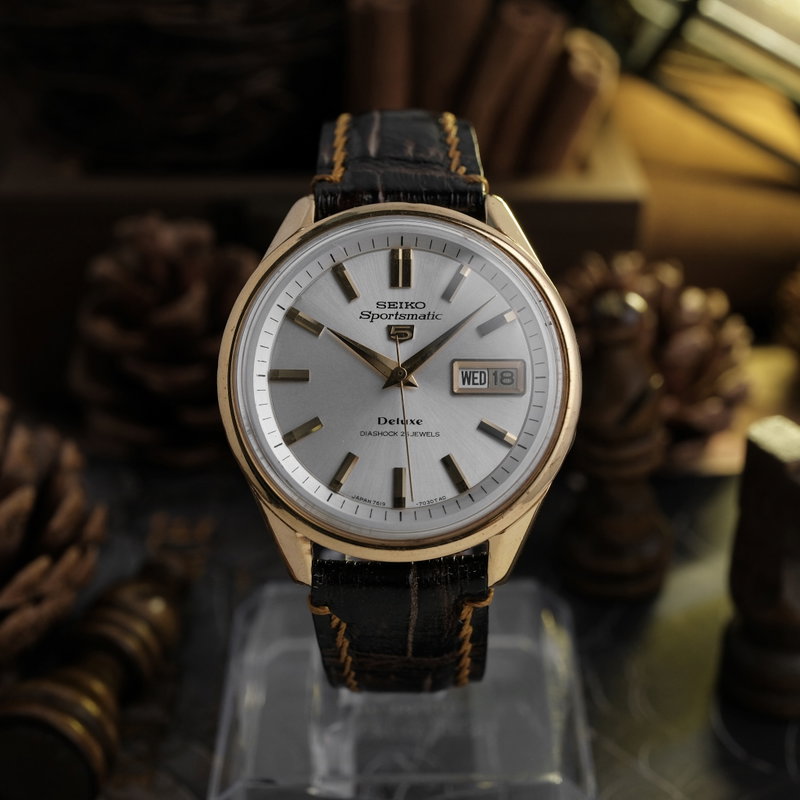
Seiko · Sportsmatic 5 Deluxe · 7619-7040 · 1966
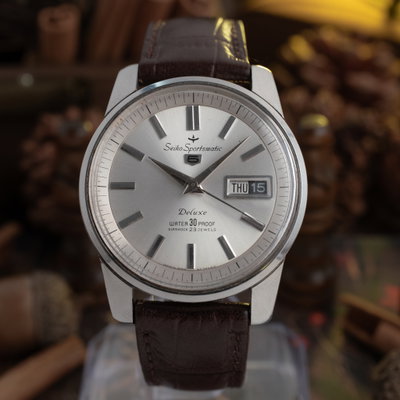
Seiko · Sportsmatic 5 Deluxe · 1964
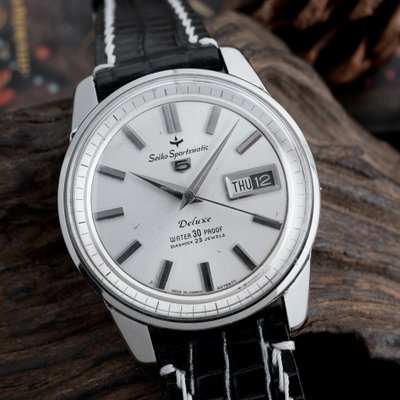
Seiko · Sportsmatic 5 Deluxe · 7606-7991 · 1964
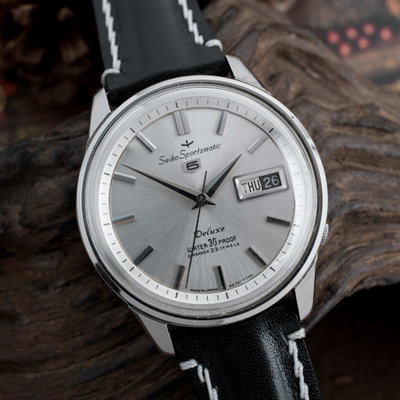
Seiko · Sportsmatic 5 Deluxe · 7606-7971 · 1964
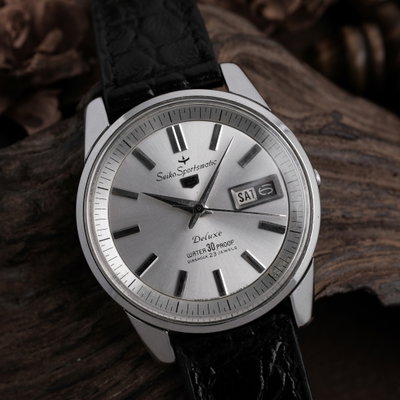
Seiko · Sportsmatic 5 Deluxe · 427990 · 1964
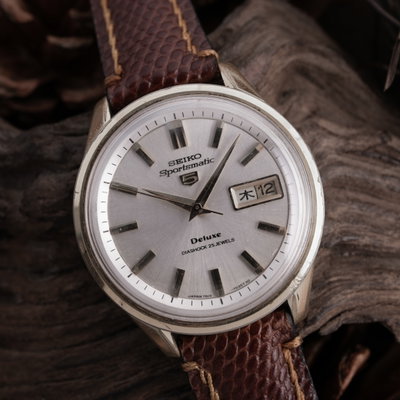
Seiko · Sportsmatic 5 Deluxe · 7619-9000 · 1966
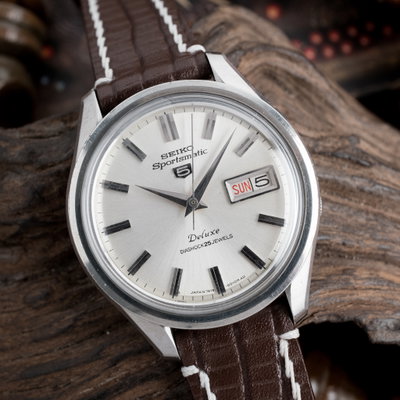
Seiko · Sportsmatic 5 Deluxe · 7619-9010 · 1966
Seiko · Sportsmatic 5 Deluxe · 427990 · 1964
More Seiko references
Related pages
Frequently asked questions
Ready to hunt for your own?
More than 100 vintage watches go under the hammer every week.