Seiko Lord Matic 5606-8130 - A 1975 Buying Guide
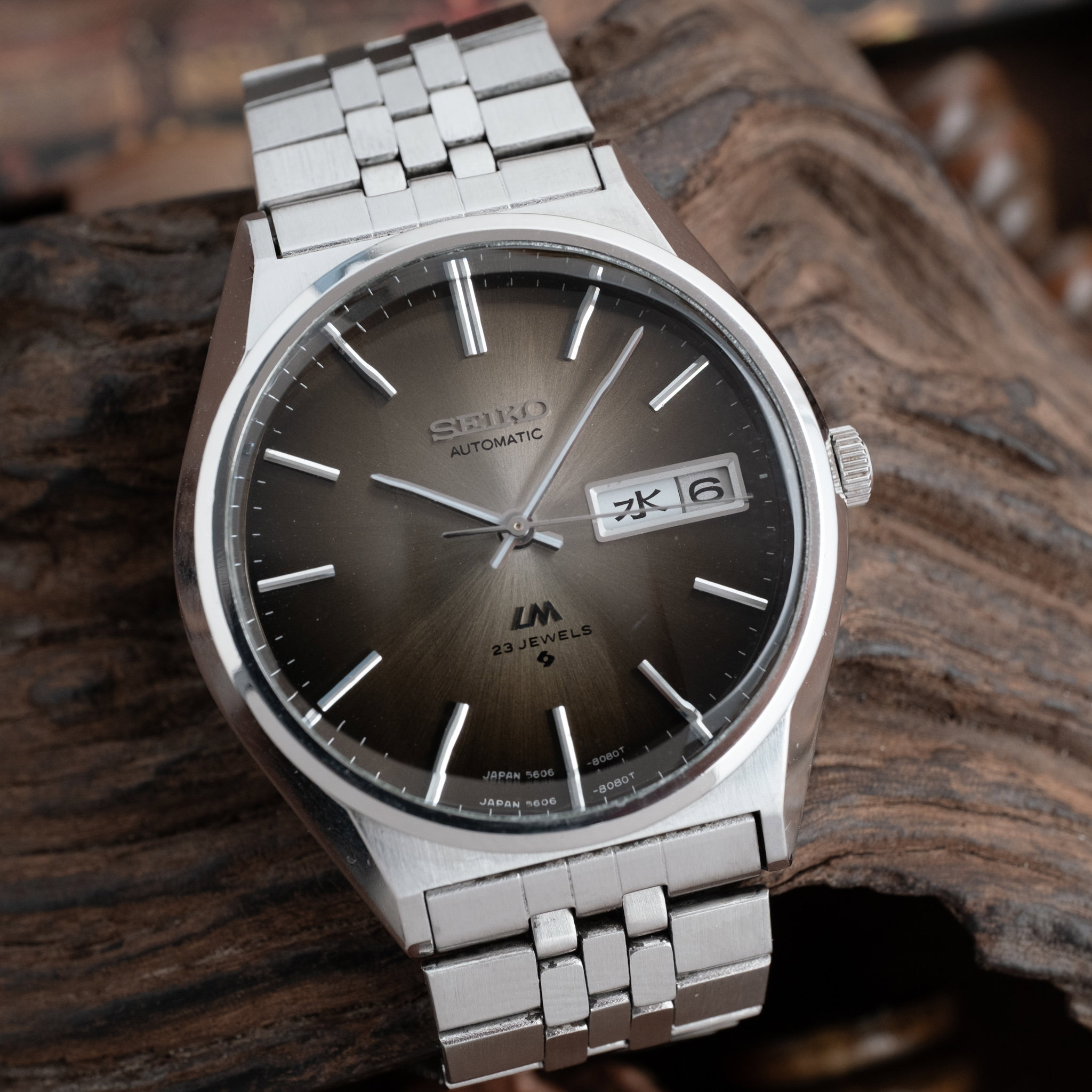
Buy the Seiko Lord Matic 5606-8130 for its preserved sunburst dial and sharp case, not merely for dial colour or a service claim.
We auction more than 100 vintage watches a week.
Get first access: new Seiko 5606-8130 drops and alerts before auctions end.
Browse 32 live Seiko auctionsIn 1975, the Seiko Lord Matic 5606-8130 paired automatic caliber 5606A with a faceted crystal and gradient or sunburst dials. The first choice is not green against grey-brown. It is a preserved dial against one with spotting, refinishing or mismatched furniture.
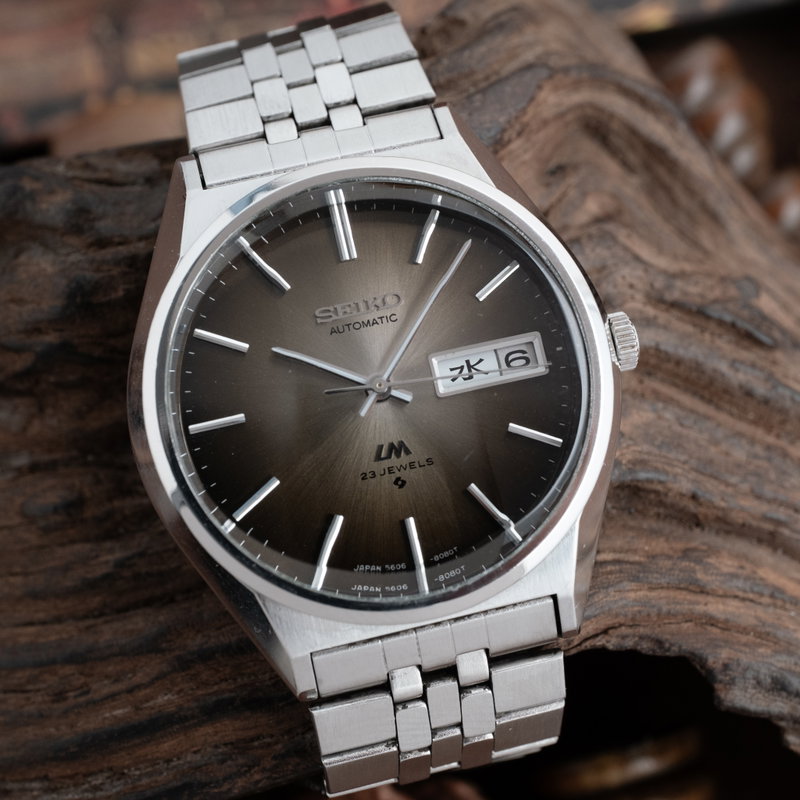
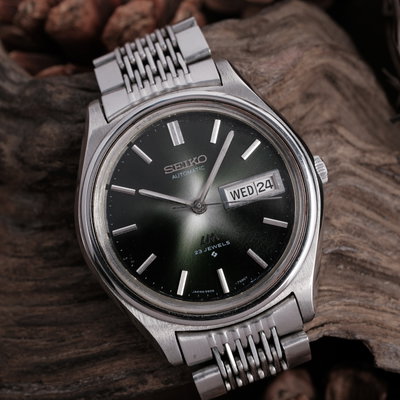
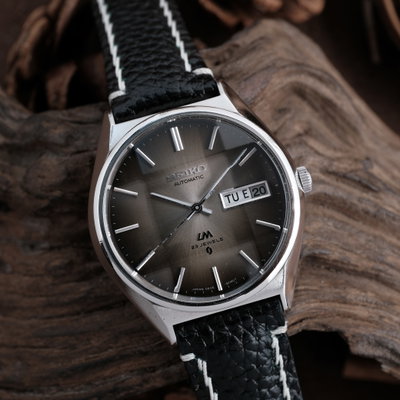
Examples we have handled measure 36 or 37 mm excluding the crown, and both sizes use stainless steel cases. Known configurations include grey-brown gradient or sunburst dials, dark green sunburst, and an English and Kanji day wheel. The evidence does not establish either colour as scarcer, so preservation should decide the premium.
Brand
Seiko
Model
Lord Matic
Reference
5606-8130
Known production year
1975-1975
| Movement | Automatic caliber 5606A |
| Jewel count | 23 jewels |
| Case size | 36-37 mm excluding the crown |
| Case material | Stainless steel |
| Known dial finishes | Grey-brown gradient or sunburst, and dark green sunburst |
| Known day display | English and Kanji configuration |
| Crystal form | Faceted crystal |
What it was built for
The 5606-8130 is a dial-led automatic from 1975 rather than a tool watch. Its practical complication is the day display, including an English and Kanji wheel on a handled example, while applied faceted indices and applied Seiko and LM logos supply the depth. No water-resistance figure is established here, so the reference should not be bought or used as a vintage sports watch.
The movement is automatic caliber 5606A with 23 jewels. The broader caliber 5606 production window runs from 1968 to 1976, which accommodates the known 1975 production year but does not independently date a complete watch. Service history remains unknown without dated documentation, and a plausible timegrapher reading cannot prove what work was performed.
Where the value sits
The dial carries the largest condition spread on the 5606-8130. Clean grey-brown examples retain their gradient or sunburst effect, while a dark green example can show minor spotting across the surface. A refinished dial costs more in lost value than modest case wear, and a genuine service dial is not the same thing as a redial. Without supporting evidence, neither should be described as the factory-fitted dial.
Case definition comes next. Sharp case lines and distinct crystal facets support the intended geometry, while polishing rounds the transitions and can blur the crystal's shape. A signed stainless steel bracelet belongs with a documented configuration, but its signature alone does not prove original fitment. Stretch, incorrect end-link fit and softened case edges should therefore affect the premium even when the dial remains clean.
Where to start
Start with the cleanest credible dial and the sharpest case, regardless of whether the diameter is recorded as 36 or 37 mm. The grey-brown and dark green versions both have a basis in handled watches, but there is not enough evidence to assign a scarcity premium by colour. Between an evenly preserved grey-brown dial and a spotted green dial at equal terms, take the grey-brown example.
A used Seiko Lord Matic 5606-8130 should then be checked for caliber 5606A, coherent hands and indices, a defined faceted crystal and sound bracelet fit. A service claim matters only when a dated receipt states the work performed; otherwise the service history is unknown. Between a polished example with a service claim and a sharp example with an honest unknown history, the sharp watch is the better starting point.
Dating this watch
| Serial range / caliber | Year | Note |
|---|---|---|
| 5606 | 1968-1976 | caliber production window |
Dating data comes from our decoder tables; treat years as approximate.
What to check before you buy
- Dial print and furniture: Known dials use a grey-brown gradient or sunburst finish, or a dark green sunburst finish, with applied faceted indices, an applied serif Seiko signature and an applied LM logo. Flat repainted surfaces or printed substitutes require explanation.
- Hands and twelve o'clock marker: Handled examples use polished baton hands with central white stripes and a double baton index at twelve o'clock. Different hand geometry, uneven relume or furniture that does not align with the minute track can indicate replacement parts.
- Case and crystal geometry: The stainless steel case measures 36 or 37 mm excluding the crown, and preserved examples retain sharp case lines beneath a faceted crystal. Soft transitions or rounded facets diagnose polishing, although polishing alone does not make the watch fake.
- Movement identity: The established movement is automatic caliber 5606A with 23 jewels. A different caliber conflicts with the handled configuration and can indicate a franken or married watch, while the 1968-1976 caliber window alone cannot authenticate the complete watch.
Other 5606-8130 examples we auctioned
13 Seiko 5606-8130 auctioned
More Seiko references
Related pages
Frequently asked questions
Ready to hunt for your own?
More than 100 vintage watches go under the hammer every week.